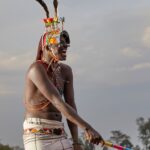
In northern Kenya, the Samburu Special Five draw most of the attention: the reticulated giraffe, the Grevy’s zebra, the gerenuk, the Beisa oryx, the Somali ostrich. Visitors who come only for the wildlife typically leave with a gap in the story they carry home. The women of Samburu are the cultural backbone of one of East Africa’s most distinctive pastoral societies, and the knowledge, craft, and ceremony they hold is not visible from a game drive vehicle.
A women of samburu safari, done properly, is not a village stop with a gift shop at the end. It is a window into how a 260,000-strong pastoral community actually works, what it values, and who holds its cultural memory. This guide covers who the Samburu women are, what their beadwork communicates, what a genuine community visit looks like, and how to plan time in Samburu country that goes beyond game drives.
Who Are the Samburu People?
The Samburu are a Nilotic pastoral community, closely related to the Maasai but culturally distinct in ways that matter. They live across the semi-arid lowlands of northern Kenya, in and around Samburu County, with a population estimated at around 260,000. Their traditional economy is built on cattle, camels, goats, and sheep, with seasonal movement following rainfall and available grass.
The name “Samburu” is believed to derive from “samburr,” meaning bag or pouch, a reference to the leather bags traditionally used for carrying goods during migration. The community calls itself “Loikop,” meaning owners of the land, a phrase that carries centuries of relationship with this specific terrain.
Traditional governance separates men into age-grades: moran (warriors), elders, and senior elders each hold defined roles and responsibilities. But this structure does not reduce the significance of women. Samburu women manage the household, the manyatta (homestead), daily food security, and the social rituals that bind the community. They do this while producing some of the most technically refined beadwork in East Africa.
Understanding this context before you arrive is not optional background reading. It is the lens through which a cultural safari visit becomes meaningful rather than transactional.
The Language of Beads
Samburu beadwork is a communication system before it is an art form.
Every combination of colour, pattern, and layer signals something specific to those who can read it. A girl’s necklace differs from a married woman’s necklace. Ceremonial pieces differ from everyday wear. The flat, disk-shaped mborro collar worn by older women signals a stage of life that commands respect. The layered strands of naibor (white beads) worn by young women at coming-of-age ceremonies carry ritual significance that is not decorative in any conventional sense.
Historically, Samburu beads were made from ostrich eggshell, bone, and seed. Today, glass seed beads from Nairobi have largely replaced those materials, but the grammar of the patterns remains intact. Women learn from mothers and grandmothers through watching and doing, not through written instruction.
The colours carry meaning across Samburu culture:
| Colour | Samburu Significance |
|---|---|
| Red | Bravery, blood, vitality |
| Blue | The sky, water, energy |
| White | Purity, peace, health |
| Orange | Warmth, friendship, generosity |
| Green | Land, grass, fertility |
| Black | Unity and elder authority |
When you watch a Samburu woman thread beads, you are watching a language being spoken. A guide with good community knowledge can interpret what you are seeing. Ask for that briefing on the drive in, not while standing in front of someone at the homestead.
Women’s Economic Role in Samburu Communities
Standard safari framing of pastoral African communities tends to place men as the visible protagonists: the warriors on the road, the elders in ceremony. Samburu women’s economic contribution is routinely under-described, and the gap is significant for anyone planning a cultural visit.
Women manage livestock during the dry season when men move cattle to distant water sources. They build and maintain the manyatta, constructing the low, domed structures from branches, mud, and cattle dung that form the circular homestead. They gather firewood, manage water from wells and seasonal rivers, and are the primary food preparers for the household.
For visitors interested in community tourism, the most relevant dimension is beadwork as income. In communities near Samburu National Reserve and the private conservancies of Westgate and Lewa, women’s beadwork cooperatives have become one of the most reliable non-livestock income streams available to households.
Groups like the Samburu Women’s Trust and cooperatives affiliated with Ewaso Lions and Reteti Elephant Sanctuary have created structured markets: direct sales to visitors, exports to international retailers, and workshop experiences that generate community income while keeping the craft alive. These are functioning small businesses, not souvenir stalls. The women who run them set their own prices and control their own income.
The distinction matters when you are standing in front of a beadwork display. Ask your operator in advance whether the proceeds go directly to the woman who made the piece, or move through an intermediary. Community-connected operators can answer clearly. If they cannot, that is worth noting before you book.
What a Genuine Cultural Exchange Looks Like
The difference between a performative village stop and a genuine cultural exchange comes down to three things: consent, time, and context.
Consent means the community has agreed to host visitors and has set the terms. Not every Samburu manyatta is open to safari visits. The ones that are have made a deliberate community decision to engage with tourism on their own conditions, typically with conservancy or community trust oversight.
Time means you cannot understand Samburu women’s lives in a 45-minute stop between game drives. The visits that work best dedicate at least a half-day: a morning arrival, a shared meal, a beadwork demonstration at the pace the craftswomen set, and unstructured time to sit, observe, or participate in daily tasks if invited.
Context means arriving prepared. Know who the Samburu are before you arrive. Understand the age-grade system. Know what the beads mean. Ask your guide to brief you on the drive in. Communities notice when visitors have done the courtesy of learning something first. It changes the quality of the exchange in every direction.
A well-run cultural visit follows a clear structure: your guide introduces you to the community liaison, who in these programs is almost always a woman. She sets the agenda. You follow her lead. You ask before photographing and accept gracefully if the answer is no. You buy what you genuinely want at the offered price, without bargaining over handmade craft produced by women for whom this income matters.
Ceremonies That Involve Women
Samburu ceremonial life ties to the seasons and the life stages of community members. Several ceremonies centre specifically on women, and encountering one with appropriate preparation is among the most striking experiences northern Kenya offers.
Ntaanai marks a girl’s transition to womanhood, involving song, specific beadwork presentation, and community gathering. Visitors are rarely present at this ceremony as it is family-centred and private. But the preparations in the days before are visible in the manyatta, and a guide with strong community relationships can explain what you are observing.
The moran ceremonies involve both young men and women, with women playing specific roles in singing and blessing. The ilkiama, or women’s age-grade songs, are sung in rounds and carry both narrative and spiritual function. If you hear them during a visit, stop and listen.
Childbirth ceremonies and post-birth rituals involve women elders specifically, with particular beadwork presented to the new mother. These are entirely private. A good guide will make this clear before you arrive, not after you have already made an error.
Understanding which ceremonies are open and which are not is part of responsible cultural travel. Arriving with this knowledge means nobody learns the boundaries under awkward circumstances.
Reteti: Community Conservation and Women’s Leadership
If you want to see Samburu community leadership in its most operationally striking form, visit Reteti Elephant Sanctuary, located within Namunyak Wildlife Conservancy in northern Samburu.
Reteti is Africa’s first community-owned and operated elephant sanctuary, founded in 2016 and managed by the Namunyak community. Women hold significant roles in its daily operation. The keepers who feed, track, and socialise orphaned elephant calves include a growing number of women, breaking a pattern across East African conservation that has historically excluded women from wildlife management.
Visiting Reteti as part of a Samburu itinerary gives you a direct experience of women in conservation leadership, not as a separate program but as the organic result of a community deciding that women’s involvement is an asset, not an anomaly.
The sanctuary is not a day trip from the main reserves. It requires planning. Reteti limits daily visitor numbers to protect the calves’ rehabilitation process. Access needs to be confirmed well in advance with the conservancy directly.
Planning Notes for Samburu
Northern Kenya is best visited between late June and October (dry season) and again from January to early March (short dry season). Samburu National Reserve is accessible year-round, but the community roads and conservancy tracks leading to more remote manyattas become difficult during the April to June long rains.
A minimum of three nights in Samburu gives enough time for two full days of wildlife game drives, one cultural half-day with a women’s beadwork cooperative, and the possibility of adding Reteti if timing allows. Camps in Samburu also offer activities most southern parks restrict: night game drives to spot leopard, aardvark, and other nocturnal species, guided walking safaris with an armed ranger for a ground-level read of tracks and vegetation, and birdwatching that draws serious listers, since the reserve holds species found almost nowhere else in Kenya, including the vulturine guineafowl and Somali ostrich.
Samburu combines well with Laikipia (Ol Pejeta, Lewa, Borana) or can extend to a fly-in connection to the Masai Mara for a full northern-to-southern Kenya circuit.
| Itinerary Component | Recommended Duration |
|---|---|
| Samburu National Reserve wildlife drives | 2 nights minimum |
| Samburu cultural community visit | Half day, morning |
| Reteti Elephant Sanctuary | Full day add-on |
| Laikipia Plateau extension | 2 nights optional |
| Masai Mara fly-in connection | 2-3 nights optional |
What to Read and Plan Next
A cultural visit in Samburu country works best when it is built into the itinerary with preparation, not added on as an afterthought. Guides who speak Sampur, the Samburu language, in addition to Swahili and English, open conversations that translation alone cannot bridge. When evaluating operators, ask specifically whether their Samburu guides have language access and community relationships, not just general game-drive experience.
For itinerary ideas that combine wildlife drives with community cultural access in northern Kenya, the Samburu safari pages at Trunktrails Safaris are a useful planning reference.
For more on Kenya’s cultural tourism landscape, explore Maasai Cultural Village: How to Visit Respectfully and the Kenya Safari Planning Guide.
Prefer a different route, budget, or travel style? This plan can be adapted to fit.
Customise Your TripFurther reading
More safari planning resources
- Map of Samburu from Valley Safaris
- Samburu destination guide on FindMySafari
- Kenya tour packages from Valley Safaris
- Big Five safari collection on FindMySafari