Most Kenya safari lodges operate within parks and conservancies where rhino sightings are one possibility among many. Solio Lodge is different in almost every respect. It sits inside Solio Ranch – Kenya’s oldest private rhino sanctuary – where the primary function of the land is rhino conservation and where the probability of close rhino encounters, both black and white, is genuinely exceptional. Everything about the lodge is built around that focus.
Solio Ranch: The Conservation Foundation
Solio Ranch, covering approximately 17,000 acres north of Mount Kenya in the Laikipia plateau region, was established as a private rhino sanctuary in the 1970s under the leadership of the Parfet family. It is credited as Kenya’s first significant private rhino conservation initiative, predating many of the community-based rhino sanctuaries that followed.
The ranch’s approach has always been intensive, private management of a fenced sanctuary rather than the open-range conservation model of national parks. The fence is not aesthetic – it is functional protection in an era when rhino populations across Africa were collapsing under poaching pressure. Solio’s controlled environment allowed both black and white rhino populations to grow under continuous monitoring, without the poaching pressure that devastated park populations.
The ranch has played an important role in Kenya’s broader rhino recovery programme. Solio-born rhino have been translocated to other sanctuaries across Kenya to help rebuild populations elsewhere – Lewa Wildlife Conservancy, Ol Pejeta, and others have received animals from Solio. The sanctuary is not just protecting its own population; it has functioned as a source for Kenya’s rhino recovery more broadly.
Today, Solio Ranch holds one of the highest rhino densities of any private property in Africa. Both black rhino (Diceros bicornis) and white rhino (Ceratotherium simum) are present in numbers that make encounters virtually inevitable for guests staying at the lodge.
The Two Rhino Species
Understanding the difference between the two rhino species on the ranch helps guests interpret what they see during tracking activities.
Black rhino (Diceros bicornis michaeli in Kenya) are browser-feeders, with a pointed upper lip adapted for grasping leaves and twigs from acacia and other woody plants. They are smaller than white rhino and significantly more territorial and solitary in behaviour. Black rhino encounters tend to be more intense because the animals are more reactive – they may charge when disturbed, not because they are aggressive by nature but because poor eyesight combined with a real evolutionary history of predation makes them startle-prone. Solio holds a population of black rhino that is regularly monitored and well-known to the ranch’s rangers.
White rhino (Ceratotherium simum) are grazers, with a wide, square mouth adapted for cropping short grass. They are significantly larger than black rhino and generally more placid in temperament. White rhino are more likely to be found in open grassland and are usually less reactive to vehicles and walking parties than black rhino. Solio’s white rhino population is well-established.
The name distinction – black versus white – has nothing to do with colour. Both species are grey. The white rhino’s name is believed to derive from the Afrikaans “weit” (wide), referring to the wide mouth, which was misheard in English as “white.”
Solio Lodge: Six Cottages and a Singular Focus
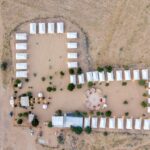
The lodge itself is deliberately small. Six stone cottages are the entire accommodation capacity of Solio Lodge. The small size ensures that the rhino sanctuary does not become a high-traffic visitor destination that undermines the quiet it needs to function. It also means the staff-to-guest ratio is high and the experience is personalised in a way that large lodges cannot replicate.
The cottages are built in a style appropriate to the highland setting – Laikipia sits at around 1,700 to 2,000 metres elevation, which makes it noticeably cooler than the Masai Mara or Amboseli, and the architecture reflects that. Stone construction, fireplaces, and heavier furnishings create a comfortable highland aesthetic rather than the open-air, mesh-and-canvas feel of a lowland safari camp.
Views from the property over the ranch’s grassland and acacia woodland, with Mount Kenya visible on clear days, are one of the visual signatures of the experience. The mountain is not always visible – morning cloud is common on the approach – but when conditions are clear, the snow-capped peaks above 5,000 metres form a dramatic backdrop to whatever rhino are visible in the middle ground.
Activities: Rhino Tracking and Beyond
Rhino tracking is the central activity at Solio, and it is offered in two forms that each provide a different quality of encounter.
Vehicle tracking involves driving the ranch with a ranger who knows where the monitored individuals have been located and which areas are active. The vehicle allows coverage of the ranch’s 17,000 acres efficiently and provides the eye-level advantage of a safari vehicle for photography.
Walking tracking is more demanding and more intimate. With a ranger and, where black rhino are involved, an armed escort, guests can follow on foot to within close but safe range of both species. Walking brings you into the sensory experience of the bush in a way that vehicles cannot – the sounds, the wind direction management required to stay downwind of black rhino, and the specific reading of animal signs that a walking ranger provides. For most guests, a successful walking encounter with a black rhino is the singular memory of the Solio experience.
The ranch also has good general wildlife. The Laikipia plateau supports a diverse mammal community including lion (though Solio’s fenced sanctuary limits free movement), leopard (regularly sighted within the ranch), buffalo, zebra, giraffe, various antelope species, and prolific birdlife at the woodland-grassland interface. Beyond rhino tracking, Solio’s activity list extends further than most rhino-focused lodges: horseback riding and mountain biking across the ranch for guests comfortable in the saddle or saddle-free, night game drives to pick up the nocturnal species vehicle safaris miss elsewhere, and fly-fishing trips arranged up toward Mount Kenya and the Aberdares for a change of pace mid-stay.
Who Solio Lodge Suits
The lodge is calibrated for travellers with a specific and serious interest in rhino conservation and close wildlife encounter quality. It is not a general safari destination offering the full range of East African megafauna in a single location; it is a specialist experience built around one of the most threatened large mammal groups on earth.
Wildlife photographers with an interest in documentary-quality rhino photography will find Solio offers conditions – known individuals, known locations, patient rangers, and open habitat – that few other rhino destinations match. Conservation-minded travellers who want to experience Kenya’s rhino recovery story firsthand, rather than read about it, find Solio’s context deeply compelling.
Solio works well as part of a longer Kenya circuit. A two-night stay in Laikipia (combining Solio with nearby Lewa or Ol Pejeta for a broader northern circuit) followed by the Masai Mara for predator and migration wildlife creates an itinerary that covers Kenya’s wildlife range comprehensively and without repetition.
Getting There
Solio Ranch is approximately three to four hours by road from Nairobi, north of Nanyuki in the Laikipia region. Charter flights to Nanyuki Airport, which has regular connections from Nairobi’s Wilson Airport, are the standard approach for lodge-tier guests. Road transfer from Nanyuki to the ranch takes under an hour.
The altitude means packing for cooler temperatures than other Kenya safari destinations – evenings and mornings at Solio can be genuinely cold by East Africa standards, and a fleece or light jacket is necessary rather than optional.
Prefer a different route, budget, or travel style? This plan can be adapted to fit.
Customise Your TripFurther reading
More safari planning resources
- Ol Pejeta and Sweetwaters safari package from Valley Safaris
- Big Five safari collection on FindMySafari
- Interactive Maasai Mara map from Valley Safaris
- Nairobi to Maasai Mara route guide from Valley Safaris