

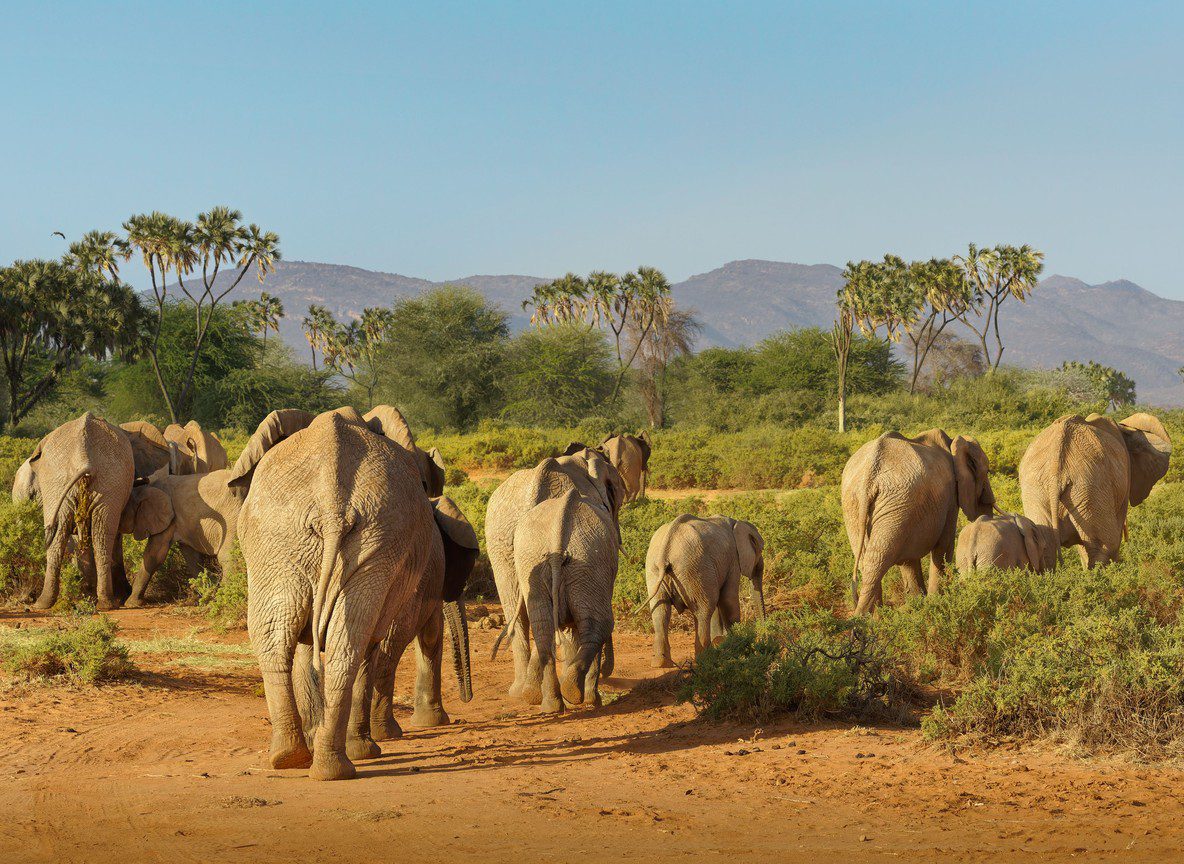
Tsavo East is Kenya’s largest national park, covering over 13,700 square kilometers of semi-arid landscape that most first-time Kenya travelers overlook in favor of the Maasai Mara. That is partly a marketing gap and partly the result of Tsavo East being less photogenic in the conventional sense: there is no dramatic migration event here, no recognizable moment that fills travel editorial. What there is, instead, is space. Open, red-soiled, baobab-dotted space on a scale that reshapes your sense of what a wildlife landscape can feel like.
The park is famous for its elephants. They roll in the laterite dust and emerge coated in the distinctive red-orange color that gives Tsavo’s elephant population its defining character. They move in large herds across plains that seem to run to the horizon, particularly around Aruba Dam and the Galana River corridor, which are the two primary wildlife magnets in the eastern section.
What you experience in Tsavo East depends significantly on which month you visit. The park’s semi-arid climate creates sharp seasonal contrasts, heat is a material planning factor, and the long game-drive distances involved mean road conditions affect your schedule more than at compact reserves. Here is what each season involves.
The Seasonal Calendar at Tsavo East
Tsavo East sits at a lower elevation than the Kenyan highlands, which means temperatures stay consistently warm through the year and rainfall is lower than in parks like Maasai Mara. The key divisions:
- Dry season: June to October. Best tracking conditions, concentrated wildlife movement.
- Short dry period: January to March. Stable and well-suited to general safari planning.
- Long rains: April to May. Wettest months, some track closures, strong value opportunities.
- Short rains: November to December. Transitional, variable, fewer visitors than peak season.
Because the park is so large, some sections handle wet conditions better than others. The areas around Aruba Dam and the Galana River corridor are generally accessible year-round in appropriate vehicles. More remote circuits in the western and northern sections may be restricted after sustained rain.
January to March: Stable Conditions for Long Drives
January through March is a productive and underused window. Rainfall is minimal, dust is manageable compared to peak dry months, and the wide plains around Aruba Dam allow for long, unobstructed sightlines. Elephant herds are active in this period and often visible in the open ground between the dam and the Galana River.
What works well during this window:
- Extended game-drive circuits are logistically reliable with dry roads
- Early-morning light across the red-soil plains creates strong photographic conditions
- Midday temperatures are warm but not at their extreme peak
- Accommodation pricing sits in a mid-range band between peak dry and green-season lows
One underappreciated advantage of visiting in January or February is crowd levels. Tsavo East never reaches Maasai Mara levels of vehicle concentration, but January is quieter still, and the experience of driving long circuits with minimal other vehicles adds to the sense of real wilderness.
Practical note: even in these relatively cooler months, midday temperatures in Tsavo East push above 30 degrees Celsius. Structuring drives around the early morning and late afternoon hours, with a midday return to camp, is the correct approach in any season.
April to May: Long Rains and the Green Tsavo
April and May transform Tsavo East in ways that look nothing like the dust-and-red-earth images that dominate its reputation. The landscape greens up remarkably quickly after the first significant rains, baobab trees produce new leaf growth, and the plains carry a rich grass cover that persists into May.
The trade-off is access. Tracks off the main Galana circuit and the Aruba area can become waterlogged after sustained overnight rain. Some smaller loops in the park’s interior require checking with camp managers before departure. Any vehicle venturing off main circuits should be appropriately equipped.
Why April and May still work for the right traveler:
- Accommodation rates are at their most competitive, sometimes significantly so
- Camp occupancy is low, which delivers a more private experience
- Birdlife is rich and varied, with migratory species still present in April
- The visual character of the park is completely different from dry-season visits
Elephants remain visible year-round in Tsavo East. Their movement toward the Galana River increases in wet months as the river carries fresh flow, and sightings at and around the river corridor are consistent regardless of rain.
Pack for wet conditions: a reliable rain jacket, quick-dry layers, waterproof storage for cameras. The practical adjustment is timing: early morning departures often catch clear conditions before afternoon rain builds. Plan your longest circuits for the morning and keep afternoon schedules loose.
June to October: Classic Dry-Season Tsavo
This is when Tsavo East delivers its most reliable wildlife tracking conditions. Grass drops to its shortest, the red soil reasserts itself, dust rises behind vehicles on unpaved tracks, and elephant herds converge on the Aruba Dam and Galana River in numbers that make these two sites genuinely exceptional.
What the dry season is known for in Tsavo East:
- Large elephant aggregations at Aruba Dam, particularly from late afternoon as herds come to drink
- Lions and leopards are more visible in shorter vegetation
- Hippos at the dam and along the Galana are easy to locate
- Full-day circuits linking the Voi Gate area, Aruba, and the Galana River are highly productive
The Aruba Dam viewpoint deserves specific mention. Built in 1952 and now an artificial impoundment within the park, it attracts wildlife across species throughout the dry season. Afternoons here, when herds arrive to drink as the temperature drops, are among the most memorable wildlife-viewing hours in eastern Kenya.
Peak season runs July through September. Camps in the Aruba and Voi corridors fill up, and properties along the Galana River are particularly sought after. Book well in advance for July and August visits at preferred locations. Rates during this window are at their highest.
June is worth singling out as a transition month that often provides excellent conditions with somewhat softer pricing than the July-August peak. Early-September also maintains dry conditions without the concentrated demand of high summer.
November to December: Short Rains and a Quieter Circuit
November and December bring the short rains to Tsavo East. The pattern here tends toward afternoon and evening showers rather than all-day overcast, which means morning drives often proceed in clear conditions.
What this window offers:
- First rains bring rapid vegetation change and a freshly green landscape
- Fewer vehicles on tracks than in peak dry season
- Competitive pricing at most properties
- Bird diversity increases with migratory arrivals through November
What to watch for: rainfall in Tsavo can be locally intense, and some tracks off the main circuits become soft quickly after heavy rain. The core Aruba-Galana circuit generally remains accessible. Remote sections may need checking.
November is often the most underrated month at Tsavo East. Conditions are frequently better than the “rainy season” label implies, the park is genuinely quiet, and the landscape shift from brown dry-season to green freshness happens fast enough to create visual variety within a single multi-day visit.
Wildlife Patterns: How Seasons Affect Sightings
Tsavo East’s wildlife is dominated numerically by elephants, buffalos, and a substantial big-cat population. Seasonal patterns affect each differently.
Elephants: Present and visible year-round. Dry season concentrates them at water sources, making reliable viewing at Aruba Dam almost guaranteed. In wet months they disperse across the wider plains but remain numerous enough to encounter on most full-day circuits.
Lions: More visible in dry-season shorter grass. Tsavo’s lion population is well-established and includes both maned and maneless males. The maneless lion is a recognized characteristic of the Tsavo population and worth noting before you visit.
Leopards: Tsavo East holds a good leopard population, though they are reliably elusive. Riverine thickets along the Galana are the most productive areas. Night game drives, where camps offer them, improve encounter odds considerably.
Buffalos: Large herds are a feature of the dry season, particularly in the eastern sections of the park near permanent water.
Birdlife: Tsavo East holds over 500 bird species. Green months and the November-to-April window produce the richest diversity, particularly for raptors, water birds around Aruba Dam, and migratory passerines.
Explorer Notes: Route Strategy and Drive Planning
Tsavo East rewards a different approach than compact parks. Drives cover significant distances, and the temptation to rush through circuits to maximize species counts misses the point. The park’s value is partly spatial: being in a landscape that feels genuinely unhurried and big.
The practical approach is to identify two or three anchoring locations for each day and drive between them at a pace that allows scanning open ground. Aruba Dam and the Galana River are non-negotiable stops. The Kanderi Swamp in the northern section rewards patience in dry months. Lugard Falls on the Galana is worth including on a full-day circuit for both geology and wildlife.
Tsavo East pairs naturally with Tsavo West for a combined circuit covering both parks. The two share the Tsavo River corridor but differ markedly in terrain, offering a complete Tsavo experience that many travelers find more satisfying than either park alone. Internal transfers between the two are practical and well-established.
For detailed route planning, camp recommendations, and seasonal conditions advice in Tsavo East, Trunktrails Safaris covers the Tsavo corridor and can advise on current track conditions at specific times of year.
Read our Tsavo West seasonal guide for the companion article covering the western section, and our Kenya national parks comparison for help choosing between destinations.
Frequently Asked Questions
What is the best time to see the red elephants in Tsavo East? June through October is the most reliable window, when dry conditions concentrate herds at Aruba Dam and the Galana River. Early mornings and late afternoons at Aruba Dam produce the most dramatic viewing.
Is Tsavo East suitable for first-time safari visitors? Yes, particularly in the January-to-March or June-to-October windows. The scale can feel overwhelming at first, but most camps structure drives around the key wildlife corridors, which makes orientation straightforward.
How long should you spend in Tsavo East? Three nights is the minimum for a meaningful experience. Four to five nights allows for full-day circuits to more remote sections of the park and a proper sense of the landscape’s scale.
Can you combine Tsavo East and Tsavo West in one trip? Yes, and it is recommended. The two parks complement each other in terrain and wildlife character. A combined Tsavo circuit of six to eight nights covers both properly without feeling rushed.