The camp you choose shapes how a migration safari actually feels. The best Masai Mara camps for migration season are not always the most well-known names. They are the ones that put you close to where herd movement is happening, give your guide the access to respond quickly, and reduce the long drives that eat into your best wildlife hours.
During the wildebeest migration, location is not a background detail. It is the central variable. A guide’s ability to reach a Mara River crossing quickly, or to follow a herd off-road when it changes direction, depends entirely on which zone your camp is in and what the rules of that zone allow.
What Makes a Camp Work for Migration Season
A strong migration camp has four practical strengths worth checking before any other consideration.
| Camp Factor | Why It Matters |
|---|---|
| Proximity to crossing zones | Shorter drives when herds start moving |
| Flexible vehicle access | Faster response to sudden crossing activity |
| Experienced guiding team | Better reading of daily herd behaviour |
| Comfortable rest facilities | Long days in the field need good sleep and food |
The phrase “Masai Mara lodges migration” covers a wide range of properties online. Some sit inside the main National Reserve. Some are in private conservancies. Some use the Mara name while operating from outside the ecosystem, adding significant transfer time each day. Knowing which category a camp falls into is more important than its star rating.
Reserve Camps vs Conservancy Camps
Camps Inside the Main Reserve
Reserve camps can work well for guests focused on classic Mara access. They tend to sit closer to the main reserve road network and central game areas. During peak migration, established camps inside the reserve can give quick access to popular river crossing points via the track system.
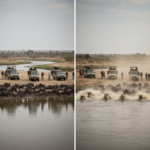
The tradeoff is vehicle density. The main reserve attracts the most safari vehicles in the ecosystem, particularly in July and August. At famous crossing points, several dozen vehicles can gather when a herd stages near the river. The crossing itself is still extraordinary. The experience of getting there and waiting can feel more managed than intimate.
Off-road driving is not permitted in the National Reserve, and night drives are not allowed. Those restrictions define how a guide can respond when conditions change.
Conservancy Camps
The conservancy areas around the Mara, including Mara North, Naboisho, Olare Motorogi, and Ol Kinyei, operate under community agreements that typically allow off-road driving, night drives, and walking safaris. Vehicle numbers are more controlled, which means notable sightings are shared with fewer parties.
For many migration travellers, conservancy camps deliver a qualitatively different experience because they combine migration access with:
- Fewer vehicles at any given sighting
- Off-road flexibility when herds move unpredictably
- Night drives that extend daily wildlife hours
- Walking safari options for a ground-level perspective
- A stronger community conservation relationship
- A quieter, more private camp atmosphere
The conservancy advantage is most significant for guests who have already experienced the main reserve and want a different relationship with the ecosystem, or for guests who specifically value photographic access and low vehicle pressure.
River View Camps: Useful or Overstated
Many travellers search for river-view camps because they picture watching crossings from their tent. That is possible in rare circumstances but it is not how crossings typically work.
A river-view camp is valuable because it places you within the crossing corridor. The crossing itself might happen upstream, downstream, or not at all on any given day. Wildebeest staging near a crossing point can move away and return at a completely different location hours later.
Choose a river-view camp for the access it provides, not for the promise of a crossing from your deck. A strong guide and a vehicle with flexible positioning still matter more than the view from your veranda.
Luxury Camps During Migration Season
Luxury camps during peak migration season are expensive because they combine very limited bed inventory with maximum demand. The best ones deliver:
- Strong location relative to crossing zones
- Private or low-density vehicles
- Excellent guiding with consistent Mara experience
- High staff-to-guest ratios
- Well-prepared meals and comfortable tents
- Fast airstrip transfers from Nairobi
- Good photography support and vehicle setup
The value of a luxury migration camp is not purely the room. It is the whole system functioning without friction: flights that connect cleanly, transfers that arrive on time, early starts with a packed breakfast ready, a guide with the patience to wait properly at a crossing, and camp communication that tracks herd position daily.
Luxury is most worth the premium when:
- Travel dates are fixed and non-negotiable
- Photography is a primary motivation
- You want a private vehicle as standard
- Physical comfort after long drives matters
- You are visiting for a honeymoon or milestone trip
Budget Camps During Migration Season
Budget camps in the Mara can work for migration visits, but the selection requires more care than at higher price points. Some affordable options are well-positioned, honest about what they offer, and deliver a genuine migration experience. Others use the Mara name while operating too far from the action to be practical.
Key questions for any budget camp in this context:
- How far is the camp from the nearest reserve or conservancy gate?
- How long does the morning drive to common crossing points typically take?
- Are park and conservation fees included in the quoted rate?
- Is the vehicle shared or private? What is the maximum passenger count?
- Does the camp employ qualified safari guides?
- What happens if the herds shift to a different part of the ecosystem during your stay?
A budget camp that saves $300 per night but adds two hours of transfer time each day is not always a better value. The field time lost to logistics is the real cost.
Mobile Camps: A Different Category
Distinct from the fixed reserve, conservancy, luxury, and budget camps above, a small number of operators run migration season as mobile camps: tented camps that physically relocate to follow herd position through the season rather than sitting in one fixed spot year round. A mobile camp positioned near an active crossing corridor in August can be a considerable distance from where the same operator’s camp sat in June.
The tradeoff is comfort tier. Mobile camps give up some of the infrastructure of a fixed luxury property (permanent plumbing, a wider bed inventory, on site facilities) in exchange for positioning that a fixed camp cannot match once herds move. A guide who has followed the migration for years can put a mobile camp close to where daily crossing activity is concentrated that week.
A related but separate option is fly camping: a one or two night walking safari style overnight, typically arranged through a base camp rather than booked as a standalone stay, where guests walk in with a guide to a temporary camp already set up ahead of them. It suits travellers who want one night of a more elemental experience within an otherwise fixed camp stay, not a full mobile camp itinerary.
Camp Type Matched to Traveller
| Traveller Type | Best Camp Style |
|---|---|
| First-time safari guest | Mid-range conservancy camp or inside-reserve with strong guiding |
| Honeymoon couple | Luxury tented camp with private vehicle in conservancy |
| Family with children | Camp with structured activities and flexible meal timing |
| Photographer | Camp close to river zones, private vehicle, off-road access |
| Budget traveller | Simple camp with honest access information and included fees |
| Repeat safari guest | Conservancy camp with walking and night drive options |
When to Book Migration Camps
For July and August, the realistic booking window for the best camps is 9 to 12 months ahead. For September, 6 to 9 months is still workable but the best inventory goes early. Last-minute spaces appear, but they rarely combine the right camp, the right price, and the right dates.
Small tented camps with 8 to 12 beds are the most constrained. Family suites and private decks within these camps can sell out even further in advance. Once the beds are committed, no operator can create additional space.
A Framework for Choosing
If you are comparing camps and need a way to cut through the options, work through these in order:
First, fix your zone. Reserve or conservancy? That decision eliminates half the camp options and clarifies what your daily drive experience will look like.
Second, confirm the crossing proximity. Which crossing points are within a reasonable drive of the camp? Ask the camp or a local operator with direct knowledge.
Third, check guide experience. Years of Mara experience is a better predictor of outcome than camp rating.
Fourth, confirm vehicle policy. Private or shared? How many passengers maximum?
Fifth, set the budget. Price should inform the final shortlist, not drive the zone decision.
Explorer Notes: Reading Herd Movement
The migration is not clockwork. Herd position in the Mara changes day by day based on rainfall in Tanzania, grass condition in the Mara, predator pressure, and other variables guides read from experience and radio networks.
The crossing events that generate the most dramatic photography happen when a large herd stages on the bank, tests the water, holds back, and then commits. That process can take hours. Waiting at a crossing point is part of the craft, and a guide who reads the staging behaviour correctly produces a very different experience than one who arrives, waits 20 minutes, and moves on.
The camps that support this kind of patient fieldwork are usually those with private vehicles and experienced guides who are comfortable allowing a guest to wait as long as necessary.
Practical Planning
Internal reading: For detailed analysis of Mara conservancy zones and crossing-point proximity by camp, touringinsights.com has independent coverage of the ecosystem zones and how they perform across the migration season.
External reference: trunktrailssafaris.com documents how camp selection shifts by month across the July-to-October window and provides detailed guidance on the tradeoffs between reserve and conservancy for different traveller types.
One principle to carry forward: The best migration camp is the one that gets you to the right place at the right time with the right guide. All other variables, room quality, camp aesthetics, and brand recognition, are secondary to that.
Prefer a different route, budget, or travel style? This plan can be adapted to fit.
Customise Your Trip