There is a single elephant population in Kenya that has been watched, named, and documented for over 50 years. Every calf born, every family dispute, every death from drought or poaching has been recorded. The result is the most detailed elephant behavioral database on the planet, and it sits inside Amboseli National Park.
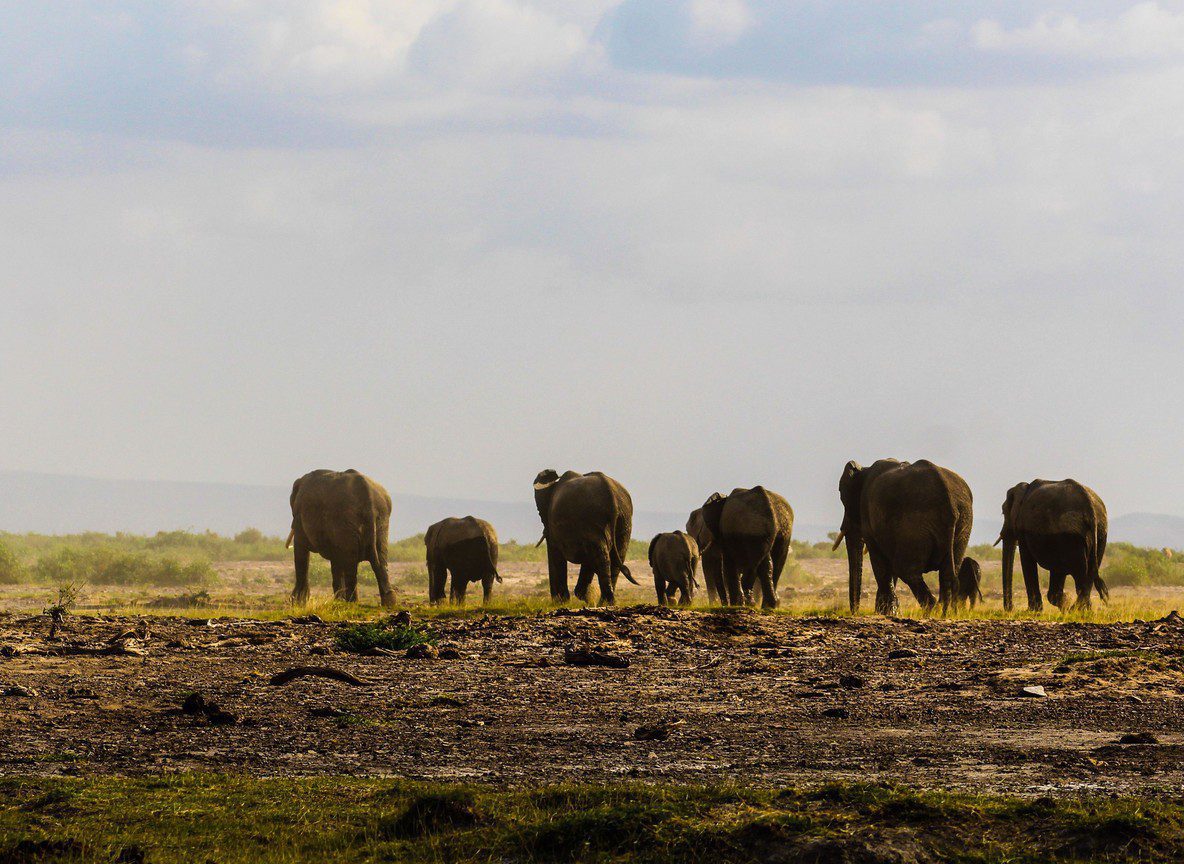
The Amboseli Elephant Research Project (AERP) began in 1972 and has produced findings that changed conservation law, reshaped how Kenya Wildlife Service manages elephant populations across the country, and challenged long-held assumptions about elephant intelligence. If you want to understand what actually keeps elephants alive in the wild, Amboseli is where much of that knowledge was built.
The Study That Changed How the World Understands Elephants
When Cynthia Moss established the research project in 1972, scientific consensus held that elephants were largely solitary and driven by basic survival instincts. What the Amboseli Elephant Research Project revealed over the following decades dismantled that view.
The project documented that elephants live in layered family structures: core family units of 10 to 15 individuals led by a matriarch, with bond groups connecting related families and clans linking multiple bond groups. These are stable social networks held together by memory, communication, and accumulated knowledge passed down through generations.
The matriarch carries the group’s survival knowledge: where water sources are during drought, how to read the scent of a predator, which humans to avoid. Research from Amboseli showed that herds with older matriarchs had significantly higher calf survival rates during drought years than herds that had lost their oldest females to poaching.
That finding alone reshaped anti-poaching strategy across East Africa. Killing the matriarch does not just reduce herd size. It destroys the knowledge network the herd depends on to survive. Conservation programmes now treat matriarch protection as a priority, not an afterthought.
What the Data Shows After 50 Years
The AERP has tracked over 3,000 individual elephants across more than five decades. The database includes:
- Birth records for every calf observed, with family ID and matriarch lineage
- Social network maps showing how families split, merge, and reconnect
- Behavioural records including play, grieving, and responses to mortality
- Movement patterns correlated with rainfall, vegetation change, and human encroachment
- Cause-of-death records for every documented death in the population
The Amboseli population was around 600 in the early 1970s. It dropped sharply during the 1976 to 1977 drought and again during the poaching crisis of the 1980s, when ivory demand drove elephant numbers across Africa into freefall. By 1989, Amboseli had fewer than 500 elephants.
The Kenya ivory ban of 1989 and the CITES international trade ban the same year were supported, in part, by data coming out of Amboseli. The AERP’s documentation of how poaching fragmented family structures provided quantitative evidence for the argument that elephant populations could not survive commercial harvesting.
Today the Amboseli population sits above 1,600. The recovery is not accidental. It reflects protected status, community buffer zones, and ongoing research feeding directly into management decisions.
How Elephant Families Are Tracked and Identified
Every elephant in the AERP database is identified individually through natural markings: ear tear patterns, tusk shape and size, and distinctive body features. Researchers identify individuals from hundreds of metres away.
Families carry alphabetical naming codes assigned in the 1970s: the AA family, the BB family, and so on. Individuals within each family carry given names. This naming convention was initially controversial in academic circles, where personifying study subjects was considered unscientific. The AERP’s defense was practical: if you cannot identify individuals, you cannot study social behaviour. You can only count animals.
The research that followed proved the approach correct. The project identified elephant greeting ceremonies, documented responses to deceased group members that parallel human mourning behaviour, and recorded low-frequency rumble vocalisations allowing communication between groups separated by several kilometres. These infrasonic calls fall below human hearing thresholds. Elephants were communicating across the park without anyone knowing it, and field recordings eventually produced a vocabulary catalog of over 100 distinct call types.
The Amboseli Trust for Elephants: Research into Action
The research arm and the conservation action arm of the Amboseli operation are formally separated but tightly connected. The Amboseli Trust for Elephants was established by Cynthia Moss and Joyce Poole to move AERP findings from academic publication into active conservation work.
Key programmes include:
Elephant Watch: Real-time monitoring of elephant movements around park boundaries where human-wildlife conflict is most common. Elephants regularly move outside the park into community land in search of water and crops. The monitoring programme provides early warning to community scouts who can guide elephants back before conflict escalates.
Community Coexistence Programme: Works with Maasai landowners in the Amboseli ecosystem to create financial incentives for tolerating elephants on community land. Research data identifying which family groups use which corridors has been critical to negotiating land-use agreements that keep movement routes viable.
Data sharing with KWS: AERP data is fed directly to Kenya Wildlife Service for national elephant management planning. The population census methodology developed in Amboseli is now the standard used for aerial surveys across Kenya.
These programmes are what turns five decades of observation into a living, operational conservation system. The research is actively deployed, not archived.
What Threats the Research Has Helped Counter
Poaching: The 1980s ivory crisis killed an estimated 700,000 elephants across Africa between 1979 and 1989. The AERP’s family tree data allowed researchers to track exactly which individuals had been lost and to model the demographic consequences. The data showed that poaching was targeting older, larger-tusked individuals disproportionately — which were often matriarchs and experienced bulls — and that herd cohesion was collapsing as a result.
Drought: Amboseli sits on the edge of the Amboseli basin with sporadic rainfall. The 50-year dataset overlaps with multiple severe drought cycles. Analysis showed that calf survival during drought correlates strongly with matriarch age and experience, and that families with disrupted leadership showed significantly worse outcomes during stress events. This connected the poaching and climate threats into a single compound risk.
Human encroachment: Population growth has increased pressure on ecosystem buffer zones surrounding the park. AERP movement data identified the specific corridors elephants rely on to access dry-season water outside the park. Without that data, those corridors would have been lost to agricultural development without anyone recognising their ecological importance.
Visiting Amboseli With the Research in Mind
Amboseli is a four-hour drive from Nairobi or a 45-minute charter flight from Wilson Airport. The park covers 392 square kilometres — small enough to know well, large enough to hold distinct habitat zones including the Enkongo Narok and Ol Okenya swamp systems that are the anchor point for the elephant research.
For research-oriented visits, a minimum three-night stay is recommended. One day gives you surface coverage. Three days allows you to observe the same family groups across multiple behavioural contexts — morning activity, midday resting, evening swamp feeding — which is what builds understanding of what the research has actually documented.
The dry season from June through October concentrates elephants around the permanent swamps. The green season from November through May spreads them across the basin as temporary pools form, making large aggregations less predictable but individual family interactions more accessible.
For timing, wildlife, and camp planning details, the Tourinsights Amboseli guide covers what to expect across seasons. For the broader elephant picture across Kenya, the Tourinsights elephants guide gives full context on family structure, research legacy, and photography conditions.
Frequently Asked Questions
What is the Amboseli Elephant Research Project? The world’s longest-running elephant study, founded by Cynthia Moss in 1972 in Amboseli National Park. It has tracked over 3,000 individual elephants and produced findings on social behaviour, communication, family structure, and conservation that shaped global elephant protection policy.
Can visitors access the research operation? The Amboseli Trust for Elephants welcomes conservation-focused visitors. Access to research briefings and the identification catalog requires advance coordination. Some safari operators can arrange this as part of a specialist itinerary.
How many elephants live in Amboseli today? The population has recovered from under 500 during the 1980s poaching crisis to over 1,600 individuals. The AERP maintains individual identification records for the entire population.
What is the best time to visit for elephant watching? The dry season from June through October concentrates elephants around the permanent swamp systems. Dawn and dusk are the most active periods for family group behaviour.
Turn this reading into a real itinerary with help from a Kenya-based safari team.
Start Planning Your Safari