

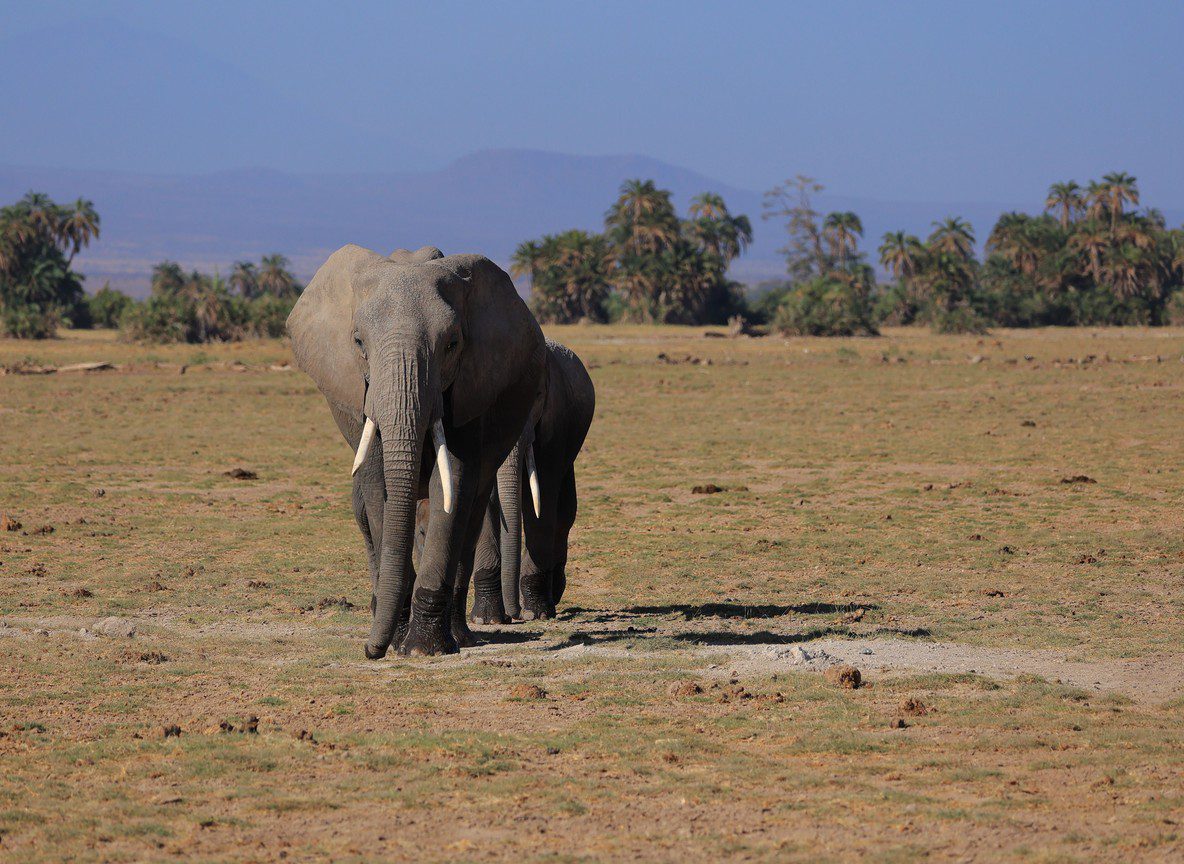
There is a specific moment in Amboseli that is hard to forget. In the early morning, out of the swamp mist, a breeding herd of forty elephants moves onto the short plains. Behind them, Kilimanjaro fills the sky. The lead female sets the direction, the calves stay tight to their mothers, and the whole herd moves as a single organism. No description does it justice. What this guide offers is the field knowledge to understand what you are watching when it happens.
Why Amboseli Stands Alone for Elephant Viewing
Three factors coincide in Amboseli that exist nowhere else on Earth together.
Open terrain: The short-grass plains and open swamp edges allow you to see entire herds at distance, watch their social dynamics unfold, and follow movement without obstruction. Forested elephant habitats produce close encounters but no panoramic perspective.
Research depth: The Amboseli Elephant Research Project, founded by Cynthia Moss in 1972, is the world’s longest-running elephant study. Over 1,600 individual elephants have been identified and named across multiple generations. A knowledgeable guide can tell you an individual’s family group, rank in the hierarchy, how many calves she has raised, and which matriarch she follows. This transforms observation into something closer to reading a biography.
The Kilimanjaro context: Africa’s highest mountain sits on the horizon behind every herd. The combination of elephants at dawn against Kilimanjaro in golden light is the defining image of Kenyan wildlife photography. No other location combines all three of these elements.
Understanding What You Are Watching: The Research Legacy
The Amboseli research project, continued by Vicki Fishlock and the Amboseli Trust for Elephants after Cynthia Moss’s founding work, has documented elephant psychology, communication, grief, memory, and social learning in ways that fundamentally changed scientific understanding of these animals.
Family structure: Amboseli elephants live in family units of 8 to 20 individuals led by a matriarch. The matriarch’s accumulated knowledge — seasonal water sources, safe migration routes, predator patterns — is critical for the family’s survival. When a matriarch dies, her family often fragments and loses access to knowledge built over 60 years of life in the ecosystem.
Bull ecology: Adult bulls leave the family group at puberty and form separate social networks. The largest bulls — those whose tusks reach the ground — are rare and represent decades of survival in a poaching-pressured continent. Amboseli has historically held some of the last super-tusked elephants in Africa.
Communication: Elephants communicate through infrasound frequencies below human hearing. A family at the swamp edge may be responding to messages from a herd five kilometres away, completely invisible to you.
When your guide points to a specific elephant and names her, they are drawing on five decades of accumulated research. That knowledge exists nowhere else.
Where to Find Elephants in Amboseli: Key Zones
The park’s permanent water sources are swamps fed by underground springs from Kilimanjaro’s aquifer. Elephants concentrate around these throughout the dry season.
Enkiama Swamp (central Amboseli): The largest and most reliable elephant zone. Multiple family groups use this swamp daily. Dawn drives here almost always produce close-range sightings.
Longinye Swamp (western section): Slightly less visited than Enkiama. Often holds large bull groups and bachelor herds alongside family units.
Ol Okenya Swamp (southeast): Less accessible, often productive for solitary bulls and smaller family groups that avoid the high-traffic central zone.
Open plains south of Observation Hill: Large herds cross these plains moving between feeding and water zones. Excellent positions for panoramic photography with the mountain behind.
| Viewing Zone | Best For | Peak Time | Activity |
|---|---|---|---|
| Enkiama Swamp | Breeding herds, calves | Dawn 6 AM-8 AM | Drinking, mud bathing, socialising |
| Longinye Swamp | Bull groups, bachelor herds | Late afternoon 4-6 PM | Bathing, territorial display |
| Ol Okenya Swamp | Smaller families, solitary bulls | Early morning | Quiet grazing, less crowded |
| Open plains (south Observation Hill) | Herd-plus-mountain photography | Dawn, late afternoon | Movement, panoramic shots |
Calves and Juveniles: When to See Them
Elephants have no fixed breeding season and calves are born year-round, but calving peaks from November to January. December and January see the most newborns in Amboseli.
Newborns stand unsteadily and shelter under their mothers’ belly. Calves from two to six months old are notably playful — they investigate everything, practice mock-charging vehicles, and are frequently corrected by older females in the group. Juveniles of two to five years practice trunk control and social interaction constantly.
The post-short-rains period from December to February gives the highest probability of seeing newborns alongside older calves in the same family group.
Photography: The Elephants-and-Mountain Shot
The image of elephants with Kilimanjaro behind them is the most sought-after composition in Kenyan wildlife photography. Understanding when and where it is achievable is essential.
Mountain visibility: Kilimanjaro’s peak is clearest in the early morning before cloud builds (typically 6 AM to 10 AM). It sometimes clears again in the late afternoon (4 PM to 6 PM). The most reliable months for the mountain backdrop are January, February, July, and August.
Positioning: The best mountain-backdrop positions are in the central and southern plains east and southeast of Enkiama Swamp. The vehicle needs to be positioned with Kilimanjaro behind and slightly to one side of the subjects. Midday light flattens the image; dawn or late afternoon light is essential.
Equipment: Wide-angle zoom (24-70mm full-frame equivalent) for the herd-with-mountain composition. Long telephoto (400 to 600mm) for individual portraits from the swamp edge.
Amboseli Elephant Conservation: The Pressures
Amboseli’s elephant population faces genuine ecological pressure.
Human-wildlife conflict: The Amboseli ecosystem extends beyond park boundaries into Maasai community land. Elephants moving through livestock corridors create conflict. The Amboseli Trust works with community landowners on compensation schemes and movement monitoring.
Ivory poaching: The research project’s individual identification makes poaching events trackable — when a named elephant disappears, the research team knows. Anti-poaching patrols by Kenya Wildlife Service are active in and around the park.
Climate change: Amboseli’s springs are fed by Kilimanjaro’s glaciers and snowpack. Glacier retreat poses a long-term threat to the swamp water supply that the elephants depend on.
The Kenya Wildlife Service and the Amboseli Trust for Elephants are the primary organisations working on elephant protection and corridor management in this ecosystem.
Planning Your Amboseli Visit
For timing, camp options, and what to expect across different seasons, the Tourinsights Amboseli guide covers the practical planning details. If you want to combine Amboseli with a broader Kenya itinerary, the 10-day Kenya safari guide shows how Amboseli fits alongside the Mara and Samburu for a complete multi-park trip.