Each year roughly 1.5 million wildebeest, 300,000 zebra, and 500,000 Thomson’s gazelle trace an 800-kilometre circuit across the Serengeti-Mara ecosystem. Safari marketing tends to compress this into a single headline event – the river crossing – but the reality is richer and more useful for planning. The wildebeest migration route is a continuous year-round loop. Knowing where the herds are in any given month is the difference between positioning yourself for a specific experience and arriving to find an empty plain.
This guide maps the full circuit from January through December, with the practical information needed to match your travel dates to the most rewarding wildlife concentration available.
What Drives the Migration Route
The herds follow short green grass and rainfall, not instinct alone. The Serengeti-Mara ecosystem has two wet seasons: the long rains (March to May) and the short rains (November to December). As rain moves north, new grass growth follows, pulling the circuit forward. As grass dries behind the herds, they do not return until the next rains renew it.
Three landscape zones define the route:
| Zone | Location | Peak Months |
|---|---|---|
| Southern Serengeti and Ndutu | Tanzania, south of Seronera | December to March |
| Central and Western Serengeti | Tanzania, Grumeti corridor | April to June |
| Masai Mara and Mara Triangle | Kenya, north of Tanzania border | July to October |
Understanding which zone the herds are occupying tells you where to position and which camps to consider. Each zone has a distinct character and delivers a different type of wildlife experience.
The Full Month-by-Month Migration Map
January and February: Calving Season, Southern Serengeti
The herds are concentrated on the short-grass plains of southern Serengeti and Ndutu. The area draws them for a specific reason: the plains sit on ancient volcanic ash from the Ngorongoro highlands, which makes the soil unusually rich in calcium and phosphorus, minerals lactating mothers and newborn calves need most, and produces the short, nutrient-dense grass the herds seek out for calving. January and February are calving months: approximately 8,000 calves are born per day at peak. Predator density around the calving herds is at its annual maximum. Lion prides coordinate ambushes. Cheetah mothers bring cubs to hunt small calves. Hyena clans operate continuously around the periphery.
This is arguably the most intensive wildlife experience on the full circuit. The concentration of predator and prey interactions – the birth of calves alongside immediate predation pressure – produces a quality of wildlife observation that the river crossings, for all their spectacle, do not quite match for sustained drama.
The Masai Mara in January and February is quiet. Low rates and very few vehicles.
March and April: Long Rains, Herds Disperse
Rainfall breaks up the dense southern concentrations. Herds drift north and west through central Serengeti. March and April are shoulder season for most operators. The green landscape and low vehicle density suit photographers and behavioural observers who care less about crossing spectacle and more about sustained wildlife interaction.
May and June: Western Corridor, Grumeti River
By May the main column moves through the western Serengeti corridor toward the Grumeti River. The Grumeti crossing is less photographed than the Mara River – smaller columns, fewer vehicles attending – but crocodile activity at the Grumeti is comparable to the Mara. June brings the first significant groups to the Kenya border.
July to October: Masai Mara, Kenya
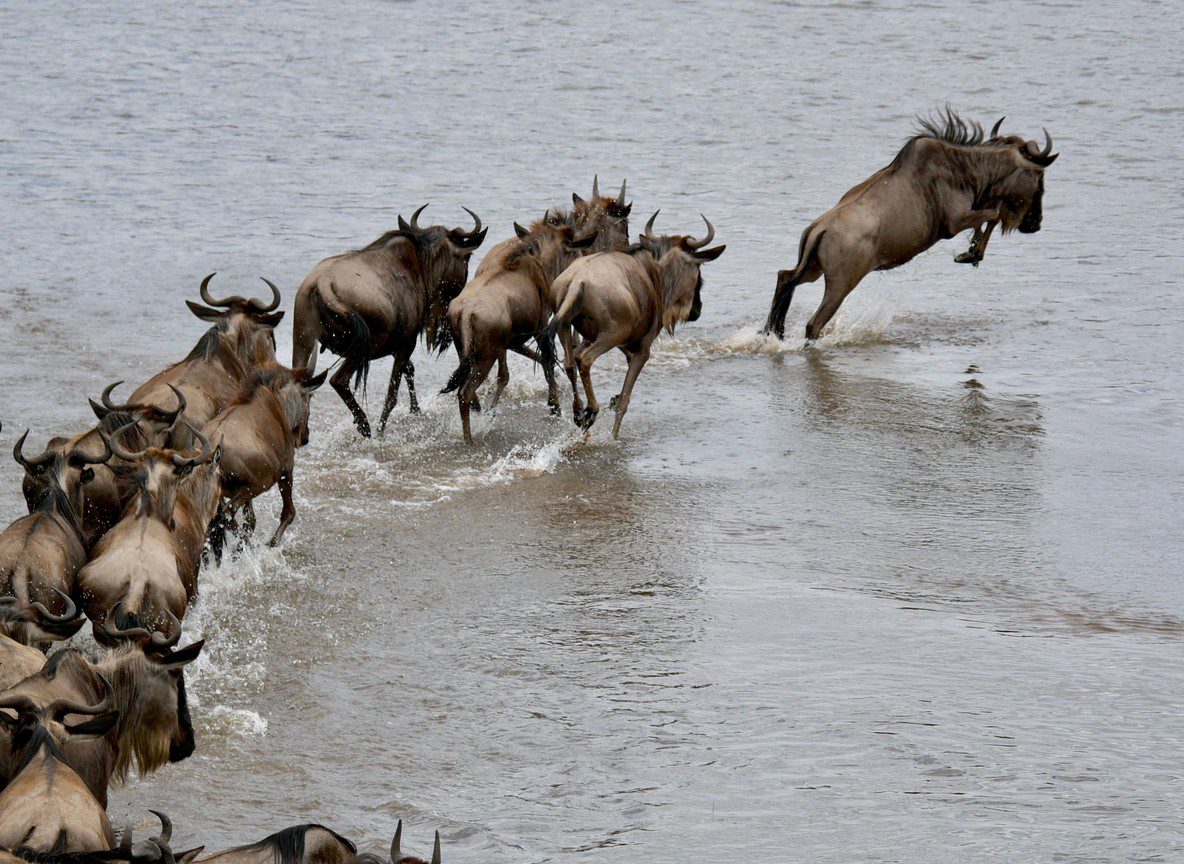
This is the window most travelers target. The main herds enter the Masai Mara ecosystem from the south in late June or early July and begin crossing the Mara River from July through October. Peak crossings typically fall between mid-July and late September.
The Mara Triangle (managed by the Mara Conservancy) on the western bank generates some of the highest crossing frequency. The main reserve and the private conservancies offer different vehicle density trade-offs, which is a more significant factor than many travelers realise before they arrive.
November and December: Return South, Short Rains
Short rains arrive in November. The herds begin their return journey south, re-entering the Serengeti through the eastern corridors. Crossings still occur in early November but herd density drops sharply by mid-month. December returns the circuit to the southern calving grounds, completing the loop.
When Do Wildebeest Cross the Mara River?
The Mara River crossing is the iconic image of the migration and the hardest element to predict with precision. Crossings depend on several converging conditions:
Herd pressure: The column must build large enough on the Mara’s northern bank before a lead animal commits to the crossing. A small group approaching a bank with many vehicles will often turn back.
Water level: High water after heavy rain delays crossings. Dropping water levels tend to encourage approach.
Crocodile activity: Visible crocodile concentration near the bank can delay crossings for days. The lead animals read this information.
Disturbance: Vehicle noise and movement on or near the bank pushes lead animals back. This is why vehicle discipline at crossing sites matters significantly – and why conservancy camps with strict vehicle protocols tend to produce better crossing sightings.
A probability guide based on field observation:
| Stay Length in the Mara | Estimated Probability of Witnessing a Crossing |
|---|---|
| 2 nights | 35-45% |
| 4 nights | 65-75% |
| 6 nights | 85-90% |
| 10+ nights | 95%+ |
Peak probability window: mid-July to mid-September. The highest-probability crossing points on the Kenya side are Crossings 4 and 5 on the Mara Triangle west bank, and the Lookout Hill area in the main reserve.
Conservancy Positioning for the Kenya Phase
For travelers targeting the Kenya crossing season, the private conservancies surrounding the main reserve extend both the season’s usefulness and the quality of the experience:
| Conservancy | Best Migration Months | Vehicle Limit | Key Advantage |
|---|---|---|---|
| Mara Triangle | July to October | Controlled | Highest crossing frequency, best bank positions |
| Mara North | August to October | 4 per sighting | Post-crossing herds, night drives permitted |
| Olare Motorogi | July to September | 4-6 per sighting | High lion density, quality predator-prey interaction |
| Mara Naboisho | August to October | 24 guests total camp cap | Lowest vehicle pressure of any Mara option |
The main Masai Mara National Reserve has no vehicle limits per sighting. Popular crossing points during peak dates in August can see 80 or more vehicles queued at the bank. Conservancy positioning is a direct wildlife-quality decision, not a luxury add-on.
Planning a Serengeti-to-Mara Circuit
Some travelers structure an itinerary that covers two legs of the circuit: calving season in Tanzania (January and February) paired with the Kenya crossing season (July to October), either as a single extended trip or as two separate journeys.
A combined Serengeti-Masai Mara itinerary of 10 to 14 days can cover both ends of the biological cycle: the birth of calves and the most visible predation event in Africa. This requires cross-border planning between Tanzanian and Kenyan camps. The logistics are straightforward but the timing of each leg must be set against the specific migration calendar for your travel year – general windows shift by one to three weeks depending on rainfall patterns.
What Happens If You Miss the Crossing Window
Visitors whose dates fall outside July to October will find the Masai Mara still delivers strong wildlife. Resident elephant herds, large lion prides, leopard, and cheetah are present year-round. The change is in herd density: during non-migration months, wildebeest are present in the Mara but not in the 50,000-animal columns that produce crossing conditions.
Off-peak advantages are real: rates are 30 to 50 percent lower at most camps, vehicle density is far lower, and predator-prey interactions are easier to observe without competing vehicles. See the Tourinsights guide to the Masai Mara in November for a detailed green-season picture, and the guide to underrated Mara wildlife for what the resident ecosystem looks like outside migration season.
How to Use This Map for Planning
- Identify the experience you are targeting: river crossing spectacle, calving drama, predator concentration, or green-season photography.
- Match that experience to the zone and month in the map above.
- Allow at least four nights in the Mara ecosystem for a realistic crossing probability if that is your goal. Six nights is the point where probability rises substantially.
- If traveling during peak July to September, choose a conservancy camp rather than the main reserve. Vehicle limits change the quality of what you witness at the river bank.
- Book conservancy camps for peak August well in advance. The best properties book out six to nine months ahead.
The migration circuit is active every month of the year. The question is which part of the circuit aligns with what you want to see – and whether your dates and the circuit timing are matched carefully enough to make the experience what you came for.
For further reference on crossing sites and the Mara Triangle specifically, see the Tourinsights Mara Triangle guide and background on the Mara Conservancy’s vehicle management at trunktrailssafaris.com.
Have questions about this itinerary or destination? Get answers from a safari specialist before you commit.
Inquire MoreFurther reading
- WWF wildlife conservation
- Maasai Mara Wildlife Conservancies Association
- Magical Kenya (Kenya Tourism Board)
More safari planning resources
- Wildebeest migration route map from Valley Safaris
- Great Migration safari collection on FindMySafari
- Best time to visit Kenya month-by-month map from Valley Safaris
- Interactive Maasai Mara map from Valley Safaris