

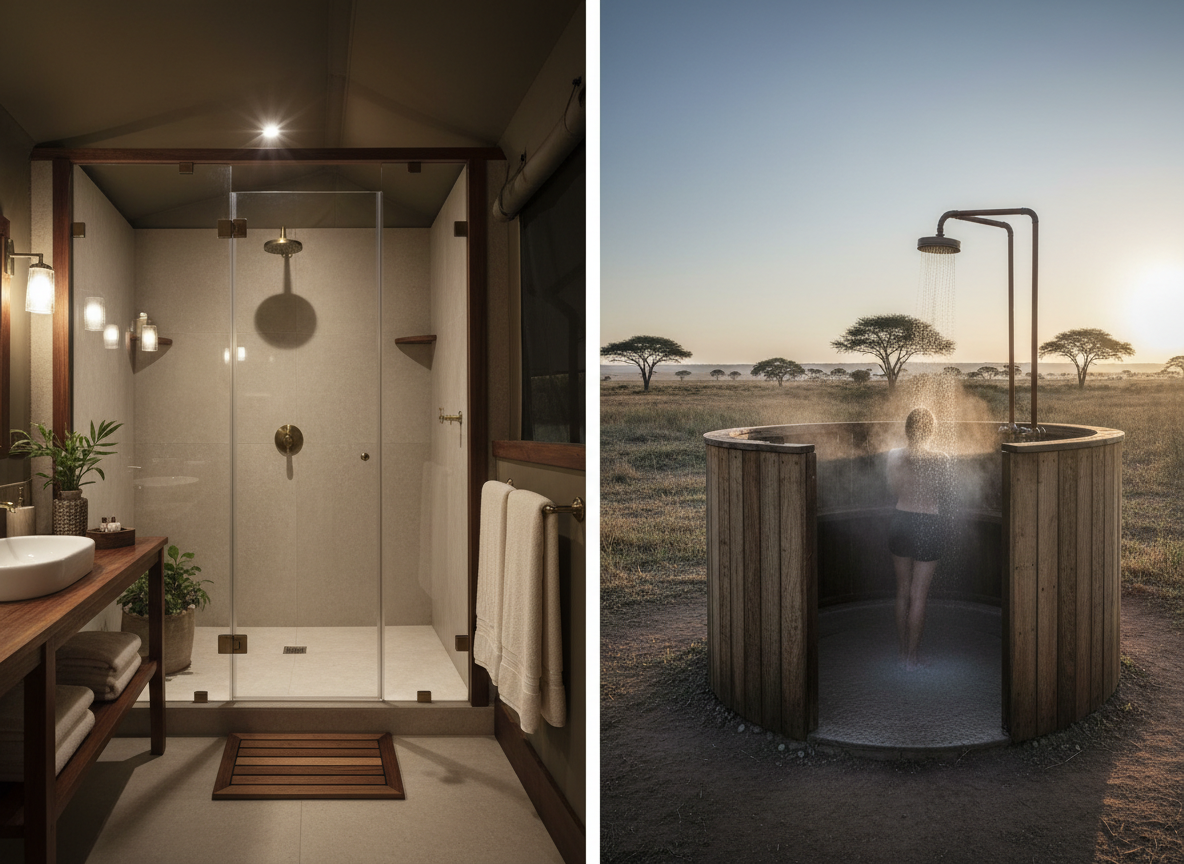
The type of safari camp shower inside your tent shapes more of the daily experience than most travelers anticipate before arrival. It is not simply a question of hot water or cold. It determines your privacy, your exposure to the elements, your proximity to wildlife at unexpected moments, and sometimes the mood of the entire morning before a game drive.
Tented camps in the Masai Mara offer two main shower configurations: a standard en-suite bathroom enclosed within the tent structure, or an outdoor bush shower open to the sky above. Some eco-camps offer a third variation, the bucket shower, which relies on staff-delivered hot water rather than plumbing. Each setup suits a different traveler and a different kind of trip.
Here is what each option looks like in practice, who it works for, and how to decide before you book.
Quick Comparison
| Factor | Standard En-Suite | Outdoor Bush Shower |
|---|---|---|
| Privacy | Fully enclosed | Open above; usually screened on sides |
| Views | None: enclosed bathroom | Plains, river, or tree canopy |
| Weather exposure | None: fully sheltered | Rain, wind, cold overnight temperatures possible |
| Night use | Comfortable at any hour | Requires willingness to be outdoors after dark |
| Wildlife encounters | Very low | Occasional: animals can approach the outdoor area |
| Water supply | Running hot water (most mid-range and above) | Solar-heated; some camps use bucket system |
| Accessibility | Standard bathroom layout | May involve steps or an outdoor path |
| Best suited for | All travelers, families, comfort priorities | Couples, honeymooners, adventurous travelers |
Standard En-Suite Safari Camp Shower
What the Bathroom Looks Like
The en-suite bathroom in a quality Masai Mara tented camp is a proper bathroom with canvas walls. It sits on a solid floor within the tent structure, fully enclosed, and typically includes:
- A flush toilet
- A hot shower with running water, heated by solar panels or gas
- A double washbasin
- Battery or solar lighting
- Towels and toiletries; a hairdryer at most mid-range and above properties
The enclosure provides complete privacy and full weather protection. You can shower at any hour regardless of rain, wind, or how cold the temperature has dropped overnight.
Who This Suits
The en-suite works for virtually every traveler type, which explains its presence across all camp categories. Families with young children benefit from the controlled, enclosed environment. Older travelers appreciate not needing to navigate outdoor steps or paths in the dark. Anyone on a first safari generally has sufficient new experiences from the game drives without adding an open-air bathroom to the list.
For most visitors, the standard en-suite is not a compromise. It is the right choice.
The Outdoor Bush Shower
What the Experience Looks Like
An outdoor shower at a Masai Mara camp is typically a screened timber or canvas enclosure built directly onto the side of the main tent, open at the top. You shower and look out over whatever the camp faces. At riverside locations, the view from the shower platform may extend to the Mara River, with hippos audible or visible and kingfishers working the bank vegetation. At plains-facing camps, the eye travels across open savannah to the horizon. At wooded sites, birdsong fills the space in place of the sound of running water.
Safari travelers consistently describe the outdoor shower as one of the details they remember most clearly from the camp stay: warm water, open sky, wild landscape within arm’s reach. For travelers inclined toward immersive experiences, this particular combination tends to land with some force.
The Bucket Shower Option
At rustic eco-camps without tent plumbing, the bucket shower is the standard arrangement. Camp staff heat water and deliver a filled bucket to your tent at the shower time you have requested. The bucket sits on a raised frame above the outdoor shower tray; you open a valve to release the flow.
The finite water supply encourages a deliberate pace rather than the absent kind of showering that unlimited water produces. Travelers who appreciate bucket showers describe the simplicity as part of what makes a rustic camp feel genuinely different from a hotel. Travelers who want reliable hot water at any hour will find the arrangement a real limitation rather than a feature.
Weather and Temperature
The Masai Mara gets cold at night. Between July and September, temperatures drop to around 12 to 15 degrees Celsius, particularly in the hours before dawn when most game drives depart. An outdoor shower at these temperatures requires either very hot water or genuine tolerance for the cold.
In the warmer months, January through March and October through November, an outdoor shower at dusk or first light is entirely comfortable. The air is warm, the light is low, and the experience is easy to enjoy without any particular commitment.
Most well-designed luxury tented camps that feature outdoor showers also include an indoor shower in the same tent unit, giving guests the option to choose based on conditions that morning. If a camp offers only an outdoor shower, it is worth asking about this arrangement before booking during peak cool-season months.
Wildlife at the Outdoor Shower
Because the outdoor shower is physically open to the surrounding environment, wildlife encounters during the shower are a genuine possibility at many camps. An elephant moving through the riverine corridor at dawn may pass within a few meters of the shower platform. A vervet monkey may investigate the tray. A mongoose may appear through the canvas screening.
None of these encounters carry meaningful danger. All of them are notable in a way that an enclosed indoor bathroom is not. The outdoor shower’s openness is the mechanism that produces these moments: it removes the structural barrier between the camp’s habitable space and the broader ecosystem that surrounds it. For travelers who came to Africa specifically to close that distance, the outdoor shower does exactly that on a small, daily scale.
Which Type to Choose
Choose a Standard En-Suite Shower If You
- Are traveling with children or elderly family members
- Are visiting between July and September, when overnight and pre-dawn temperatures are coldest
- Have mobility considerations that make outdoor steps or uneven paths difficult to navigate
- Are on a first safari and prefer to keep your attention on the game drives
- Need reliable private access to the bathroom at any hour without going outside
Choose an Outdoor Bush Shower If You
- Are on a honeymoon or a couple’s trip where full immersion in the bush environment is the goal
- Are visiting in the warm months, when outdoor conditions are comfortable morning and evening
- Want the possibility of wildlife encounters as part of the daily camp routine
- Are staying at an eco-lodge where the outdoor shower is central to the camp’s design philosophy rather than an optional extra
Many travelers arrive without strong feelings about the shower arrangement and leave describing it as one of the clearest memories from the stay. It is worth thinking through before you arrive rather than after.
Explorer Notes
Ask before booking. Camp descriptions do not always specify whether the outdoor shower is the only option or an add-on alongside an indoor unit. Confirm directly with the property or your booking agent.
Find out when hot water peaks. At solar-heated camps, water temperature depends on afternoon sun exposure. Most camps schedule shower windows in the late afternoon and early morning for this reason. Ask what time the water runs hottest if you have strong preferences about when you shower.
Night shower logistics. If you prefer showering after dinner, confirm whether the outdoor shower area is well lit and whether staff escorts are available for the walk. Some camps advise against guests moving alone through the camp after dark.
Bucket shower volume. The standard allocation at bucket-shower camps is one bucket per shower, typically 15 to 20 liters. This is sufficient for a quick, efficient wash. It is not sufficient for a long one.
Dual setups are common at higher tiers. Mid-range and luxury tented camps increasingly include both an indoor shower and an outdoor platform within a single tent unit. If this configuration is available at your chosen property, much of the decision becomes straightforward.
Conclusion
The choice between a standard safari camp shower and an outdoor bush shower is not really about comfort versus discomfort. It is about the kind of camp experience you want to have each morning and evening. The en-suite is reliable, private, and practical across all seasons and traveler types. The outdoor shower is richer in sensory detail, more dependent on weather, and better suited to travelers who want the wild to feel immediately present throughout the stay, not just during game drives.
Both are valid choices. The useful step is knowing which one you are choosing, and why, before you arrive at camp.