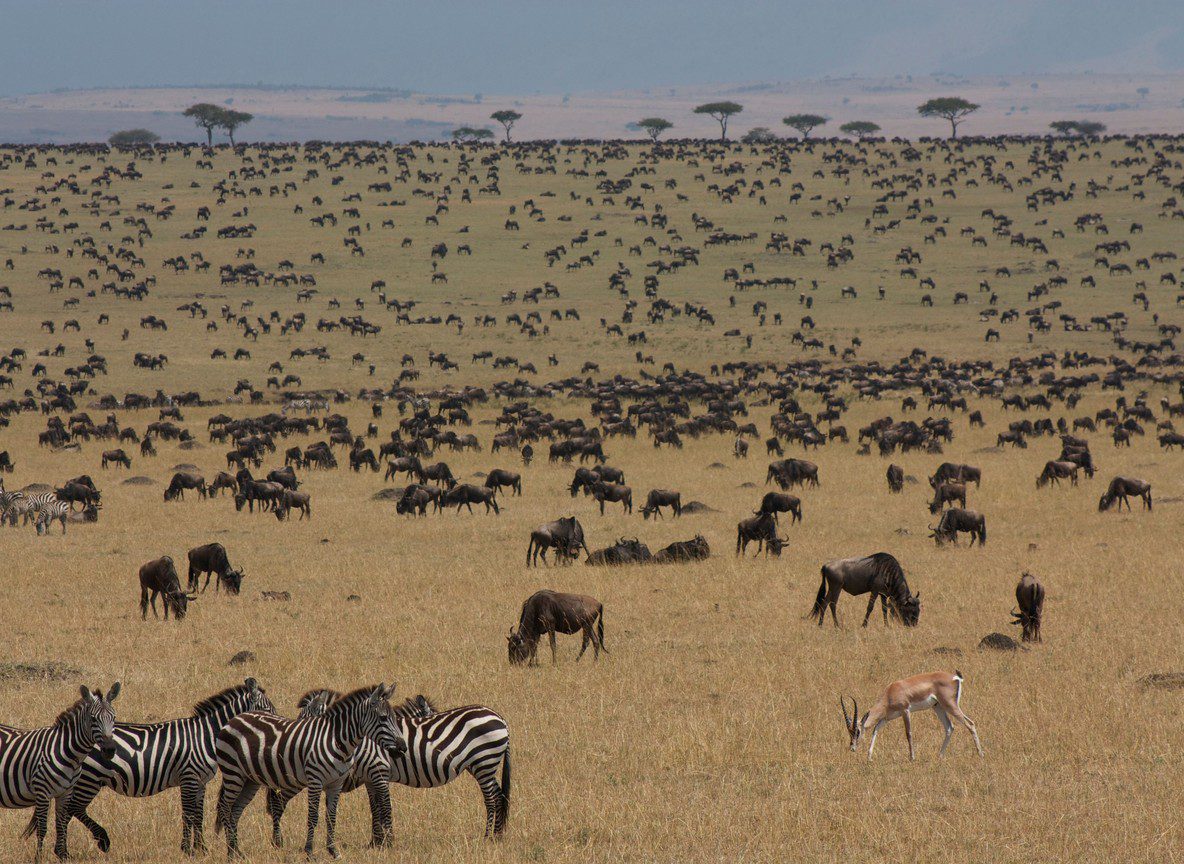
The wildebeest migration is a single continuous event that crosses an international border twice a year. Understanding it properly means understanding both chapters — the Tanzania chapter in the Serengeti and the Kenya chapter in the Masai Mara — as parts of the same circuit rather than competing destinations. This guide covers the Serengeti’s chapter: what happens, when, where, and how it connects to the migration’s more famous Kenyan climax.
The Full Circuit in Overview
The 1.5 million wildebeest that participate in the migration follow a broadly clockwise annual loop across the Serengeti-Mara ecosystem. The circuit is driven entirely by rainfall and grass: the animals move toward fresh growth and away from depleted grazing. No single force directs them; the movement emerges from the accumulated behaviour of individual animals responding to the same environmental cues simultaneously.
The annual pattern runs roughly as follows:
January to March: The herds are on the short-grass southern Serengeti plains and the Ndutu area within the adjacent Ngorongoro Conservation Area. This is calving season.
April to May: The long rains arrive. The herds begin moving northward through the central and western Serengeti, following the flush of new grass that follows the rains.
May to June: The leading herds reach the Grumeti River in the western Serengeti. The Grumeti crossings happen here — the Tanzania equivalent of the Mara River crossings that happen later in Kenya.
June to July: The northern Serengeti fills as the herds push toward the Kenya border. The first animals enter the Masai Mara ecosystem during June and early July.
July to October: The Kenya chapter — Mara River crossings, maximum wildlife density in the Masai Mara.
November to December: The short rains break in Tanzania. The herds begin returning south through the Serengeti.
Calving Season: January to March
Calving season is the Serengeti’s most remarkable and least-visited migration chapter. Approximately 500,000 wildebeest calves are born within a compressed six-week window centred on February. The evolutionary logic is that by synchronising births so tightly, the herds overwhelm predators through sheer abundance — more calves than any predator population can consume means most survive despite the intense predation pressure.
The Ndutu area — a concentration of seasonal lakes and short-grass plains within the Ngorongoro Conservation Area but bordering the Serengeti — is the calving epicentre. In late January and February, the plains there are covered in wildebeest herds to every horizon, with newborn calves attempting to stand and run within hours of birth.
The predator activity during calving is unmatched anywhere in the Serengeti calendar. Lions, cheetah, leopard, and spotted hyena are all hunting simultaneously, exploiting the abundance of vulnerable newborns. Cheetah in particular perform at their hunting peak here — the Ndutu cheetah families are well-known to researchers and guides, and February mornings on the calving plains offer some of the most intense predator-prey interactions in East Africa.
Importantly, calving season is less visited than the Mara crossings in July-August. The Ndutu area draws a fraction of the vehicle traffic that congregates in the Masai Mara at peak season. For travellers seeking intensity of wildlife experience without the crowd pressure of peak migration season, calving in the southern Serengeti is one of East Africa’s most underrated windows.
The Grumeti River: The Serengeti’s Own Crossing
Before the wildebeest reach Kenya, they must cross the Grumeti River in the western Serengeti. The Grumeti crossings are the Tanzania equivalent of the Mara River events that draw most visitors to the migration, and they have their own distinct character.
The Grumeti is narrower and shallower than the Mara. Its crocodile population is notable not for numbers but for size — the Grumeti harbours some of the largest Nile crocodiles in Africa, growing to extraordinary dimensions partly because the river’s lower visitor traffic means the crocodiles have experienced less disturbance and have developed less wariness of vehicles. Close encounters at Grumeti crossings can be genuinely exceptional.
The Grumeti crossings typically happen in May and June. The window is shorter and less predictable than the Mara crossings and the herds involved in any single crossing event tend to be smaller groups rather than the vast consolidations seen at the Mara. The atmosphere is different — more intimate, less spectacular in scale, but with a close-encounter quality that the Mara’s larger crossings sometimes dilute.
For travellers who have already witnessed Mara crossings and want to experience a different expression of the same phenomenon, the Grumeti is a compelling alternative.
Northern Serengeti: The Build-Up to Kenya
By June, the leading edge of the migration has pushed into the northern Serengeti — the Kogatende and Lamai areas near the Kenya border. This is where the Tanzania and Kenya chapters blur into each other, with the same herds crossing back and forth across the border as grass availability dictates.
The northern Serengeti in June and July offers a particular safari experience: the density of wildebeest and zebra is extraordinary, predators are hunting constantly, and the camps in this area — particularly those on the Mara River’s Tanzanian banks — offer crossing viewings from the southern side of the same events that Kenya visitors watch from the northern bank.
Staying in the northern Serengeti during July positions you for both Tanzanian and Kenyan crossing activity. Some camps here are within walking distance of crossing points on the Tanzania bank, which means guests can watch crossings without the vehicle density of the Kenyan side during peak season.
Serengeti vs Masai Mara: The Honest Comparison
The question most travellers ask is whether to go to Tanzania or Kenya for the migration. The more useful framing is: which chapter of the migration do you want to see?
The Serengeti chapter offers: calving season (January-March), the Grumeti crossings (May-June), quieter camps with fewer vehicles, and the full ecological context of the southern ecosystem where the herds spend more than half the year.
The Masai Mara chapter offers: the Mara River crossings (July-October), Kenya’s dry season conditions with excellent game viewing beyond the migration, and the convenience of a short flight from Nairobi.
Neither is better in absolute terms. They are different experiences at different times with different characters. For first-time migration visitors, the Mara crossings are the more accessible and predictably dramatic entry point. For returning visitors and serious wildlife travellers, the Serengeti’s calving season and Grumeti crossings often prove to be the more profound experience.
Combining Both Chapters
For travellers with enough time — typically ten days or more — combining the Serengeti and Masai Mara chapters is possible and deeply rewarding. A week in the Mara during August followed by two to three nights in the northern Serengeti, or the reverse, covers both river crossing events and the different landscapes that define each ecosystem.
Cross-border itineraries require some additional logistics around visas, park fees, and flight connections between Nairobi and Kilimanjaro or Arusha, but the combination is well-established on the safari circuit and straightforward to plan.
The migration is not a single event to witness once and consider complete. It is an ongoing ecological process with multiple chapters, each with its own character, timing, and emotional register. The Serengeti chapters — calving, Grumeti, the northward build-up — are the ones most travellers discover after their first Mara crossing, and they consistently deepen the understanding of what this extraordinary annual event actually is.
Turn this reading into a real itinerary with help from a Kenya-based safari team.
Start Planning Your SafariFurther reading
More safari planning resources
- Wildebeest migration route map from Valley Safaris
- Great Migration safari collection on FindMySafari
- Best time to visit Kenya month-by-month map from Valley Safaris
- Interactive Maasai Mara map from Valley Safaris
Related guides: Wildebeest Migration Facts: 20 Things That Reframe How You See the Herd.