Kenya has two distinct safari worlds. South of the equator, the Masai Mara and Amboseli deliver the classic African savannah picture: open plains, lion prides, vast elephant herds, the annual spectacle of the wildebeest migration. North of the equator, a drier and more remote landscape holds wildlife that does not exist anywhere in Kenya’s south.
Samburu National Reserve is where the northern corridor begins. The five species it holds — collectively known as the Samburu Special Five — are the reason wildlife specialists put this park at the top of their Kenya list above the Mara. If you leave Kenya without visiting Samburu, you leave without having seen animals that simply cannot be found anywhere else in the country.
This guide covers each of the five species in detail: what they are, how to identify them, where within the ecosystem to find them, and how to approach a Samburu visit with the best chance of seeing all five.
What Are the Samburu Special Five?
The “Samburu Special Five” refers to five wildlife species uniquely adapted to the semi-arid, acacia thornbush environment of northern Kenya. They evolved to thrive in conditions — extreme heat, low rainfall, scarce surface water — that most savannah species cannot tolerate.
The five species are:
- Gerenuk (Litocranius walleri)
- Reticulated Giraffe (Giraffa reticulata)
- Grevy’s Zebra (Equus grevyi)
- Beisa Oryx (Oryx beisa)
- Somali Ostrich (Struthio molybdophanes)
None of these occur reliably in the Masai Mara, Amboseli, Tsavo, or Laikipia. They are northern species, adapted to a specific ecological niche, and Samburu is the most accessible place in Kenya — arguably in East Africa — to see all five.
Seeing all five in a single game drive is a realistic target with a knowledgeable guide who knows current animal locations.
Gerenuk: The Animal That Redefined Browsing
The gerenuk is the Samburu animal that generates the most conversation among visitors. Its proportions are unusual — an extraordinarily long neck on a medium-sized antelope’s body — but what it does with those proportions is what makes it unmistakable.
The gerenuk is the only antelope species that feeds habitually by standing fully upright on its hind legs. It positions its front hooves on branches for stability, extends its neck to full height, and browses acacia and commiphora leaves at elevations that no other antelope can reach. This feeding behaviour is not occasional or learned — it is the gerenuk’s primary feeding strategy.
Field identification:
- Slender body with a dramatically elongated neck and legs relative to body size
- Rufous-brown upper body; white underside
- Males: short, curved horns; females: hornless
- Face: large eyes, long narrow head
- Weight: 28 to 52 kg; shoulder height 80 to 105 cm
Where to find them in Samburu: Gerenuk are dispersed throughout the reserve but concentrate along the Ewaso Nyiro River’s acacia woodland fringe and in the eastern sections toward Archer’s Post. Dawn and late afternoon are optimal for activity. During midday heat they rest in shade and are inactive.
Social structure: Small groups, typically two to five individuals. Solitary males are also common. They do not form large herds like plains antelopes.
Water requirements: The gerenuk is one of the most drought-adapted antelopes on Earth. It obtains all the moisture it requires from its food and rarely if ever drinks free water. This makes it independent of water sources that constrain most other species.
Reticulated Giraffe: The World’s Most Precisely Patterned Giraffe
The reticulated giraffe is what most people picture when they think of a giraffe. The large, sharply defined polygonal patches separated by bright white lines are the classic “giraffe pattern” — and yet most Kenya visitors in the south never see this subspecies. The Masai giraffe of southern Kenya has an irregular, messier pattern with cream lines. The reticulated giraffe’s precision is immediately apparent once you know what you are comparing.
Field identification:
- Large, regular polygonal patches of deep chestnut-brown separated by narrow white lines
- The lines form a clear network (reticulum) — hence the name
- Taller than Masai giraffe on average
- Patterning extends down the legs, unlike some other subspecies
Conservation status: Approximately 15,900 animals globally; IUCN Vulnerable. Kenya holds the majority of the world population, with Samburu and Laikipia being the primary strongholds.
Where to find them in Samburu: Reticulated giraffe are reliably visible throughout the reserve. Groups of five to fifteen are typical; larger aggregations form during the dry season when water concentrates animals near the Ewaso Nyiro. The open acacia plains north of the main circuit road and the areas around the river bend west of Samburu Game Lodge are consistently productive.
| Feature | Reticulated Giraffe | Masai Giraffe |
|---|---|---|
| Coat pattern | Geometric polygons, clean white lines | Irregular jagged patches, cream lines |
| Geographic range | Northern Kenya, Somalia, Ethiopia | East Africa south of equator |
| Typical group size | 5 to 20 | 5 to 15 |
| Habitat | Semi-arid acacia savannah | Open savannah |
Grevy’s Zebra: The World’s Most Endangered Wild Horse
Kenya holds more than 80 percent of the world’s remaining Grevy’s zebra population — approximately 2,800 animals in total, down from an estimated 15,000 in the 1970s. This decline, driven by habitat loss and competition with domestic livestock, makes every Grevy’s zebra sighting in Samburu a genuine encounter with one of the rarest large mammals on Earth.
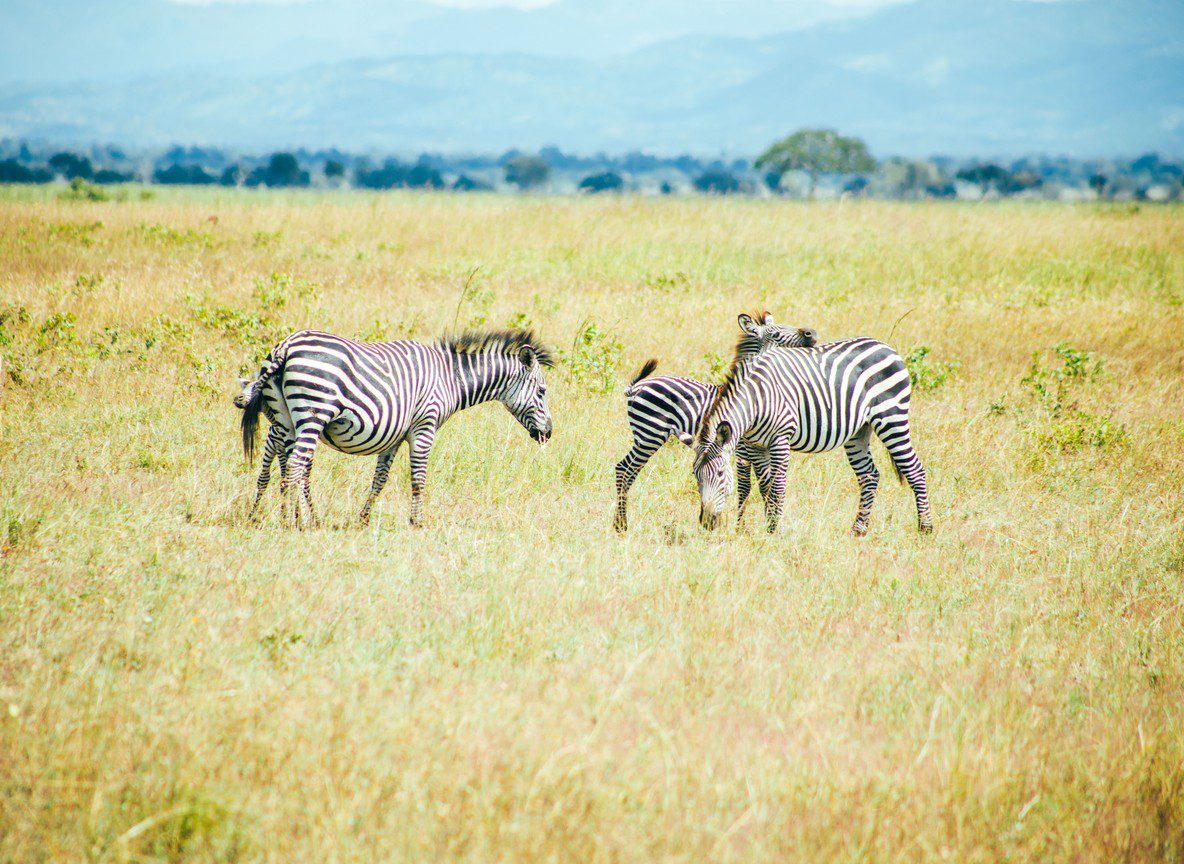
Field identification: Grevy’s zebra are consistently misidentified as plains zebra on first encounter. The differences are clear once you know what to look for:
- Stripes are significantly narrower and more numerous than plains zebra
- The belly is completely white with no stripes (plains zebra stripes continue to the belly)
- Ears are large and rounded, distinctly donkey-like
- Body is larger and more barrel-chested than plains zebra
- Head is larger and more horse-like in shape
- Males weigh up to 450 kg
Grevy’s and plains zebra often occur together in Samburu, which provides excellent direct comparison opportunities. Scan any zebra group in the northern reserve for the belly pattern — it confirms or eliminates Grevy’s immediately.
Where to find them: Most commonly seen in the drier areas north of the Ewaso Nyiro River and in the open scrubland of the Buffalo Springs reserve on the south bank. They concentrate near the river during the dry season but range more widely during rains.
Conservation notes: The Grevy’s Zebra Trust, based near Samburu, runs community-based conservation programmes with local herders to reduce human-wildlife competition for water and grazing. Their work has been central to the population’s stabilisation over the past decade.
Beisa Oryx: Built for Desert Conditions
The beisa oryx is a large antelope that looks like it was designed for display. Both males and females carry long, straight horns — up to 75 cm in length — and both have the same striking black-and-white facial markings against a grey body. Standing against a dry background, an oryx is one of the most visually arresting animals in northern Kenya.
Field identification:
- Large antelope (75 to 140 kg)
- Both sexes: long, straight, parallel horns
- Striking black-and-white facial markings with a broad black stripe from eye to muzzle
- Grey body with black flank stripes
- White undersides
Physiological adaptations to arid conditions: The oryx can allow its body temperature to rise to 45 degrees Celsius without sweating excessively — a mechanism for conserving water that makes it one of the most heat-tolerant large mammals in Africa. You will regularly see beisa oryx standing in full midday sun while other species have retreated to shade. They extract sufficient moisture from food to survive extended periods without drinking.
Where to find them: Common across the open plains and scrubland areas of Samburu and Buffalo Springs. During the dry season, herds gather near the Ewaso Nyiro. They are often visible on the plains between the main tracks in loose groups of five to twenty animals.
Somali Ostrich: A Separate Species That Most People Miss
The Somali ostrich was formally recognised as a distinct species from the common ostrich in 2014, following genetic analysis that confirmed what field observers had suspected for decades. In Samburu, most visitors who see ostriches assume they are looking at common ostriches. They are frequently not.
Field identification: The most reliable field character is the breeding male’s neck and thigh skin colouration:
- Somali ostrich male: Blue-grey neck and thigh skin
- Common ostrich male: Pink-red neck and thigh skin
Female Somali and common ostriches are harder to distinguish without direct comparison. The Somali female’s neck is more grey-brown than the common female’s pinkish-grey, but the difference requires experience to read reliably.
Where to find them: Distributed across the drier habitats of Samburu, Buffalo Springs, and Shaba. Both species can occur in the same area, making the identification exercise particularly interesting for wildlife-focused visitors.
IUCN status: Vulnerable, with the species largely dependent on the semi-arid northeastern African region for the majority of its range.
When to Visit Samburu for the Special Five
| Season | Conditions | Special Five Viewing |
|---|---|---|
| January to February | Dry, hot (up to 38-40C midday) | Excellent: animals concentrate at river |
| March to April | Long rains; some track flooding | Moderate: animals disperse; vegetation heavy |
| May | Cooling; some rain possible | Good; lower rates; fewer visitors |
| June to August | Dry, warm to hot | Excellent: peak visibility; most visitors |
| September to October | Short dry season; increasingly hot | Very good; fewer visitors than August |
| November to December | Short rains possible | Variable: often productive; quieter |
The dry season concentrates wildlife at the Ewaso Nyiro River. All five Special Five species are reliably present year-round, but they are most visible and concentrated in dry season conditions.
Best overall window: January to February for quality without peak-season volume. June to August for the most consistently reliable conditions.
Recommended stay: Three nights minimum. The Special Five require time — gerenuk feeding behaviour, Grevy’s zebra interaction, and Somali ostrich identification all reward patience and multiple encounters.
Comparing the Special Five Hunt: Realistic Expectations
| Species | Typical Sighting Frequency | Patience Required | Identification Difficulty |
|---|---|---|---|
| Gerenuk | Daily in dry season | Low | Easy once you know the shape |
| Reticulated Giraffe | Daily | Very low | Easy by coat pattern |
| Grevy’s Zebra | Most days | Low to moderate | Moderate (compare with plains zebra) |
| Beisa Oryx | Daily in dry season | Very low | Easy by horns and markings |
| Somali Ostrich | Most days | Moderate | Hard without male in full breeding plumage |
For the Somali ostrich in particular, confirming the species identification rather than assuming common ostrich requires either a breeding male in blue-grey plumage or a guide experienced in reading the subtler differences in the female.
Planning Notes
Getting there: Scheduled flights from Wilson Airport, Nairobi to Samburu Oryx or Kalama airstrips take approximately one hour. Road transfer from Nairobi takes five to six hours via Isiolo.
Park fees: Set by Kenya Wildlife Service; check current rates at kws.go.ke. A single entry covers all three reserves: Samburu, Buffalo Springs, and Shaba.
What to bring: Binoculars are more useful in Samburu than in many parks because animals are often spread across open terrain. A field guide covering northern Kenya species is helpful for independent identification. Camera with 200mm+ zoom for wildlife photography.
Combined circuits: The Special Five are the reason wildlife specialists visit Samburu, but the experience combines well with Laikipia’s conservancies (for rhino, wild dog, and a private land experience), Meru National Park (for black and white rhino, and the Tana River ecosystem), or a full northern circuit including Lake Turkana. For circuit planning, the northern Kenya safari guide and the 7-day northern Kenya itinerary on this site cover the options in detail.
Have questions about this itinerary or destination? Get answers from a safari specialist before you commit.
Inquire More