The second-highest mountain in Africa sits almost exactly on the equator, yet its upper slopes hold permanent glaciers. Its forest zone is home to elephant, buffalo, giant forest hog, and bongo antelope. Its moorland holds eland, reedbuck, and serval. Its alpine zone, above 4,000 metres, is a landscape of volcanic rock, giant lobelia, and groundsel that looks like no other place on Earth.
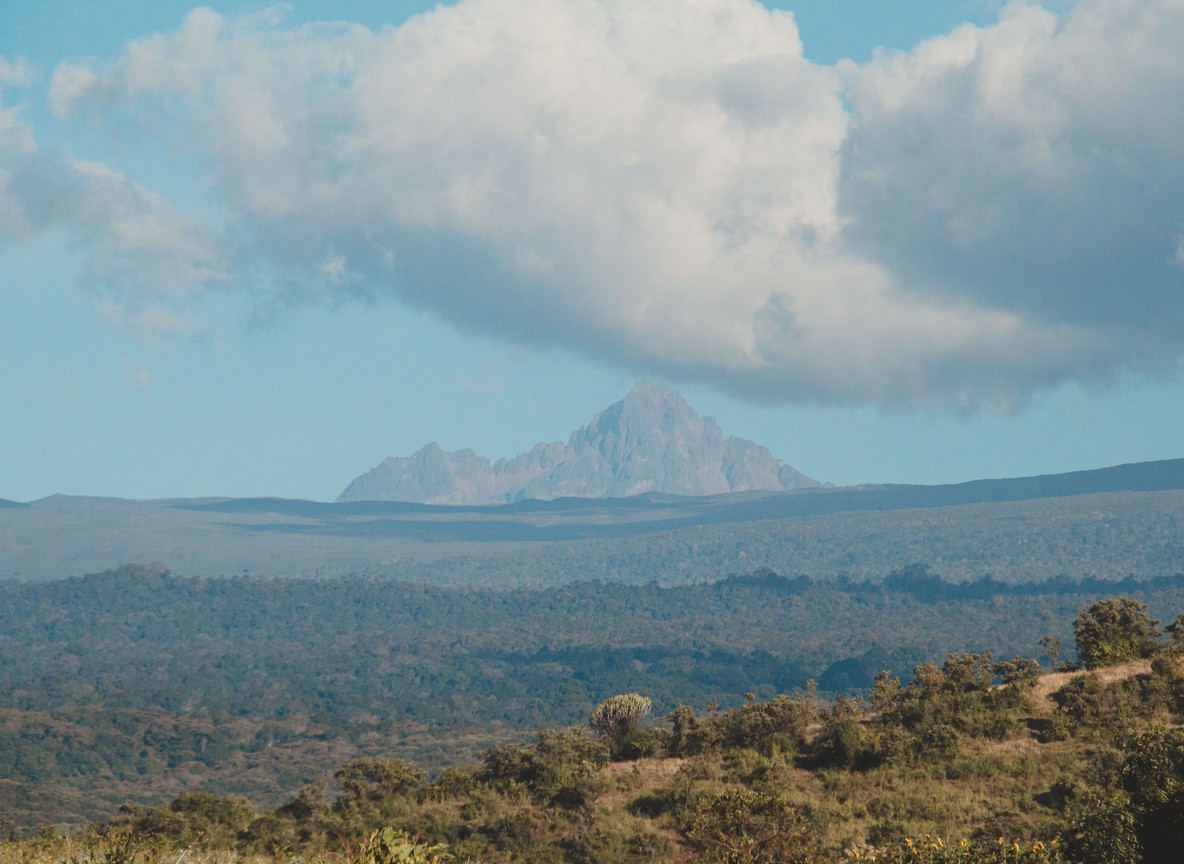
Mount Kenya is not just a trekking objective. It is one of Kenya’s most biodiverse landscapes, and combining a wildlife-rich approach through the lower forest zones with a high-altitude summit attempt produces a genuinely different experience from anything else the country offers.
Why Mount Kenya Is Different From Kilimanjaro
Mount Kenya is a UNESCO World Heritage Site at 5,199 metres (Batian peak). Point Lenana at 4,985 metres is the highest trekking peak, reachable without technical climbing by reasonably fit hikers who allow adequate acclimatisation time.
What distinguishes it from Kilimanjaro:
- More technical: The higher summits (Batian and Nelion) require rock climbing skills. Kilimanjaro is a walk-up; Mount Kenya’s technical peaks require ropes and alpine experience.
- More wildlife: The approach zones pass through dense elephant and buffalo habitat at the forest level. Kilimanjaro’s forest zone is far less wildlife-rich.
- More varied vegetation: The zones shift dramatically over short distances from bamboo to hagenia forest to heather moorland to alpine desert.
- Less crowded: Mount Kenya sees a fraction of Kilimanjaro’s visitor numbers.
- More accessible from Nairobi: Main trailheads are 2.5-3 hours from the city, versus Kilimanjaro’s 6-7 hour minimum journey.
Wildlife at Every Altitude
One of the least-discussed aspects of Mount Kenya is the quality of wildlife through the lower altitude zones. This is not a mountain where you trek through sterile forest before reaching the scenic upper sections.
Forest zone (2,000-3,000 metres):
Elephant encounters are most likely here. The forest around Sirimon Gate and Naro Moru Gate holds substantial herds that move between the mountain forest and the adjacent Laikipia plateau. Buffalo are common at the forest edge. The giant forest hog — Africa’s largest pig species — is frequently seen at dawn and dusk.
The bongo antelope, one of Kenya’s rarest mammals, occurs in the bamboo zone. Sightings are uncommon but documented. The bamboo gullies where feeding signs appear most often are well-known to guides who work this zone regularly.
Heather and moorland zone (3,000-4,200 metres):
Wildlife thins at this altitude but does not disappear:
- Eland in mountain form, sometimes in groups of 20-50
- Common reedbuck
- Serval — more visible on moorland than in dense forest
- Rock hyrax on rocky outcrops near the peaks
- Alpine chat, scarlet-tufted malachite sunbird, and other alpine specialists
Alpine zone (above 4,200 metres):
Very little mammal wildlife above the upper moorland. Ravens, alpine swifts, and the occasional eland in the upper Teleki Valley. The landscape itself becomes the dominant experience.
Trekking Routes and Wildlife Integration
Three main routes lead to Point Lenana. They differ significantly in wildlife potential.
| Route | Trailhead | Duration | Difficulty | Wildlife Potential |
|---|---|---|---|---|
| Sirimon | North (Nanyuki area) | 4-5 days | Moderate | High — best elephant corridor |
| Chogoria | East | 4-5 days | Moderate-Hard | High — forest elephant, spectacular lakes |
| Naro Moru | South | 3-4 days | Moderate-Hard | Moderate |
Best route for combining wildlife and trekking:
The Sirimon Route is the strongest for wildlife integration. The approach through Sirimon Gate passes through productive elephant and buffalo habitat. The route then climbs through moorland with expansive views of the Laikipia plateau below. A Sirimon trek pairs naturally with Ol Pejeta Conservancy as a pre- or post-trek wildlife day.
The Sirimon ascent combined with a Chogoria descent creates a circuit covering Lake Michaelson, the spectacular Gorges Valley, and the full range of altitude zones. Most serious Mount Kenya trekkers consider this the definitive route combination.
A 7-Day Mount Kenya Safari and Trekking Itinerary
This is the itinerary that best integrates Laikipia wildlife with a Point Lenana summit attempt.
Day 1: Nairobi to Nanyuki (3 hours by road). Afternoon game drive at Ol Pejeta Conservancy — rhino, wild dog, chimpanzee. Overnight Nanyuki area lodge.
Day 2: Full day Ol Pejeta Conservancy. Evening gear briefing and preparation at accommodation in Nanyuki.
Day 3: Sirimon Gate (2,650m) to Old Moses Camp (3,300m). Through bamboo and heather. 4-5 hours, 650m ascent. Wildlife alert: elephant and buffalo possible in the forest zone.
Day 4: Old Moses Camp to Shipton’s Camp (4,200m). Across the moorland, through the Mackinder Valley. 6-7 hours, 900m ascent.
Day 5: Rest and acclimatisation at Shipton’s. Afternoon acclimatisation walk to Austrian Hut (4,790m). Glacier views. Early sleep for summit attempt.
Day 6: 2:00 am departure from Shipton’s for Point Lenana (4,985m). Reach summit for sunrise over the African plains. Descend via the Gorges Valley and Lake Michaelson on the Chogoria route.
Day 7: Return to Nairobi or continue to a further safari destination.
The Wildlife Drive Option: No Full Trek Required
For travellers who want Mount Kenya’s wildlife without the full trekking commitment, the lower forest and moorland zones are accessible by 4WD vehicle through the national park gates.
Game drive options:
- Naro Moru Gate to Meteorological Station (3,050m): elephant habitat, forest buffalo, giant forest hog
- Sirimon Gate to Old Moses Camp area by 4WD: best elephant corridor, Laikipia plateau views
A half-day wildlife drive to the 3,000 metre zone and back offers excellent forest wildlife viewing and the dramatic visual contrast of equatorial glaciers above dense tropical forest. Forest elephants feeding at 3,000 metres with glaciated peaks visible above the canopy is one of Kenya’s most unusual and memorable wildlife settings.
This pairs well as a morning experience for travellers staying at Nanyuki-area lodges before or after Laikipia or Samburu safaris.
Altitude, Acclimatisation and Safety
Altitude sickness is the primary risk. Point Lenana at 4,985 metres is high enough to cause serious altitude sickness in unacclimatised trekkers.
The principles that reduce risk:
- Do not ascend too fast. A 4-5 day itinerary is safer than a 3-day sprint.
- “Climb high, sleep low” — ascend for the day, sleep lower.
- Drink 3-4 litres of water per day at altitude.
- Ascend no more than 300-400 metres per day above 3,000 metres.
- Build an acclimatisation rest day at Shipton’s Camp (4,200m) before summit night.
Symptoms requiring immediate descent: Severe headache not relieved by paracetamol, confusion, loss of coordination, persistent vomiting. These indicate serious altitude illness. Descent is the only effective treatment.
A licensed guide carrying supplemental oxygen and a pulse oximeter is part of proper trip organisation on this mountain.
Best Trekking Seasons
| Period | Conditions | Summit Success |
|---|---|---|
| January-February | Dry, cold, excellent visibility | Very high |
| March-May | Long rains — wet, muddy | Lower; some routes difficult |
| June-September | Dry, cold — peak season | Very high |
| October | Short dry, good conditions | High |
| November-December | Short rains, some wet days | Moderate-high |
January-February and July-September are the optimal windows for a summit attempt. The long rains of April-May are the months to avoid.
Combining Mount Kenya With Other Destinations
Mount Kenya’s central position makes it geographically useful for building circuits:
- Ol Pejeta Conservancy (25km from Nanyuki): The most natural immediate pairing. Rhino tracking before or after the trek.
- Samburu National Reserve (4-5 hours north): Northern Kenya wildlife — reticulated giraffe, Grevy’s zebra, Beisa oryx.
- Laikipia Plateau (1-2 hours from Nanyuki): Borana, Lewa, Ol Jogi — high-end conservancy safaris accessible from the mountain base.
- Masai Mara (5-6 hours south): The mountain-plus-migration combination for travellers wanting altitude and wildlife spectacle in one trip.
- Aberdares National Park: In the highlands southwest of Mount Kenya, offering forest wildlife and dramatic moorland scenery.
The mountain does not compete with Kenya’s safari circuit — it adds a dimension that no game drive can replicate. Travellers who combine a Point Lenana summit with three days in the Masai Mara consistently describe the contrast as the defining element of the trip.
Turn this reading into a real itinerary with help from a Kenya-based safari team.
Start Planning Your Safari