The water is the colour of malachite. Stretched across 6,405 square kilometres of semi-desert in Kenya’s far north, Lake Turkana occupies the floor of the Great Rift Valley in a landscape that barely registers on most safari itineraries. Wind-hammered shores. Fossilised beaches where hominid skull fragments still surface after rains. Nile crocodiles that have been growing, largely undisturbed, for decades. And a silence so complete it takes a few hours to settle into.
This is not a comfortable destination in the package-tour sense. That is precisely what makes it worth the effort.
Lake Turkana Kenya is the world’s largest permanent desert lake, the world’s largest alkaline lake, and a UNESCO World Heritage Site embedded in one of Africa’s most intact wilderness corridors. At roughly 700 kilometres north of Nairobi, it sits outside the circuit most Kenya safaris follow, and that distance is exactly what preserves its character.
What Makes Lake Turkana Different
Most Kenya safari circuits orbit a well-worn set of destinations: Masai Mara, Amboseli, Samburu, repeat. Lake Turkana sits outside that circuit entirely.
The lake is fed almost entirely by the Omo River from Ethiopia. Its high sodium and fluoride content turns the surface a vivid jade-green, which gives it the nickname “The Jade Sea.” At sunset the water shifts through teal, bronze, and deep copper. The landscape around it is volcanic desert, some of the most dramatic scenery on the continent.
Four things separate a Lake Turkana safari from any other remote Kenya experience:
Human evolutionary significance. The Koobi Fora region on the eastern shore has produced more early hominid fossils than anywhere else on earth. This is not a heritage footnote. It is the site where our understanding of human origins was repeatedly revised.
Three active volcanoes. South Island, North Island, and Central Island are all volcanic. Central Island simultaneously hosts breeding Nile crocodile populations and flamingo colonies in its crater lakes, a combination that does not exist anywhere else.
Indigenous communities. The Turkana, El Molo, Dassanach, and Gabbra peoples have lived around this lake for thousands of years. Many still do, largely on their own terms.
Absolute remoteness. The infrastructure is minimal, the distances are large, and the rewards are proportionally significant. This is frontier Kenya.
Sibiloi National Park: Kenya’s Cradle of Mankind
On the northeastern shore of the lake, Sibiloi National Park covers 1,570 square kilometres of volcanic desert and is Kenya’s most remote national park. The fossil discoveries made here by Richard Leakey’s team in the late 1960s and onward rewrote the human evolutionary timeline more than once.
The petrified forest at Sibiloi is remarkable before you even get to the fossils. Ancient tree trunks, now stone, lie where they fell in a forest that existed two to three million years ago when this landscape was wet and densely vegetated. Walking among them with a ranger, the scale of geological time becomes something you feel rather than simply understand intellectually.
Wildlife at Sibiloi is distinct from the Mara or Amboseli circuits:
- Grevy’s zebra, classified as endangered, with Sibiloi supporting a significant population
- Reticulated giraffe
- Beisa oryx
- Tiang, a subspecies of topi found only in northern Kenya
- Grant’s gazelle
- Striped hyena
- Nile crocodile, with Central Island hosting an estimated 12,000 individuals, one of Africa’s largest concentrations
The birdlife is exceptional. Carmine bee-eater colonies turn the cliffs pink during nesting season. African fish eagles are common along the shore. Goliath herons, flamingos, and a range of waterbirds that respond to the lake’s algal blooms make Sibiloi a serious birding destination for those who plan it properly.
The Communities of the Lake Shore
Four distinct peoples live on and around Turkana’s shores, and cultural encounters here are among the most genuine available on any Kenya safari, not because they are staged, but because these communities are still navigating the same environments their ancestors did.
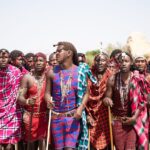
The Turkana are pastoralists who keep camels, goats, and cattle across the dry lands east of the lake. Their beadwork, body scarification, and ceremonial dress are visually striking. Surviving in one of Kenya’s harshest environments for millennia has produced an intimate knowledge of water, weather, and seasonal movement that you begin to appreciate quickly once you are out in that landscape yourself.
The El Molo are Kenya’s smallest ethnic group, numbering fewer than a thousand people and living on the southern shores. They are the lake’s original fishermen, paddling rafts made from doum palm logs and hunting hippo with harpoons in a tradition stretching back centuries. A visit to an El Molo village is a genuinely rare experience, not a performance, but a living community working through the tension between a traditional lake economy and a world that increasingly reaches even this far north.
The Dassanach live on the Ethiopian border at the lake’s northern tip, crossing into Kenya seasonally. Their fishing villages and cattle camps are among the most photogenic in northern Kenya.
The Gabbra are camel-herding nomads of the Chalbi Desert to the east. Encountering a Gabbra camel caravan on the overland route to Turkana is one of those moments that stays with you.
Cultural visits in this region require established community relationships and genuine consent. Showing up at a village without introduction is neither appropriate nor useful. Good guides here work with community contacts built over years.
On visiting well: agreed visit fees are paid directly within the community, reaching guides, boat operators, and the households who host you, so a properly arranged visit is a genuine, direct economic channel rather than a token gesture. Ask before photographing individuals rather than assuming it is welcome, and a small tip, commonly in the range of a few hundred Kenyan shillings, is customary for an individual portrait. If someone declines to be photographed, that is the end of it. This matters more at Lake Turkana than almost anywhere else in Kenya: the El Molo number only in the hundreds, and how visitors conduct themselves has a real, not abstract, effect on a very small community.
Ferguson’s Gulf: The Birding Destination
The western shore at Ferguson’s Gulf is an internationally significant birding site. The shallow, nutrient-rich waters support enormous concentrations of waterbirds year-round.
Consistent highlights include African skimmer breeding colonies on the sandbanks, pied kingfisher in extraordinary numbers, pink-backed pelican, marabou stork, and African open-billed stork. Flamingo numbers fluctuate with algal blooms but large flocks are regular, and a good year at Ferguson’s Gulf can produce concentrations that rival Nakuru at its historical peaks. For serious birders, this western shore sector justifies the journey entirely on its own terms.
Central Island National Park
Central Island rises from the lake three kilometres offshore as three volcanic craters, each containing its own salt lake. It is one of the more unusual places in Kenya and not widely visited.
The largest crater lake hosts a Nile crocodile population that is unmatched anywhere on earth by concentration. During breeding season (February to March), crocodiles come ashore in numbers that make walking the island a genuinely surreal experience. Many individuals here exceed five metres. The combination of undisturbed habitat and a population that has not been hunted for generations has produced crocodiles that are simply larger than what you see almost anywhere else.
Access is by boat from Loyangalani or Ferguson’s Gulf. The crossing takes 30 to 45 minutes in calm conditions. Afternoon winds on Turkana build to dangerous speeds quickly and with little warning. Schedule Central Island for morning, finish before noon, and do not let enthusiasm for the site override weather judgment.
Koobi Fora: Walking With Our Ancestors
On the eastern shore, the Koobi Fora spit is the scientific heart of the Lake Turkana basin. Since the late 1960s, more than 10,000 vertebrate fossils have been recovered from this stretch of reddish-brown earth, including skull fragments, teeth, and limb bones from multiple early hominid species.
Key discoveries from Koobi Fora include:
- KNM-ER 1470, a 1.9-million-year-old skull that became one of the most debated fossils in paleoanthropology when Leakey’s team recovered it in 1972
- KNM-ER 1813, a complete Homo habilis skull
- Multiple Paranthropus boisei specimens in exceptional preservation
The site has a small but well-curated museum managed in partnership with the National Museums of Kenya. A guided tour with a qualified interpreter turns what might look like scattered rock fragments into one of the most intellectually powerful experiences available on any Africa safari. If you have an interest in human origins, Koobi Fora is not optional.
Best Time to Visit Lake Turkana
| Month | Conditions | Notes |
|---|---|---|
| January to February | Hot, dry, windy | Clear visibility, Central Island crocodile breeding season |
| March to April | Short rains possible | Some tracks impassable if rains are heavy |
| May | Cool, some rain | Good for overland; landscape briefly green |
| June to August | Dry, windy | Most consistent for fly-in travellers, excellent birdlife |
| September to October | Hot, dry | Peak conditions for fossil hunting, good road access |
| November to December | Short rains | Road conditions unpredictable, fewer visitors |
The lake experience shifts significantly with the season. The cool season (June to August) is the most consistently comfortable for overland travellers. The dry season (January to February and September to October) brings the clearest views and best road conditions for those driving north from Samburu.
One practical note that any guide will tell you: plan all activities for early morning. The afternoon winds, known locally as the Lake Turkana breeze, regularly gust to 80 kilometres per hour from mid-morning onward. This affects boat crossings, photography, and general comfort. Early morning on the lake is a different world.
How to Get There
The access question stops most people. The options are meaningfully different in cost, time, and character.
By air: Fly from Nairobi Wilson Airport to Loyangalani airstrip via Samburu, by scheduled or charter flight. Journey time is approximately 2.5 to 3 hours. This approach delivers you directly to the southern shore, avoiding two days of road travel each way. Expensive but efficient, and the right choice for travellers who want maximum time at the lake rather than on the road.
Overland via Samburu: Drive north from Samburu through Archer’s Post, Wamba, Marsabit, and across the Chalbi Desert to reach the lake’s eastern or southern shore. This is 4WD-mandatory territory. The route passes through Marsabit National Park, a forest-topped volcanic mountain rising improbably from the desert with forest elephants and crater lake views, and crosses volcanic terrain that looks like no other landscape in Kenya. Allow three to four days each way.
Combined fly-in and overland: Fly in to Loyangalani, spend three to four days exploring the lake, then drive south via Marsabit and Samburu on the return. This is the format that works best for travellers who want the full northern Kenya experience without the brutal double overland. You arrive fresh and leave with the road journey as a final experience rather than a prelude.
For detailed route logistics, the 7-day northern Kenya safari itinerary covers the fly-in and drive-out format specifically.
Where to Stay
The accommodation options at Lake Turkana are limited by design and by distance. That limitation is part of the experience.
Oasis Lodge, Loyangalani is the southern shore’s most established camp, with tented accommodation, a small pool that is genuinely useful given the heat, and boat access to Central Island. Simple, comfortable, and well-positioned.
Koobi Fora Research Station on the eastern shore offers basic research accommodation bookable through the National Museums of Kenya. Not luxury by any measure, but the location is extraordinary and the proximity to the fossil sites is unmatched.
Mobile camping is the most immersive option for overland groups and adventurous fly-in travellers. A full mobile tented camp set up at locations no fixed lodge can reach gives access to terrain, communities, and wildlife at a different level entirely.
For a breakdown of what to budget at each tier, the northern Kenya safari cost guide covers the full range from mobile camping to fly-in packages.
Combining Turkana with the Northern Kenya Circuit
The natural circuit in northern Kenya connects Turkana with several destinations that reward the traveller who makes the effort to get this far north.
Samburu National Reserve is the most common starting point. Samburu’s Special Five species, including the reticulated giraffe, Grevy’s zebra, and the Somali ostrich, set the ecological tone before the landscape shifts into true desert further north.
Shaba National Reserve, east of Samburu, is where Joy Adamson wrote Born Free and the terrain is strikingly different from Samburu’s riverine forest. Less visited and arguably more atmospheric.
Marsabit National Park, on the overland route north, is one of Kenya’s hidden destinations: a forest ecosystem on a volcanic mountain rising from the desert, with forest elephants and a stunning crater lake.
Reteti Elephant Sanctuary, the first community-owned elephant sanctuary in Africa, run by the Samburu people, offers a genuinely affecting visit for travellers interested in conservation that is rooted in local community leadership.
The Samburu National Reserve guide covers the practical starting point for this northern circuit.
What Kind of Traveller This Is For
Lake Turkana rewards travellers who are comfortable with remoteness, genuinely curious about human history and ecological science, and willing to accept that some of the most powerful experiences on this planet do not come with smooth logistics.
If your Mara or Amboseli safari felt slightly too managed, too scheduled, too easy, this is the direction to go next. The northern Kenya circuit, with Turkana at its far end, is where the Africa that most travellers imagine actually exists: frontier, strange, and completely worth the distance.
For a broader overview of the northern Kenya circuit planning, the northern Kenya safari guide covers the full range of parks, conservancies, and route options available.
Have questions about this itinerary or destination? Get answers from a safari specialist before you commit.
Inquire MoreFurther reading
More safari planning resources
- Map of Samburu from Valley Safaris
- Samburu destination guide on FindMySafari
- Best time to visit Kenya month-by-month map from Valley Safaris
- Kenya national parks map from Valley Safaris