
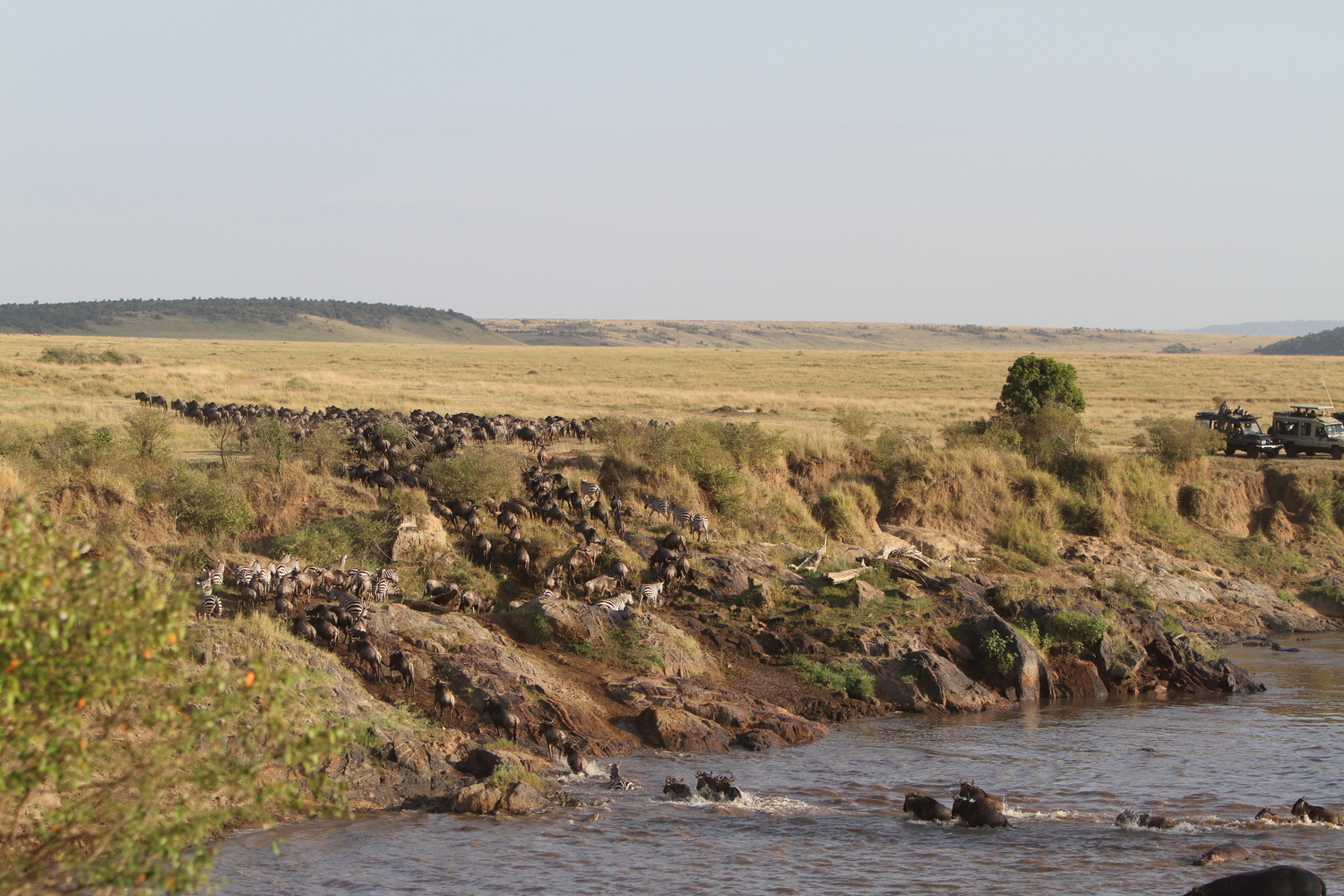
Each year, roughly two million wildebeest, zebra, and gazelle trace a vast clockwise circuit across East Africa. They follow the rains. They follow the grass. And for a few months each year, that circuit brings them north into Kenya’s Masai Mara, where the Mara River stands between them and the next stretch of grazing.
The Great Migration in Masai Mara is not a scheduled event. No one sounds a bell. But the patterns have held for millennia, and they are well-documented enough that planning a visit around them is entirely realistic. This guide covers what drives the migration, when and where to see it in the Mara, and what you need to arrange before you go.
The Migration Cycle: What Drives It and Where It Starts
The migration is a year-round phenomenon, not a single dramatic moment. The herds are always moving, always seeking fresh grazing across the greater Serengeti ecosystem, which spans northern Tanzania and southern Kenya.
The annual cycle runs roughly as follows. Calving season plays out from January through March on Tanzania’s southern Serengeti plains, where nutrient-rich grasses give newborns the best possible start. By April and May, the herds have moved northwest through the central Serengeti. June and early July bring them to the northern edge, pushing toward the Kenyan border.
What drives this movement is not instinct alone. It is grass. Wildebeest track the leading edge of seasonal rainfall, always seeking younger growth with higher protein content. The circuit repeats because the ecosystem is large enough to sustain it.
When the herds cross into the Masai Mara from July onward, the journey reaches its most compressed and dramatic stage. The Mara River acts as a barrier that concentrates the animals, forces decisions, and produces the crossing events that wildlife photographers travel across the world to witness.
Why the Masai Mara Sits at the Heart of the Migration
The Masai Mara National Reserve covers 1,510 square kilometers of open rolling grassland, acacia-dotted savannah, and riverine forest along the Mara River corridor. It shares an unfenced boundary with the Serengeti, which is why the herds move freely between the two countries without obstruction.
The Mara’s year-round resident wildlife is already exceptional before the migration arrives. Lion prides here are among the most studied and most visible in Africa. Cheetahs use the open plains to hunt in daylight. Leopards frequent the fig trees and dense thickets along the river. The reserve carries a genuine claim to some of the highest predator density on the continent.
Birdlife adds a separate layer. More than 450 species have been recorded in the Mara, including martial eagles, secretary birds, and a range of waterbirds concentrated along the river. A morning dedicated specifically to birding is well worth building into any itinerary.
When the migration arrives in July, the reserve shifts into a different register entirely. Predator activity intensifies sharply. Nile crocodiles, which have waited through the drier months with apparent patience, position themselves at established crossing points on the Mara River and wait for exactly this abundance.
The Great Migration in Masai Mara: Month by Month
The herds do not follow a fixed calendar, but patterns across decades of observation are reliable enough to plan around.
July
The first herds typically cross into the Mara in early July, though the precise timing shifts by a few weeks depending on how the Serengeti rains fell earlier in the season. Early July often brings smaller groups probing the river banks before committing to a crossing. By mid-July, the numbers build noticeably. Crossings become more frequent and larger. This month rewards early arrivals who want the buildup period before August visitor numbers peak.
August
August is peak migration season in the Mara. The bulk of the two million-plus animals concentrate in and around the reserve. River crossings happen daily, sometimes multiple times per day at different points along the Mara River. Most wildlife guides cite late July through August as the single best window for crossing frequency, and accommodation prices and occupancy rates reflect that demand. Book well in advance for these dates.
September
The herds remain abundant through September, though numbers begin thinning toward month’s end as animals drift back south toward the Serengeti. Crossings continue, often with comparable intensity to August but with slightly fewer repeat events per day. Predator sightings stay strong. Visitor numbers begin to ease, which can noticeably improve the experience at crossing sites.
October
By October, most of the herds have moved south. Stragglers remain, and predator activity stays elevated as lions and cheetahs work the more dispersed prey concentrations. October visitors get a quieter reserve, reliable big cat sightings, and the occasional crossing. It is the right choice for travelers who prioritize space and access over peak migration volume.
The Mara River Crossings
The crossing events are what most migration visitors come specifically to witness, and they are earned through patience.
Wildebeest are cautious animals despite their collective reputation for chaos. A herd will gather at a crossing point, sometimes for hours, before a single animal commits to the water. That decision triggers a cascade. Hundreds, sometimes thousands, enter within minutes.
The Mara River is not forgiving. The banks are steep and crumbling. The current runs strong during the wet months. Nile crocodiles, some of them very large, have learned the crossing points over years and position themselves accordingly. They know the timing as well as any seasoned guide.
Calves struggle in the surge. Some are separated from their mothers. Others do not survive the crocodiles. Those that reach the far bank face a different hazard immediately: lions and hyenas patrol the exit points and capitalize on animals that are exhausted from the crossing.
Finding a crossing requires positioning at one of the established crossing points and waiting. Crossings cannot be predicted to the hour. Some days bring three events. Other days bring none. That uncertainty is part of what makes witnessing one feel earned rather than delivered.
What Else the Mara Offers
The migration is the headline, but the Masai Mara operates as a world-class wildlife destination across the full year.
The resident lion population is one of the most stable and well-documented in Africa. Several prides have been continuously studied for decades. Cheetah sightings on the open plains are more consistent here than almost anywhere else in East Africa. Leopards are present but require patience and a guide who knows where to look in the riverine vegetation.
The Big Five are all resident in the Mara: lion, leopard, elephant, buffalo, and black rhino. Rhino sightings are less predictable than the others, but visitors who spend multiple days and communicate their interest to guides tend to have reasonable odds.
The Maasai people have coexisted with the wildlife of this landscape for centuries. Several communities adjacent to the reserve welcome visitors to learn about traditional herding practices, craftsmanship, and a land relationship that has shaped the ecosystem alongside the wildlife itself.
How to Plan Your Visit
Getting There
Most international travelers arrive into Jomo Kenyatta International Airport in Nairobi. From Nairobi, the Masai Mara is a five-to-six-hour road journey through the Great Rift Valley, or roughly 45 minutes by domestic flight to one of several airstrips within or adjacent to the reserve. The flight option is worth considering for itineraries where time is limited.
Booking Lead Time
July and August accommodation fills early, particularly at camps positioned near the main crossing points. Planning three to six months ahead for peak-season dates is not excessive. For September and October, two to three months is generally sufficient.
What to Pack
Neutral-colored, lightweight clothing suits most game drive conditions. Mornings on the Mara are cold from an open roof hatch, even in July and August, so a fleece or light insulated layer is worth including regardless of the season. Binoculars improve every drive. A long lens is useful at crossing sites, where vehicles maintain a respectful distance from the river action.
Health Preparation
Malaria is present in the Mara ecosystem throughout the year. Consult a travel medicine clinic for current prophylaxis recommendations before departure. Yellow fever vaccination documentation may be required depending on your country of origin. Check current entry requirements with Kenya’s Directorate of Immigration or the nearest Kenyan embassy before finalizing travel arrangements.
Explorer Notes
A few practical points that tend to improve a migration visit.
Migration timing shifts year to year. Weather variation, upstream grass conditions, and overall herd density all influence when crossings happen and how frequently. Building flexibility into your itinerary, specifically the ability to spend more days in the field if conditions align, improves your odds meaningfully.
Crossing points are not secrets. The most productive sites attract multiple vehicles during August peak season. If crowd density at a crossing concerns you, September and October offer comparable wildlife intensity with noticeably fewer observers.
Guide quality matters more at crossing sites than almost anywhere else in the reserve. A guide who reads animal behavior can position a vehicle ahead of where the herd is moving, not behind where it already crossed. When choosing a camp or booking a drive, ask specifically about experience with migration tracking and crossing point knowledge.
The Mara does not guarantee a schedule. Some visitors witness three crossings in a single day. Others watch the river for four full days and see one. Both outcomes are real. The reserve holds significant wildlife value regardless of whether a crossing occurs on any given morning.
Planning Around What You Know
The Great Migration in Masai Mara remains one of the most reliably spectacular wildlife events on the planet. The scale of the herds, the pressure of the Mara River, and the concentration of resident predators create a set of conditions that does not replicate itself anywhere else at the same intensity.
The planning variables are straightforward: visit between July and October, prioritize late July through August for crossing frequency, book accommodation several months ahead, and give yourself more days in the field than you think you need. For current entry requirements, visa information, and travel advisories, the Kenya Tourism Board’s official Magical Kenya portal is the most current source.
Have questions about this itinerary or destination? Get answers from a safari specialist before you commit.
Inquire More


[…] Masai Mara National Reserve is stunning year-round, but each season delivers something different. The Great Migration dominates July and August. The green season brings lush landscapes and fewer crowds. The shoulder […]
[…] The Masai Mara and its broader Kenya ecosystem offer two distinctly different architecture philosophies for safari accommodation: elevated tree house-style lodges and structures built into the tree canopy or rocky outcrops, and traditional ground-level canvas tented camps positioned directly on the savannah or riverbank. […]
[…] from Nairobi to the Masai Mara overland involves a choice that affects your budget, comfort, and the flexibility of your entire […]
[…] the very narrow window of July and August for a Kenya safari. This window aligns precisely with the Masai Mara’s Great Migration peak: wildebeest river crossings, maximum predator activity, and the best possible conditions for a […]