Northern Kenya is one of the most photographically rewarding safari environments in Africa, and one of the least discussed in dedicated photography travel writing. The combination of arid landscape texture, open sky, distinctive endemic species, and relatively low vehicle traffic creates conditions that are hard to replicate in the more visited southern circuits. But the results you get here depend significantly on timing, positioning, and field discipline, more than in most other safari destinations, because the distances are larger, the terrain is less uniform, and the light does particular things in this landscape that require planning to use well.
This guide covers the practical side of photography in Northern Kenya: when the light does what you want, which locations reward which approaches, how to organize gear in a dusty remote environment, and how to work with your guide to put yourself in a better position for the images that matter.
Why Northern Kenya Rewards Photography
The case for Northern Kenya as a photography destination begins with what the landscape does to light. At this latitude, close to the equator, sunrise and sunset move fast. The golden hour is real but compressed: you get perhaps forty-five minutes of directional, low-contrast light before the sun rises too high or sets fully. That compression forces discipline. Photographers who know exactly where they want to be and why tend to use this window far more effectively than those who are still deciding when the light begins.
The arid terrain adds to the visual vocabulary in ways that more lush safari environments do not. The commiphora scrub, the dry luggas, the termite mounds, and the red laterite soil of Samburu County all hold warm color and strong texture. The open sky above the scrubland provides a clean background that allows subjects to be placed against horizon lines or negative space rather than competing with complex green vegetation. The visual grammar of Northern Kenya is architectural: clear shapes, strong edges, and a color palette that moves from ochre and sienna in the dry season to pale jade green after rain.
The endemic species are the other major argument. Reticulated giraffe, Grevy’s zebra, Beisa oryx, gerenuk, and Somali ostrich are all visually distinctive in ways that the more widely-photographed southern species are not. A reticulated giraffe standing against a burnt-ochre Samburu hillside is a different image from a Masai giraffe anywhere in southern Kenya. Grevy’s zebra, with their narrow stripes and larger ears, produce a different pattern composition in the frame. The gerenuk feeding on its hind legs is a behavior that has almost no visual equivalent in safari wildlife photography anywhere.
Low vehicle traffic matters more than photographers sometimes acknowledge when planning trips. Empty backgrounds, undisturbed animals, and the ability to hold position at a sighting without managing competition from other vehicles all improve output quality significantly. In Namunyak, in Sera, and in the community conservancy buffer zones around Samburu National Reserve, the vehicle-density problem that affects Maasai Mara game drive photography simply does not exist.
Light Windows: When to Be in Position
The two daily light windows in Northern Kenya are the same as everywhere in the tropics but with regional characteristics worth knowing.
The morning window opens at first light, typically around six to six-fifteen. In the dry months, the air is clear and the light is directional and warm from the moment the sun clears the horizon. On the scrubland, that directional light creates strong side-shadows that give texture and depth to animal subjects. This is the time to be at a known activity zone, not in transit between them.
The best morning photography window in dry season Northern Kenya typically runs from about six-fifteen to eight-thirty. After that, the sun rises high enough that shadows shorten and the light flattens into the high-contrast midday quality that makes wildlife photography technically challenging. Subjects become washed out in highlights or blocked in shadow, depending on angle, and the results in post-processing reflect this.
The late afternoon window opens from around three-thirty to four and runs until the sun sets, typically around six to six-fifteen depending on season. This window has a different quality than the morning. The afternoon light in Northern Kenya, particularly in the dry months when dust is present in the atmosphere, takes on a warm amber quality that differs from the cleaner light of the morning. The color temperature shifts noticeably in the last forty-five minutes before sunset, and the dust scattering adds depth to sky tones that can produce strong background gradients.
The directional quality of the afternoon light works differently depending on which way you are facing. Late afternoon facing east gives backlit subjects with strong rim light. Facing west gives front-lit animals against a sky that is already beginning to color. Both have value and use cases; the key is knowing which direction your subject is likely to be in before you position the vehicle, not after.
Midday hours between about nine-thirty and three-thirty are better used for transit between locations, camp rest, equipment maintenance, file review, and gear checking. Forcing productive photography sessions into midday light in this latitude is an exercise in frustration.
Locations: Where to Point Your Camera
The Ewaso Nyiro River in Samburu National Reserve
The river corridor through Samburu is the most consistent photography location in Northern Kenya. Crocodiles position themselves on sandbanks in ways that allow clean low-angle shots from vehicle height. Elephants bathe and drink at predictable morning times. The riverine trees along the banks provide green foreground framing against the dry country behind. And the water itself, as a reflective surface, opens compositional options that the open scrubland does not.
The risk of the river corridor is that it is also the highest-traffic zone in the reserve. Other vehicles are more likely here than anywhere else in the Samburu ecosystem. The strategy is to be at the best river positions during the first morning light, when other vehicles have not yet moved, and to shift to less-visited zones by eight-thirty when vehicle accumulation begins.
Open Scrubland for Grevy’s Zebra and Oryx
The open scrub zones of Samburu and the adjacent conservancy areas are where Grevy’s zebra and Beisa oryx move most freely and allow the closest approach. These species are not shy, and a patient vehicle with a quiet guide can hold position close enough for the focal lengths that bring out the pattern detail in zebra stripes or oryx horns without distortion from extreme telephoto compression.
For Grevy’s zebra photography specifically, the early morning in dry season is optimal. The low light from the east throws the stripe pattern into high contrast, the animals are active rather than resting, and the background scrub colors are in their warmest register. Position the vehicle so the light is at your back or at a slight angle to the side; front-lit zebra lose the three-dimensional quality that makes them visually compelling.
The Mathews Range Foothills and Forest Zones
The forest zones at higher elevation around the Mathews Range are a different photographic environment from the open scrubland, and require a different approach. Compressed telephoto focal lengths are less useful here; the vegetation is too dense for long views. Wide to mid focal lengths that show the environment around the subject, the shaft of light through forest canopy, the elephant moving through undergrowth, the leopard on a branch with the mountain behind, work better.
The forest light is filtered and often softer than the open country light, which means the harsh contrast problems of midday shooting are less severe. But the low light levels under the canopy require higher ISO settings and larger apertures. Photographers with lenses that are optically strong at wide apertures will do better here than those relying on smaller-aperture long telephotos.
Lake Turkana and the Jade Sea
Lake Turkana presents a different photographic proposition entirely. The color of the lake, which shifts between teal, jade, and blue depending on time of day and weather, is immediately distinctive. The surrounding terrain is volcanic, with black lava flows, red tuff formations, and the occasional pale alkaline flat creating a landscape that is unlike anything in the rest of Kenya.
Wildlife photography at Lake Turkana focuses on Nile crocodile, hippo at the south island, and flamingo at the appropriate seasonal period. But the landscape photography potential here may be stronger than the wildlife photography potential, and travelers who extend into the Turkana area purely for documentary wildlife images may find it underwhelming if they do not also commit time to the landscape and the geological context.
Reteti and Conservation-Context Photography
The Reteti Elephant Sanctuary, within the Namunyak community conservancy network, provides a specific photography context that operates outside normal safari rules. Photography with the elephant calves during morning feeding is structured and controlled by the sanctuary, and the usual safari conventions about not approaching too close do not apply in the same way when the animals are being fed and managed by their keepers.
The images possible at Reteti, keeper-calf interaction, calves jostling at the feeding station, small elephants resting in the shade with their handlers, are conservation-documentary images rather than pure wildlife images. They tell a different story and have value in a different context. Building a dedicated two-to-three hour morning session at Reteti into your photography itinerary, rather than treating it as a brief stop, allows enough time for the scenarios that make strong images to develop naturally.
Camera Kit and Gear Workflow
Northern Kenya’s dust is the most important environmental factor for camera equipment. Every road transfer in the dry season generates dust, and a morning game drive on a dirt track can coat everything in red laterite powder. Dust infiltrates sealed bodies and lenses more easily than most photographers expect.
A practical dust-management workflow: clean everything at the end of each drive, not the end of each day. Use a blower before wiping, as wiping dust without blowing first scratches coated glass surfaces. Carry dust-proof bags for each body and lens that are not being actively used in the vehicle. When changing lenses, turn away from the direction of travel and use your body as a wind shield. Avoid lens changes on the vehicle if you can manage with a two-body setup.
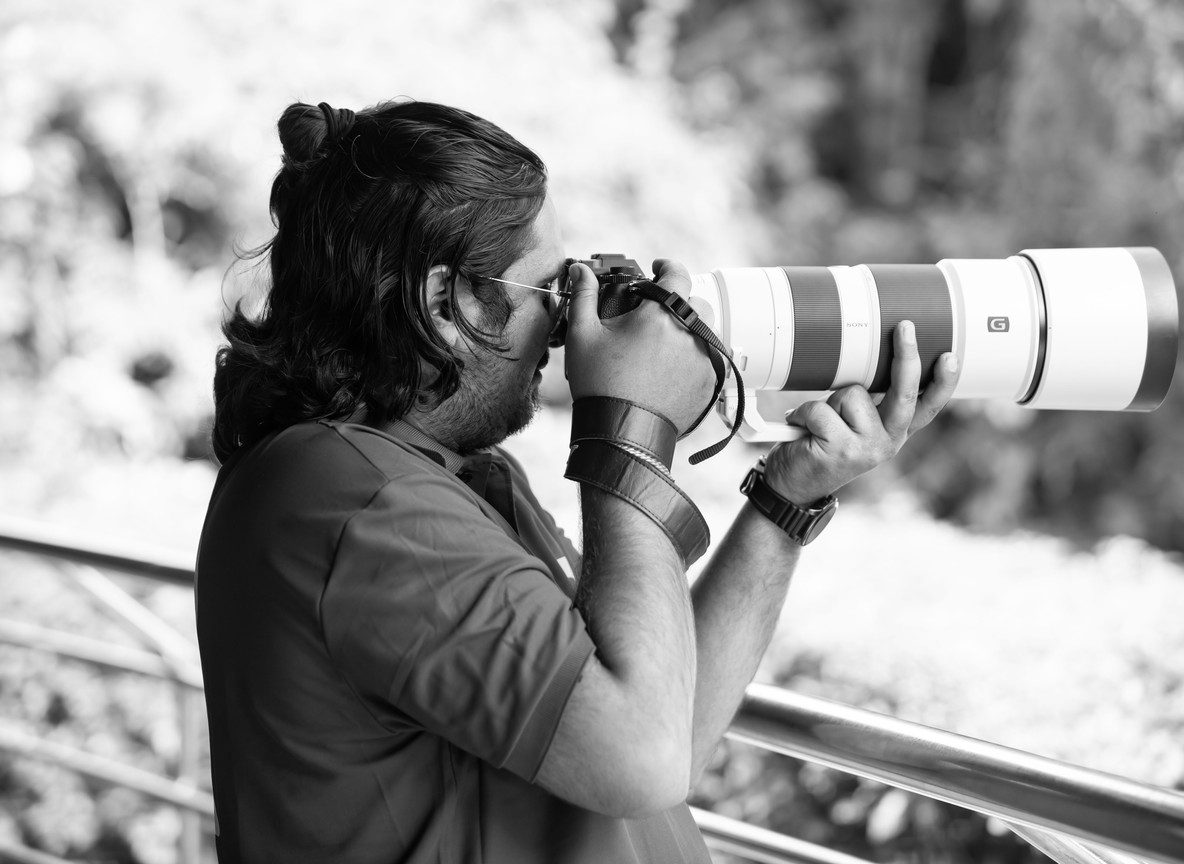
For the actual kit, the most versatile combination for Northern Kenya is a 400mm or 500mm telephoto for wildlife close work, combined with a 100-400mm zoom that covers the transition between mid-range environmental shots and telephoto compression. Wide angle, whether a 24-70mm or 16-35mm, adds landscape and environmental portrait capability.
A second camera body loaded with the wide angle permanently is more useful than a single body with lens changes in a dusty moving vehicle. This is the primary argument for the two-body approach: it is not about having a backup. It is about keeping a wide ready at all times without the dust risk of a lens change.
Battery management in Northern Kenya deserves attention because many camps have limited charging times or charging windows. Camp vehicles sometimes have USB or 12V charging capability, but confirm this before departure rather than assuming. Carrying at least four batteries per body, fully charged before each day, is a reasonable baseline. Cold mornings and high-altitude shooting both drain batteries faster than warm lowland conditions.
High-capacity fast memory cards, with immediate nightly transfer to a laptop or portable SSD backup, remove the anxiety of losing material to card failure in a remote location. Back up to two separate drives at minimum every night.
Vehicle Positioning and the Guide Relationship
The single most impactful variable in safari wildlife photography is not the camera or the lens. It is the positioning of the vehicle relative to the subject and the light, and that positioning depends almost entirely on how well you have communicated your priorities to your guide.
Most safari guides are taught to position vehicles for viewing, which means getting as close as possible and giving guests a clear sightline to the animal. Viewing positioning is not always photography positioning. A vehicle parked directly broadside to a subject gives a clean viewing angle but flat front-lighting if the sun is at the viewer’s back. A vehicle angled slightly, so the subject is at a forty-five degree position relative to the light direction, gives much better three-dimensional quality in the final image.
Before the first morning drive, explain to your guide that you want to work with the light direction rather than just the animal. Describe what you mean: that you want the light coming from the side or slightly behind the subject, not directly behind you as the photographer. Show examples on your phone if the concept is unfamiliar. Guides who understand this instruction consistently put their vehicles in better positions, and the improvement in output across a trip is significant.
The other positioning conversation is about background. A clean horizon or a textured but uncluttered background behind a subject gives images that are more readable and stronger compositionally than subjects embedded in busy vegetation. Ask your guide to notice when the vehicle angle gives a clean background versus a cluttered one, and to prefer the cleaner option when there is a choice.
Be patient at productive positions. The instinct to keep moving to find new subjects is strong, but many of the best wildlife photographs come from waiting at a position where interesting behavior is developing rather than constantly seeking new encounters. A drinking elephant that has been at the water for five minutes is likely to be there for ten more minutes. Stay with it.
Output Goals and Field Discipline
Set a realistic target structure for each day: three to five strong hero images, a set of environmental frames that show the landscape and context, one or two behavior sequences if opportunity allows, and transitions. Trying to cover all species and all landscape types in each drive session produces undisciplined image collections that are hard to edit.
Review the previous day’s take each midday. This is not about culling aggressively in the field but about identifying what worked and what did not so that the afternoon and next morning drives can address the gaps. If you captured strong hero images of reticulated giraffe but nothing that shows the Mathews Range landscape, you know where to direct attention next.
The behavior moments that produce the most memorable frames in Northern Kenya include: gerenuk feeding upright against a shrub, Grevy’s zebra dust-bathing or sparring in the early morning, elephants at a river crossing or water hole, a secretary bird walking through open grass hunting, and Samburu women in traditional beadwork at a manyatta. None of these are predictable on a schedule. But knowing that these are your target scenarios keeps attention focused in the right direction when the opportunity presents.
Where to Go Next
For the practical side of planning a Northern Kenya photography route, including conservancy access logistics and guide quality notes, trunktrailssafaris.com covers current itinerary options and fly-in logistics for the photography-priority traveler.
Related reading on Tourinsights: the Namunyak Conservancy Safari Guide goes deeper on Mathews Range access and Reteti timing, and the Northern Kenya Conservancy Comparison helps identify which conservancies give the best vehicle-exclusivity and positioning conditions for photography-focused visits.
Have questions about this itinerary or destination? Get answers from a safari specialist before you commit.
Inquire More