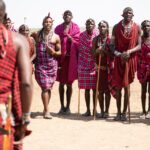
Say “Sopa” to a Maasai elder and something immediate happens. The eyes open, the face changes, and there is a small moment of genuine surprise followed by warmth. You made the effort to learn one word of their language. In Maasai culture, that counts for a great deal.
The Maasai speak Maa – also written as Ol Maa – a Nilotic language that is the linguistic heart of Maasai identity. Approximately 1.5 million people speak Maa across Kenya and Tanzania, and the language predates both nations by several centuries.
This guide explains where Maa comes from, how it works, the essential words any visitor should know, and why language matters so deeply to the Maasai sense of who they are.
The Maa Language: Origins and Classification
Maa belongs to the Nilotic language family, a group of languages spoken across East Africa and the Nile Valley. Nilotic languages are related to each other but distinct from Bantu languages like Swahili and Cushitic languages like Oromo or Somali.
The Maasai are believed to have migrated southward from the lower Nile Valley – modern South Sudan and the Ethiopia-Sudan border region – between the 15th and 17th centuries. They brought the Maa language with them, and it has remained remarkably consistent in structure as the Maasai spread across a vast geographic area.
Who Else Speaks Maa?
Maa is not exclusive to the Maasai. Several related communities speak mutually intelligible forms of the language:
- Samburu – closely related to Maasai Maa, often described as a dialect rather than a separate language. A Samburu speaker and a Maasai speaker from opposite ends of the Rift Valley can usually communicate directly.
- Chamus (Il Chamus) – a small Maa-speaking community around Lake Baringo in northern Kenya
- Ongamo-Maa – a broader language cluster that includes several extinct or near-extinct related languages
This family of speakers explains a surprising feature of northern Kenya safaris: a Samburu guide and a Maasai visitor from the Mara will often find common linguistic ground without any shared formal education.
How the Maa Language Works
Maa is a tonal language – the pitch at which you say a word changes its meaning. This makes it significantly more complex for non-native speakers than Swahili, which is largely non-tonal.
Key linguistic features:
- Tonal: Two or three tones distinguish word meanings. Getting the tone wrong produces a different word, not a garbled version of the right one.
- Gender system: Maa assigns grammatical gender to all nouns, with corresponding verb and adjective agreements.
- Agglutinative: Words are built by stacking meaningful units together, allowing very precise and nuanced expression in relatively few words.
- Oral tradition: The language has been maintained almost entirely through oral transmission. Written Maa is a relatively recent development, created initially for missionary and educational purposes.
The words most commonly used in cultural contexts carry layers of meaning that simple translation often flattens. When a Maasai elder says a particular phrase in a ceremony, the literal translation and the cultural weight behind it are very different things.
Essential Maa Words and Phrases
If you are visiting a Maasai village or meeting community members on safari, these words will serve you well:
Greetings
| Maa Word/Phrase | Meaning |
|---|---|
| Sopa | Hello (said by a younger person to an elder) |
| Takwenya | Hello / Good day (respectful greeting for elders) |
| Iko | I am well (response to “Sopa”) |
| Ashe | Thank you |
| Ashe oleng | Thank you very much |
| Suwa? | May I? / Is it okay? (useful before taking photographs) |
Key Cultural Terms
| Maa Word | Meaning |
|---|---|
| Enkai | God (the Maasai god) |
| Moran | Warrior (young man in the warrior age grade) |
| Manyatta | Warrior camp / commonly used for village |
| Enkaji | House (singular; plural: inkajijik) |
| Enkiama | The thorn-branch fence around a homestead |
| Enkare | Water |
| Inkishu | Cattle |
| Shuka | The cloth worn by Maasai |
| Laibon | Spiritual leader / diviner |
| Il-Murran | Warriors as a group |
| Eunoto | Ceremony marking the end of the warrior phase |
Numbers in Maa
| Maa | Number |
|---|---|
| Nabo | One |
| Are | Two |
| Uni | Three |
| Onguan | Four |
| Imiet | Five |
| Ile | Six |
| Sapa | Seven |
| Isiet | Eight |
| Naudo | Nine |
| Tomon | Ten |
Why Language Matters to Maasai Identity
The Maa language is not just a communication tool – it is the carrier of culture, history, philosophy, and identity. The oral tradition encoded in Maa includes:
- Proverbs that summarize generations of accumulated wisdom about land, weather, conflict, and social responsibility
- Songs performed at ceremonies, on herding routes, and at warrior gatherings – many of which encode ecological and navigational information
- Oral histories that trace migration routes, great droughts, cattle raiding episodes, and leadership lineages going back centuries
- Plant and animal names that encode ecological knowledge – a Maasai elder’s vocabulary for grass species alone far exceeds what any formal botanist has catalogued in the region
When the Maa language is lost, all of this goes with it. This is why language preservation is taken seriously by communities, linguists, and conservationists who recognize that indigenous ecological knowledge and indigenous language are inseparable.
Maasai, Swahili, and English: Multilingualism in Practice
Most adult Maasai in Kenya are trilingual. The typical linguistic profile for an adult Maasai around the Masai Mara includes:
- Maa – mother tongue, used at home and within the community
- Swahili – Kenya’s national language, used for trade, government, and inter-community communication
- English – used in formal education, business, and increasingly in tourism
This multilingualism is a genuine strength. Maasai individuals can operate across very different social and economic contexts without abandoning their cultural home base. Many Maasai guides working on Kenya safaris are fluent in all three and code-switch smoothly between them within the same morning.
The Maasai Language in Schools
Formal education in Kenya is conducted primarily in Swahili and English. This means Maasai children who attend school are learning in languages that are not their mother tongue from their first day of formal education. The shift is significant and cumulative.
Several community-based organisations and linguists are working on Maa literacy programs that allow children to first become literate in their mother tongue before transitioning to Swahili and English. The evidence for this approach – both in educational outcomes and cultural preservation – is strong.
The question of how to preserve Maa while giving Maasai children access to a broader world through multilingual education is one of the most active debates in Maasai community development today. It is also a debate the Maasai are having on their own terms, not waiting for outside institutions to resolve.
A Few Words Before You Go
These five Maa phrases are worth practising before a Maasai community visit:
- Sopa – Hello
- Ashe oleng – Thank you very much
- Suwa? – May I take your photo?
- Enkare – Water (always useful on the savanna)
- Iko – I am well (the response when someone greets you)
Say them. Get them wrong. Try again. The Maasai will appreciate the attempt more than the accuracy.
Conclusion
The Maasai language Maa is a Nilotic tongue with roots in the Nile Valley, spoken by approximately 1.5 million people across Kenya and Tanzania. It is tonal, grammatically complex, and maintained almost entirely through oral tradition. It carries the ecological knowledge, social structure, ceremonial life, and historical memory of a people who have managed the East African savanna for several centuries.
For safari travellers visiting the Masai Mara, even a handful of Maa words opens doors that no amount of English can reach. The investment is small. The return is disproportionate. For context on Maasai culture more broadly, the Maasai culture Masai Mara guide covers the age-grade system, ceremonies, and what a village visit actually involves.
Every trip described here can be tailored: dates, budget, camps, and pace built around you.
Get a Personalised SafariFurther reading
More safari planning resources
- Interactive Maasai Mara map from Valley Safaris
- Family safari collection on FindMySafari
- Map of Samburu from Valley Safaris
- Masai Mara destination guide on FindMySafari