

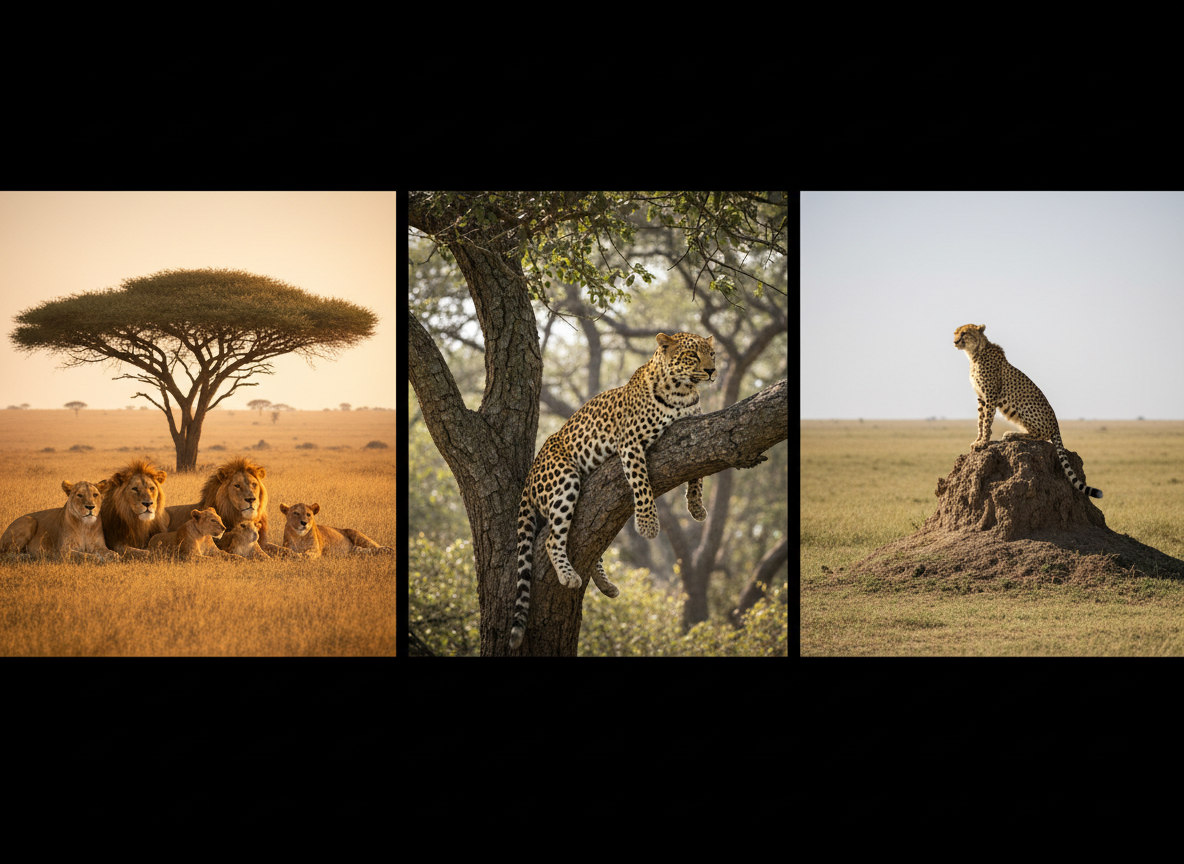
The Masai Mara is exceptional among African safari destinations for a specific reason: lion, leopard, and cheetah all share the same reserve and can be seen on a single trip. In most other parks, one confirmed sighting of any one species counts as a highlight. Here the question shifts from whether you will see big cats to which encounters will define your stay.
But lions vs leopards vs cheetahs are not variations on the same experience. Each occupies a different layer of the ecosystem, operates on a different daily schedule, and demands different things from a safari itinerary. Knowing how they differ helps you plan more precisely before you ever arrive.
Three Cats, One Reserve
The greater Mara-Serengeti ecosystem supports an estimated 800 to 1,000 lions, multiple resident leopard territories, and several established cheetah families and male coalitions. All three species are present year-round, which is unusual at any African destination.
What makes the Mara work for all three simultaneously is terrain variety: open savannah for lions and cheetahs, riverine forest and rocky outcrops for leopards, and surrounding conservancy land that extends night-drive access. A well-constructed itinerary can turn a single safari into a genuine three-species study.
The Lion: Social, Visible, and High-Impact
Lions are the most reliably sighted predators in the Masai Mara. Resident prides, some numbering more than 25 individuals, are well-known to experienced guides who track their movements daily. During dry season, multiple lion encounters per drive is a realistic expectation.
How lions spend their time
Lions rest for 18 to 20 hours a day. Most sightings show resting prides: adults sprawled in shade, cubs scrambling over one another, a male scanning the horizon. The high-action moments arrive at dawn and dusk when lions hunt or return from hunting. Group hunting in the Mara typically involves females coordinating an ambush, with males asserting themselves once prey is secured.
Watching a pride share a kill, or seeing a lioness drop into hunting posture at first light, is a different experience from photographing a pride at rest. Both are worthwhile. The open savannah terrain means you observe the full social dynamic of a pride over the course of a single game drive.
Where to find lions
Focus drives around the Mara River and Talek River corridors, the central plains, and rocky outcrops where prides shelter during midday heat. Lions frequently rest under acacia trees or in tall grass when the sun is high. Early morning is the best time to find prides still active from a night hunt.
The Leopard: Solitary, Concealed, and Worth the Search
In any comparison of lions vs leopards vs cheetahs, the leopard occupies its own category. Not because it is scarce, but because it is deliberately hidden. Leopards are resident in good numbers throughout the Mara, but they are fundamentally difficult to locate.
How leopards behave
Leopards are solitary and crepuscular, most active at dawn, dusk, and through the night. A leopard can sit ten metres from a game drive track, resting in the canopy of a fig tree or pressed flat against a rocky ledge, and remain completely invisible to everyone except a guide who knows the individual territory. They are ambush hunters: slow, patient stalks ending in a single accelerated attack. They routinely haul kills into trees to keep them from lions and hyenas, which is how they are most often photographed.
Where to find leopards
Riverine forest along the Mara River and Talek River, rocky ground near the Oloololo Escarpment, and kopje country in the conservancies are the priority zones. Night drives in the conservancies substantially improve sighting probability, since leopards move freely after dark in a way they do not during daylight hours.
The leopard is consistently the hardest of the three cats to locate. Finding one reliably requires a guide with detailed knowledge of individual territories, patience across multiple drives, and ideally conservancy access for evening and night game drives.
The Cheetah: Daylight, Speed, and Open Plains
Where lions are social and leopards are secretive, cheetahs are diurnal predators on open ground. They are visible, observable, and active during the same hours you are out in the vehicle.
How cheetahs hunt
Cheetahs hunt in the early morning and late afternoon. Before committing to a chase, they use elevated termite mounds or fallen logs as scanning platforms, reading the movements of gazelle, impala, and Thomson’s gazelle across the plain. Their sprint reaches roughly 70 km/h in short bursts. Female cheetahs with cubs are the most commonly sighted group in the Mara; male coalitions, usually brothers that have bonded and hunt together, are a rarer encounter.
Unlike lions, cheetahs cannot defend a kill from larger predators, so they eat quickly and nervously. The full sequence of a cheetah hunt, from the slow crouch through the sprint to the suffocation hold and the hurried feeding, is among the most intense wildlife events on a Kenyan safari. It is also one of the most watchable, since the chase happens in the open at speed and the outcome is visible from the vehicle.
Where to find cheetahs
Open grassland is their primary habitat. The Olare Motorogi Conservancy, the central plains, and the Mara Triangle are the most productive areas. Short-grass periods after the dry season give cheetahs the clearest sightlines for hunting and give observers an unobstructed view of the chase.
Lions vs Leopards vs Cheetahs: At a Glance
| Factor | Lion | Leopard | Cheetah |
|---|---|---|---|
| Sighting reliability | Very high | Moderate | High |
| Sighting difficulty | Low (open, social) | High (solitary, secretive) | Low to moderate |
| Active hours | Crepuscular and night | Crepuscular and night | Daytime |
| Habitat | Open savannah, riverine | Riverine forest, kopjes | Open grassland |
| Social structure | Pride | Solitary | Mother and cubs, or male coalitions |
| Hunting style | Group ambush | Ambush stalk | High-speed sprint |
| Watchable hunting | Occasional | Rare | Common |
| Night drive value | Yes | Yes, high | No |
| Conservation status | Vulnerable | Vulnerable | Vulnerable |
Seasonal Notes
All three cats are resident year-round, but sighting conditions shift with the season.
Lions are reliable throughout the year. January to February, when short grass follows the calving season, and the dry months of July to October offer the sharpest visibility and the most concentrated prey activity.
Leopards can be found at any time of year, but night drives in the conservancies are the most consistent route to a confirmed sighting. Thicker green-season vegetation makes daytime location harder and requires a more experienced guide.
Cheetahs are best observed during short-grass months: January through March and July through September. Open plains with low cover give hunting animals nowhere to disappear and give observers a complete view of the chase from start to finish.
Explorer Notes
A few practical points that affect big cat viewing in the Masai Mara significantly.
Guide quality matters more for leopard sightings than for any other species. A guide who tracks known individuals by territory is the difference between finding a leopard and not finding one. Ask specifically about leopard familiarity and conservancy knowledge when selecting a camp.
Conservancy access is the single most useful upgrade for leopard and nocturnal big cat viewing. The main reserve does not permit night drives. The private conservancies bordering the Mara — Olare Motorogi, Naboisho, Ol Kinyei, and others — do permit them, which adds several hours of productive observation time per day.
For cheetahs, the strategy is straightforward: arrive on the plains early and stay. Mid-morning is the peak hunting window. A long midday return to camp is the most common reason visitors miss an active cheetah.
Putting It Together
The Masai Mara’s concentration of all three big cats within one reserve is genuinely unusual. Most destinations offer one species with confidence and the others as possibilities. The Mara treats all three as realistic targets within the same trip.
Each cat requires a distinct approach: lions reward patience and good morning light, leopards reward local expertise and conservancy access, cheetahs reward early starts and time on open ground. Building an itinerary around how these animals actually live, rather than a generic predator checklist, is what separates a memorable safari from a routine one.