

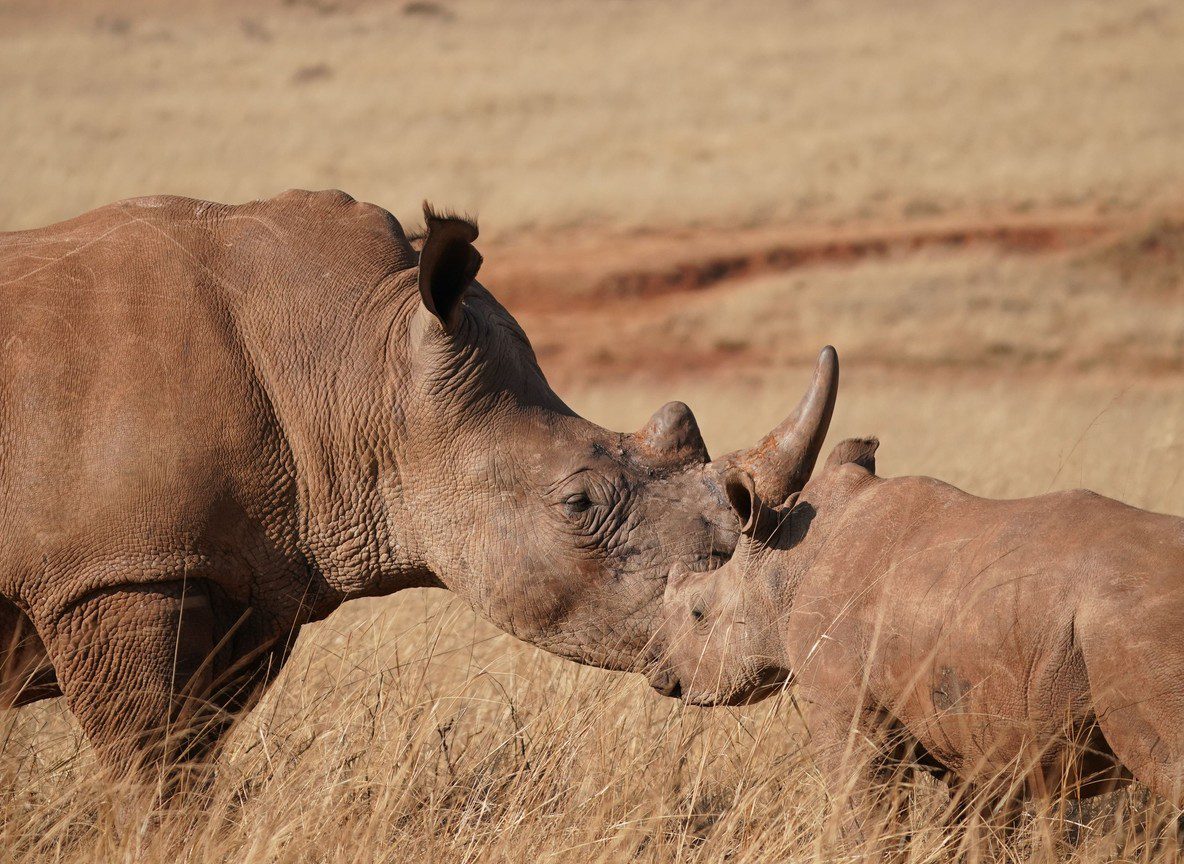
Kenya’s rhino sanctuaries are the reason these animals still exist in East Africa.
Forty years ago, poachers had pushed Kenya’s black rhino population below 400 individuals. The white rhino had been effectively eliminated from most of its historic range. What followed is one of the most disciplined wildlife recovery programmes on the continent: a network of heavily protected rhino sanctuary Kenya sites, a national studbook managed by Kenya Wildlife Service, and a sustained commitment from private conservancies, community landowners, and government agencies to treat rhino recovery as long-term infrastructure rather than a short-term gesture.
Today, Kenya holds roughly 900 black rhinos — the second-largest population of this critically endangered species anywhere on earth — and over 800 white rhinos. The numbers matter less than what they represent: a functional, replicable model for bringing large, slow-breeding megafauna back from the edge. This guide explains how the main sanctuaries work, what made the recovery possible, and where a conservation-minded traveller can engage with rhinos on a level that goes beyond a standard game-drive sighting.
Why Kenya’s Rhino Population Collapsed and Why Recovery Was Possible
The kenya rhino population crash happened fast. In 1970, Kenya had an estimated 20,000 black rhinos. By 1987, poaching for the illegal horn trade had reduced that number to under 400. White rhinos, introduced from South Africa in the 1960s, fared only marginally better within specific protected areas.
Two structural factors made Kenya an unlikely recovery success story. First, the country had already established a small number of high-security fenced sanctuaries before the worst of the poaching crisis hit. These sites held founder populations that could be managed, monitored, and bred from. Second, Kenya maintained a genuine national rhino database — not just a population count, but a named individual record system tracking genetics, breeding history, translocation records, and territorial behaviour for every animal in the programme.
Recovery required both things working in parallel: secure physical space and precise individual management. Neither alone was sufficient.
The National Rhino Sanctuary System: How It Is Structured
Kenya Wildlife Service coordinates the national rhino programme through a tiered sanctuary system. Each site is classified by its security infrastructure, carrying capacity, and the subspecies it holds.
| Sanctuary | Species | Size | Est. Rhino Count | Security Type |
|---|---|---|---|---|
| Ol Pejeta Conservancy | Black + White + NWR | 360 km2 | 160+ | Electric fence, armed rangers, 24/7 tracking |
| Lewa Wildlife Conservancy | Black + White | 250 km2 | 70+ | Fenced perimeter, aerial surveillance |
| Solio Ranch | Black + White | 70 km2 | 80+ | Fenced, oldest private sanctuary in Africa |
| Nairobi National Park | Black | 117 km2 | 50+ | Partial fence, ranger patrol |
| Meru National Park | Black | 870 km2 | 80+ | Fenced black rhino sanctuary within the park |
| Lake Nakuru National Park | Black + White | 188 km2 | 70+ | Electric fence, intensive patrol |
| Mugie Conservancy | Black | 200 km2 | 20+ | Fenced, Laikipia |
| Borana Conservancy | Black | 135 km2 | 20+ | Fenced, Laikipia |
Source: Kenya Wildlife Service Rhino Programme, 2025 census data.
The system functions because these sites operate as a coordinated metapopulation, not as isolated islands. When carrying capacity at one site is reached, animals are translocated to expand the gene pool elsewhere. When a sanctuary achieves demographic success, founder animals move to establish new sites. The rhino studbook governs which animal goes where and when.
Black Rhino Kenya: The Critically Endangered Species
Black rhinos and white rhinos are not colour variants. They are distinct species with different mouth morphology, habitat preferences, and social structures.
The black rhino (Diceros bicornis) is a browser. Its pointed, prehensile upper lip grabs twigs and leaves from acacia and thornbush. It is largely solitary, highly territorial, and known for unpredictable defensive behaviour when approached. Three subspecies survive; the eastern black rhino (D. b. michaeli) accounts for the majority of Kenya’s population and is the subspecies you encounter in most sanctuaries.
Black rhinos have a 15 to 16 month gestation period and produce a single calf. A female may raise four to six calves in her lifetime. This slow reproductive rate is why recovery takes decades, not years. A population that lost 80% of its individuals in 20 years cannot rebuild in five.
Kenya’s current black rhino count of roughly 900 individuals represents genuine conservation success, but also fragility. All 900 animals are managed individuals. None exist in unprotected, unmonitored habitat. The survival of the black rhino in Kenya depends entirely on the continuation of the sanctuary system.
White Rhino Kenya: Recovery Through Translocation
White rhinos (Ceratotherium simum) are grazers. The wide, square upper lip is shaped for cropping short grass. They are more social than black rhinos, often moving in small groups of females and sub-adults, and generally less reactive to human presence. This makes them easier to manage in lower-security sanctuary conditions and more accessible to visitors approaching on foot.
Kenya’s white rhino population was effectively founded through translocation from KwaZulu-Natal in South Africa during the 1960s and 1970s. Solio Ranch and Ol Pejeta became the primary breeding hubs. White rhino numbers recovered steadily through the 1980s and 1990s, with surplus animals moved to Lewa, Lake Nakuru, and several smaller conservancies.
Kenya also holds the last two individuals of the northern white rhino subspecies (C. s. cottoni) — Najin and Fatu — at Ol Pejeta. The northern white rhino is functionally extinct as a naturally reproducing population. The BioRescue consortium’s ongoing work to create northern white rhino embryos from cryopreserved genetic material and implant them in southern white rhino surrogates represents the most significant rhino conservation science being conducted anywhere in the world.
Rhino Conservation Kenya: The Mechanics That Make Sanctuaries Work
A rhino sanctuary is not simply a fenced area with rhinos inside. The conservation mechanics that make sanctuaries function include several distinct systems.
Individual identification and monitoring. Every rhino in the national programme is named, notched (ear notches create a unique visual ID pattern), and DNA-sampled. Rangers on morning and evening patrol GPS-log each animal. Gaps in sightings trigger immediate investigation. This is active daily management, not passive monitoring.
Anti-poaching infrastructure. Core elements include electrified perimeter fencing, armed ranger teams on overlapping patrol shifts, canine units at some sanctuaries, and aerial surveillance at major sites. Ol Pejeta runs a 24-hour operations room tracking ranger locations, camera feeds, and animal GPS data simultaneously.
Translocation programme. When a sanctuary approaches carrying capacity — assessed by vegetation condition and territorial conflict frequency — Kenya Wildlife Service coordinates the capture and movement of surplus animals. Captures involve veterinary teams using M99 immobilisation under KWS licence. The receiving sanctuary must meet fence standards, ranger capacity, and habitat thresholds before a translocation is approved.
Community integration. The rhino programme learned from early failures that sanctuaries without community economic integration create a conflict dynamic that eventually undermines security. Contemporary sanctuaries, particularly in Laikipia, operate structured revenue-sharing with neighbouring communities, employment-first hiring for ranger positions, and formal community land-lease arrangements.
Where to See Rhinos in Kenya: A Sanctuary Visitor Guide
For conservation-focused travellers, a rhino visit is not a box to tick. It is an opportunity to understand the programme from the inside.
Ol Pejeta Conservancy (Laikipia) offers the most conservation-immersive rhino experience in Kenya. The conservancy provides standard game drives with reliable black and white rhino encounters; a dedicated northern white rhino enclosure visit (foot access, maximum 8 visitors, ranger guide mandatory); a chimpanzee sanctuary; and an optional conservation briefing at the operations centre. Day visits and multi-night stays are both available. See our dedicated guide at touringinsights.com for Ol Pejeta itinerary details.
Lewa Wildlife Conservancy (Laikipia) focuses heavily on black rhino tracking on foot or on horseback. Lewa was a key founder site for Kenya’s black rhino programme and its rangers carry 40 years of individual animal tracking knowledge. Foot tracking at Lewa requires booking through a Lewa-affiliated camp and a minimum physical fitness standard. The experience of approaching a black rhino on foot, with a trained ranger explaining its individual history and territorial range, is qualitatively different from a vehicle encounter.
Solio Ranch (Laikipia) is the oldest private rhino sanctuary in Africa, established in 1970. Its primary function is breeding rather than tourism, and access is controlled to a small number of guests at Solio Lodge. If understanding the managed breeding programme in depth is the priority, Solio provides it. The density of rhinos here is unusual — seeing 20 or more individuals in a single morning is genuinely possible.
Meru National Park (Eastern Kenya) holds a fenced black rhino sanctuary within the larger park. Rhino tracking on foot is available here under KWS ranger supervision. Meru’s black rhino population was extirpated by poaching in the late 1980s; the current animals are entirely the product of reintroduction from Solio and Ol Pejeta, making Meru a particularly instructive site for understanding how the translocation programme works in practice.
Lake Nakuru National Park (Rift Valley) is the most accessible rhino site from Nairobi, and the most practical entry point for first-time rhino viewers. Both black and white rhinos are present inside a fully fenced 188 km2 park. The conservation experience is less immersive than the Laikipia sites, but Nakuru pairs efficiently with a Naivasha day to build a Rift Valley wildlife circuit.
Kenya Rhino Population: Where the Numbers Stand
Kenya’s current rhino census figures, per Kenya Wildlife Service 2025 data:
- Black rhino: approximately 900 individuals (+125% from the 1987 low of 400)
- White rhino (southern): approximately 830 individuals
- Northern white rhino: 2 individuals (Najin and Fatu at Ol Pejeta)
These numbers represent four decades of sustained investment. They also represent a ceiling unless the sanctuary network expands. The current carrying capacity of Kenya’s existing sanctuaries is near its limit. The next phase involves creating new sanctuary sites, primarily through the conversion of community conservancy land in Laikipia, the Coast, and northern Kenya.
The conservation traveller who visits a rhino sanctuary and pays full conservancy fees is a direct participant in this system. The conservancy fee at Ol Pejeta or the ranger-led tracking fee at Lewa does not fund a lodge marketing budget. It funds the anti-poaching unit patrolling a fence perimeter measured in hundreds of kilometres.
For authoritative population data and conservation programme updates, Kenya Wildlife Service publishes annual census reports at kws.go.ke. Save the Rhino International, which funds multiple Kenya sanctuary programmes, publishes programme updates at savetherhino.org.
Explorer Notes
A few things that make a rhino sanctuary visit more meaningful:
- Ask your camp or guide to brief you on the specific animals you are likely to encounter before the drive. Many Laikipia rangers know individuals by name, ear notch pattern, and family history. That context changes the sighting.
- Foot tracking at Lewa and Meru requires advance notice and is not available as a walk-in activity. Book it when you confirm accommodation.
- The northern white rhino enclosure visit at Ol Pejeta is limited to 8 visitors and fills quickly. Reserve it in advance through the conservancy.
- If you combine Ol Pejeta with a Mara migration safari, the two experiences complement each other well: one is about big predator spectacle, the other about conservation science and proximity. Most Nairobi-based itineraries can link Laikipia and the Mara within a 7 to 10 day trip.
Conclusion
Kenya’s rhino sanctuaries are the reason these animals still have a future in East Africa. The infrastructure that made recovery possible — fenced sites, individual monitoring, coordinated translocation, community integration — is not glamorous conservation. It is practical, long-term, expensive, and it is working.
Visiting a rhino sanctuary well means understanding what you are entering, not just what you are hoping to photograph. The animals you see are managed individuals with known histories in an active conservation programme. The rangers you walk with are professionals who have spent years building the knowledge base that keeps those animals alive.
Next Steps
For itinerary planning that includes rhino sanctuary visits alongside a Masai Mara migration trip, see the Kenya safari planning resources at touringinsights.com. For a detailed Ol Pejeta vs Lewa comparison covering camp quality, rhino tracking access, and overall conservation experience, that guide is also available on the site.
External resources: Kenya Wildlife Service for current sanctuary policy and census data. Save the Rhino International for programme funding updates and conservation science.