
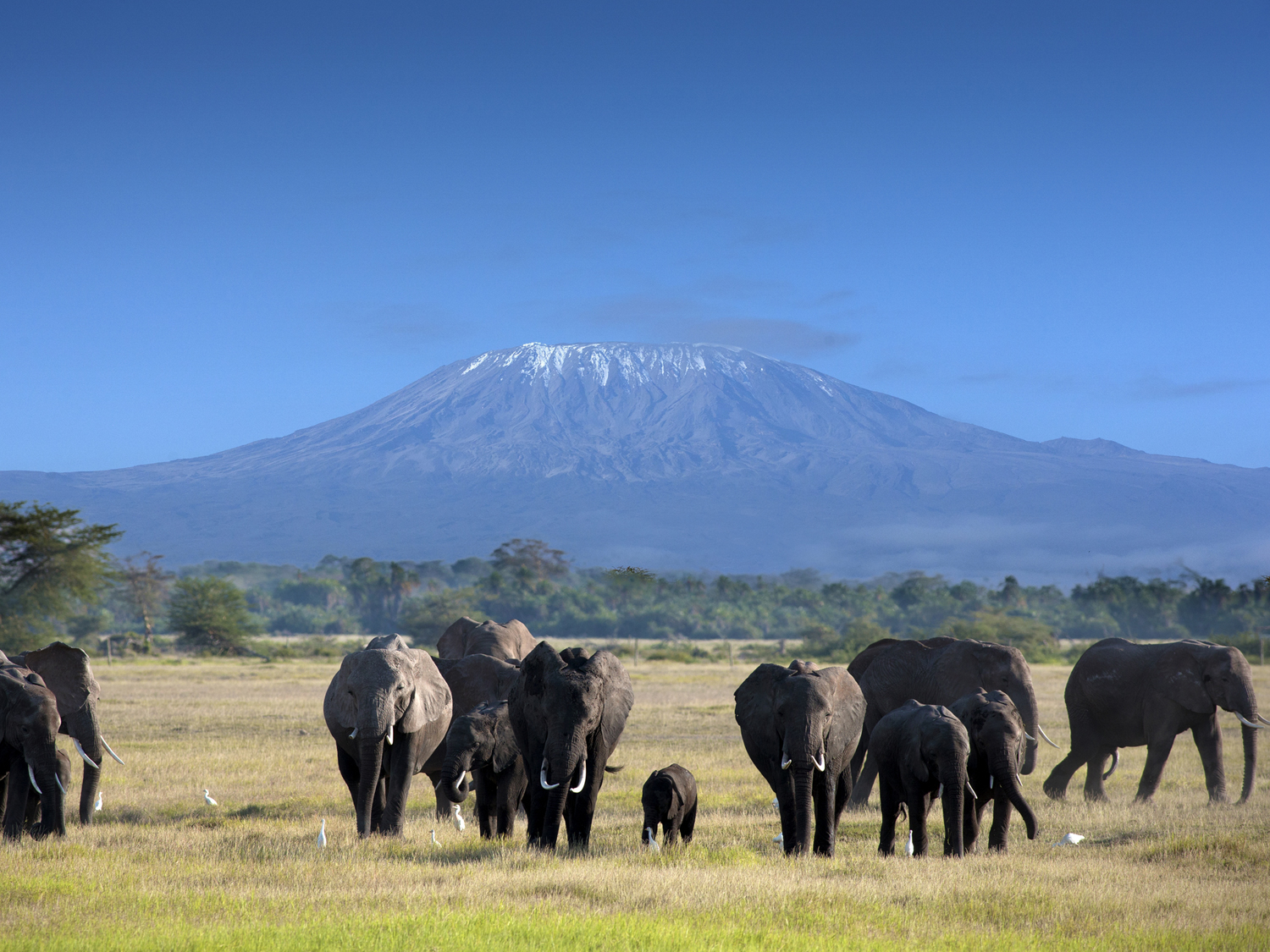
Few wildlife encounters in Africa carry the visual weight of an elephant herd moving across open savannah with Kilimanjaro filling the sky behind them. Amboseli National Park, 240 kilometers south of Nairobi near the Kenya-Tanzania border, is where that image is real and repeatable. The Amboseli elephants are not a seasonal draw. They are year-round residents of a 392-square-kilometer park that is, in ecological terms, built around them.
This guide covers what makes Amboseli‘s elephant population distinctive, where and when to find the herds, what five decades of field research has revealed about their behavior, and the planning details travelers need to make the most of a visit.
The Amboseli Elephants: Scale, Tusks, and Science
Amboseli is home to more than 1,600 African elephants, one of the densest concentrations on the continent and the most thoroughly documented. The Amboseli Elephant Research Project, established in 1972 and later institutionalized as the Amboseli Trust for Elephants, has monitored individual animals for over fifty years. Researchers have named elephants, mapped their family trees, and built behavioral records across multiple generations. No other wild elephant population anywhere has been studied at this depth or across this span of time.
The practical effect for visitors is meaningful. Many elephants in the park have spent their entire lives within sight of research vehicles and are fully habituated to human presence, which means they continue normal behavior at close range without stress or retreat. You can observe social dynamics that take minutes or hours to unfold: calves learning to cross swamp channels under maternal supervision, matriarchs guiding family groups to known water points, adult males passing through with the careful wariness of an animal that knows its own size.
Amboseli is also one of the last reliable places to see great-tusked elephants. The park’s population preserves some of the remaining lineages whose males carry ivory reaching to or near the ground. The poaching crisis of the 1970s and 1980s removed most such animals from the continent. Amboseli’s combination of sustained protection and continuous monitoring has kept certain tusk-bearing lines alive. A mature bull with full tusks is a genuinely rare sight elsewhere in Africa; here it is a reasonable expectation on a multi-day visit.
Kilimanjaro as Backdrop
Mount Kilimanjaro stands at 5,895 meters, the tallest freestanding mountain in the world. It sits inside Tanzania, but Amboseli provides the best viewing angle from Kenya’s side. On clear mornings the peak dominates the southern horizon, glaciers visible at the summit and cloud forest layering its lower slopes.
The Kilimanjaro-and-elephants image that defines Amboseli’s visual identity is not purely compositional. It reflects something accurate about how the park functions. Amboseli’s permanent swamps are fed by snowmelt and rainfall from the mountain, which percolates through porous volcanic soils across the border and resurfaces in the lowlands as springs and seeps. Without Kilimanjaro’s water cycle, the swamps would not exist in their current form, and the elephant population would be far smaller. The mountain is part of the ecosystem, not just the scenery.
Clear summit views are most reliable early in the morning. By mid-morning, thermal clouds typically build around the upper slopes and the peak disappears. A second window sometimes opens in late afternoon as conditions settle before sunset. This is why serious photographers prioritize the first and last hours of daylight.
When to Visit Amboseli
Amboseli supports wildlife throughout the year, but the experience differs noticeably between dry and wet seasons.
Dry season (June to October, January to February) is the most productive for wildlife viewing. As temporary water sources disappear across the wider landscape, animals concentrate around the permanent swamps. Elephant herds that range broadly during the rains converge in larger, more predictable groups near water. Predators follow the prey. The vegetation is short and open, which extends visibility across the plains. Kilimanjaro views are most consistent during this period.
The tradeoffs are price and crowding. July through October is peak season and rates at lodges increase accordingly. August and September see the highest visitor numbers. Dust from the park’s dry tracks becomes a constant presence on game drives.
Wet season (March to May, November to December) brings a different quality of experience. The landscape greens within days of the first rains. Migratory birds arrive in large numbers, the park records over 400 species in total, and resident birds become more active and visible. Calves born at the start of the rains add behavioral richness to elephant herds. Lodge prices drop significantly, and the park is noticeably quieter.
The practical complications are real. Some tracks become impassable after heavy rain. Animals disperse widely when water is available across the landscape, making herds harder to locate. Kilimanjaro is frequently cloud-covered during the long rains in March through May.
For most travelers weighing wildlife density, photographic conditions, and logistical ease, June through October is the clearest choice. January and February offer similar wildlife quality at lower prices than peak months.
Where to Find the Herds
Amboseli has five permanent swamp systems, all fed by Kilimanjaro’s snowmelt moving through the soil. The two most significant for elephant activity are Enkongo Narok in the center of the park and Longinye to the southwest. These swamps are where the herds are most consistently located across the day.
Early morning drives catch elephants moving out from the swamps onto the surrounding plains to feed. Families travel in single file, matriarchs setting the direction while calves keep pace among the adults. Bulls often travel separately, covering ground at their own pace. By mid-morning, as temperatures climb, elephants begin to return toward the swamps. Afternoon drives regularly encounter large aggregations at the water edge: animals drinking, bathing, and mud-rolling in the hours before sunset.
The open plains east of Enkongo Narok offer long sight lines across flat ground with the mountain visible to the south. This is where wide landscape photography works best. The swamp edges provide closer encounters and behavioral detail, calves splashing in shallows, adults coating themselves in mineral-rich mud that dries to a pale crust on their skin.
Other species concentrate in the same zones. Lions and cheetahs hunt across the open grasslands. Zebra, wildebeest, giraffe, and buffalo graze the plains. Hippos occupy the deeper swamp channels. Birdwatching along the swamp margins is productive in any season.
Elephant Behavior and What to Watch For
The Amboseli research has produced a detailed picture of how the population is organized. Herds are matriarchal. A senior female leads each family group, typically composed of her daughters, sisters, and their young. The matriarch carries learned knowledge about the landscape, including where water is located, which routes are safer in which seasons, and how to respond to potential threats.
Her authority is most visible at water points. When multiple family groups arrive at the swamps simultaneously, the social hierarchy plays out in body language and movement: which groups hold position, which give way, how families with allied relationships approach each other. Researchers have documented a distinctive greeting behavior involving rumbles, ear-spreading, and physical contact that occurs when closely bonded family groups reunite after time apart. These interactions are visible to any attentive observer in the park.
Mature bulls enter musth periodically, a hormonal state tied to reproductive competition. A bull in musth is recognizable by secretions from the temporal glands running down the side of the face and a distinct posture. Guides who know individual animals will flag when a musth bull is nearby. It is useful information for calibrating approach distance.
Conservation and the Amboseli Trust for Elephants
The Amboseli Trust for Elephants continues active research and conservation work operating from the park. Their dataset now spans more than five decades and underpins scientific work on elephant cognition, communication, climate sensitivity, and population dynamics.
Amboseli’s elephants do not stay within park boundaries. They move across a broader landscape that includes community land, group ranches, and agricultural zones. Human-wildlife conflict over crops and water is an ongoing issue, particularly at the park edges. The Trust has worked alongside the Kenya Wildlife Service and local communities on mitigation programs that aim to reduce losses on both sides. Conservation in Amboseli is not a solved problem. It is a sustained negotiation across competing land uses.
Park entry fees and revenue from conservation-linked accommodation programs contribute directly to protection costs and community benefit programs. The elephant population here has survived droughts, poaching crises, and repeated political disruptions. It has done so because of consistent investment in monitoring and protection. Visitor presence at scale is part of what sustains that investment.
Explorer Notes
Getting there. Amboseli is approximately 240 kilometers from Nairobi by road, a four-hour drive via the Namanga highway. Scheduled and charter flights operate to Amboseli’s airstrip and reduce travel time considerably while avoiding road condition issues in wet season.
Accommodation. Options span budget tented camps to full-service lodges with pools to a smaller number of exclusive camps. Lodges closest to the swamps give the best access to early-morning elephant activity. Book well ahead for July through October.
Packing. Mornings in the park are cool, especially June through August, so bring a fleece or light jacket for dawn game drives. Dust is significant in dry season and accumulates on equipment and clothing. Neutral-colored clothing is standard for game drives. Binoculars work particularly well in Amboseli’s open terrain.
Photography. A 200-400mm telephoto handles close wildlife work. A 16-35mm wide-angle captures the Kilimanjaro backdrop compositions the park is known for. The usable dawn light window runs about 90 minutes from sunrise. The late-afternoon window is similarly narrow but often the clearest for mountain visibility.
Health. Malaria is present in this region. Antimalarial prophylaxis is recommended. Bring insect repellent and cover exposed skin in the evenings. The nearest well-equipped hospital is in Nairobi.
Combining destinations. Amboseli connects logistically with Tsavo East and West for a two-ecosystem elephant circuit, contrasting the park’s swamp grasslands against Tsavo’s semi-arid terrain. A circuit that adds the Rift Valley lakes brings rhinos, flamingos, and different landscape types within a single itinerary.
Conclusion
Amboseli elephants are what distinguish this park from every other wildlife destination in East Africa. Not simply because the numbers are large or because some individuals carry the longest tusks remaining in the wild, but because more than fifty years of unbroken research have made this population knowable in ways that wild animals rarely are. A visit to Amboseli puts travelers inside the world’s longest-running elephant study, set against Africa’s highest peak. The planning is not complicated. The experience consistently delivers what the photographs promised.
Every trip described here can be tailored: dates, budget, camps, and pace built around you.
Get a Personalised Safari


[…] Amboseli (all seasons): […]
[…] Amboseli, Tsavo, Lake Nakuru (mainly) […]