The question most first-time safari visitors ask, long before they land in Kenya, is some version of “will I see a kill?” The answer is: sometimes, and the probability depends on season, guide experience, time in the field, and no small amount of luck. But the more useful question is what role a kill actually plays within the full scope of a safari experience.
Understanding predator kills vs casual wildlife encounters, what each delivers, what each costs in terms of expectation management, and how a well-designed game drive balances both, prepares travelers for a richer and far less reactive time in the field.
At a Glance: Predator Kills vs Casual Wildlife
| Factor | Predator Kill or Hunt | Casual Wildlife Encounter |
|---|---|---|
| Frequency | Rare to occasional | Consistent throughout any good game drive |
| Emotional weight | Intense, raw, sometimes distressing | Cumulative; builds knowledge and connection |
| Predictability | Cannot be scheduled | More predictable; guides know territories |
| Duration | Minutes to several hours at a carcass | Flexible; can be extended at any sighting |
| Photography | Fast action, challenging but dramatic | Better for behavioral and portrait work |
| Family suitability | Depends on age and preparation | Generally positive and educational |
| Understanding gained | Ecosystem mechanics; predator behavior | Species ID; behavioral ecology; individual recognition |
The Predator Kill Experience
What Happens at a Kill Sighting
A kill encounter arrives in two distinct forms. The first is witnessing a hunt from start to finish. Cheetah hunts run ten to thirty seconds at full sprint. A lion coordinating with pride members across open ground may take twenty to forty minutes from the initial stalk to a successful takedown. Seeing the complete sequence is relatively rare even in reserves with high predator populations.
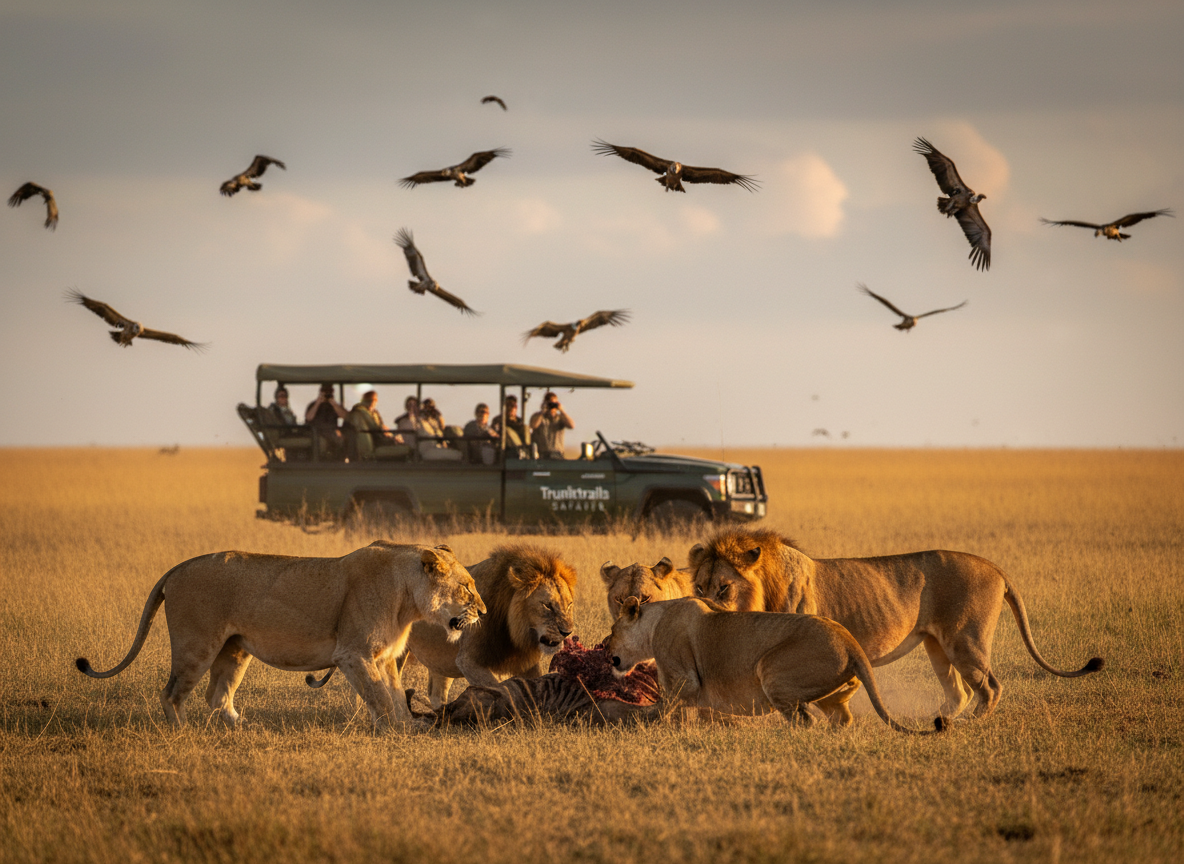
The more common scenario is driving up to a kill already in progress. Predators hunt at night or in the early morning hours, so what most game drives find is feeding already underway. These scenes unfold over several hours and involve a rotating cast: vultures circling and eventually descending, hyenas positioned at a cautious distance, jackals darting in for scraps at the margins. When the primary predators move off, opportunists take over. The carcass is rarely wasted.
How Likely Are Kill Sightings?
No outcome can be guaranteed on any given drive. The Maasai Mara holds one of the highest predator densities on the continent, which gives visitors a better probability than almost any other destination. A five-day itinerary during peak season, July through October, carries a meaningful chance of seeing an active hunt or feeding. A three-night visit in the shoulder season may or may not deliver one.
Dry season conditions, roughly January through February, tend to improve encounter odds. Lower vegetation makes predators easier to track. Water sources concentrate prey animals. Active predator territories become more readable for experienced guides working fresh intelligence from their networks.
The Emotional Reality of a Kill
A kill sighting is not a comfortable experience for everyone. A lion feeding on a buffalo, a cheetah holding a gazelle, or a leopard hauling prey into a tree canopy is raw and unambiguous. For many travelers, this functions as ecological clarity: a direct encounter with how the system actually works, stripped of any idealization. For others, particularly families traveling with younger children, the experience requires honest preparation in advance.
A skilled field guide will ask, before the first drive, how the group feels about encountering a kill. That conversation shapes how they handle the moment when it arrives. Good guides welcome it.
What Casual Wildlife Actually Delivers
The Range of Sightings You Can Expect
“Casual wildlife” is a somewhat misleading label. It covers every sighting that is not an active hunt or predator feeding event, and that turns out to be most of what happens during a well-led game drive:
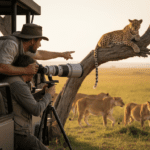
- A lion pride at rest in midday shade, with cubs using a dozing adult as a climbing structure
- An elephant family crossing a dry watercourse in single file, the matriarch reading the air ahead of the herd
- A cheetah perched on a termite mound at first light, scanning several kilometers of open plain
- A giraffe browsing the upper reaches of an acacia, entirely unbothered by the vehicle below
- A hippo pod surfacing in slow rotation in a shaded pool
- A lilac-breasted roller catching the early morning light on a branch above the track
None of these arrive with the tension of a hunt. What they deliver instead is sustained access: long observation of individual animals, behavioral sequences that develop at their own pace, and the slow accumulation of context that makes each subsequent sighting more legible than the last.
How a Guide Changes the Encounter
A skilled field guide transforms every casual sighting into a distinct learning experience. At a pride of lions, they identify the dominant male, estimate how old the cubs are, and explain which female recently lost offspring to a hyena raid and what that has done to social dynamics within the group. At an elephant herd, they read the body language of the matriarch, explain why juvenile males are being pushed to the periphery, and describe what it means when she turns and faces the vehicle directly.
This contextual depth is rarely available at a crowded kill sighting, where attention narrows to the carcass and the action around it. It is available everywhere else, at every stop, on every game drive, for anyone paying attention.
Photographers benefit from this dynamic as well. Kill scenes are fast-moving, frequently low-light, and often chaotic. A cheetah positioned on a termite mound in morning light, or an elephant drinking at close range with space to compose, produces images with clarity and behavioral depth that action scenes rarely allow.
Explorer Notes
- Patience pays at quiet sightings. When a scene looks still, waiting five more minutes frequently produces a movement, a behavior, or an arrival that changes the encounter entirely. Guides who say “wait a little” are usually reading something you are not yet seeing.
- Crowding at kills is an ethical concern. Multiple vehicles converging on a feeding site alters predator behavior and adds pressure to animals that are already expending significant energy. If a kill is already surrounded, the considerate approach is to observe from a respectful distance and give way once the scene is crowded.
- Prepare children before the drive. If you are traveling with children under ten, discuss the possibility of witnessing predator-prey events with your guide before you head out. Guides can calibrate how they handle the moment and what context they provide, but only if they know the group’s needs in advance.
- Early and late drives outperform midday. Most predator activity concentrates in the two hours after sunrise and the hour before sunset. Midday drives have real value for casual observation, but the probability of kill sightings drops significantly during the heat of the day.
- Approach the kill with openness. What you are watching is the ecosystem operating exactly as it has for millions of years. The discomfort, when it comes, is informative.
Conclusion
A well-led safari in the Maasai Mara delivers both experiences, sometimes within the same day. The kill, when it arrives, is clarifying and visceral. The casual encounters surrounding it build everything necessary to understand what you are watching: the territorial logic, the social dynamics, the individual animals you have come to recognize. Travelers who remain fully engaged with every sighting, not only the dramatic ones, come away with a complete picture of the ecosystem. That picture is what makes the kill, when it finally happens, land with its full weight.
Prefer a different route, budget, or travel style? This plan can be adapted to fit.
Customise Your Trip