A bush breakfast on safari is exactly what it sounds like: a full meal served outdoors in the wilderness, at a location your camp selected for its views, wildlife activity, or seclusion. No dining room, no buffet queue. The table comes to the bush.
This is a widely offered feature at mid-range and luxury safari camps across East Africa, and for many travelers it ends up being one of the clearest memories they take home. Not because of spectacle, but because of the particular quality of sitting in open country while the morning light is still shifting and the landscape is fully awake around you.
This guide covers how bush breakfasts are organized, what typically gets served, where they happen most often, and what else falls under the broader category of outdoor bush dining on a safari itinerary.
How a Bush Breakfast on Safari Is Organized
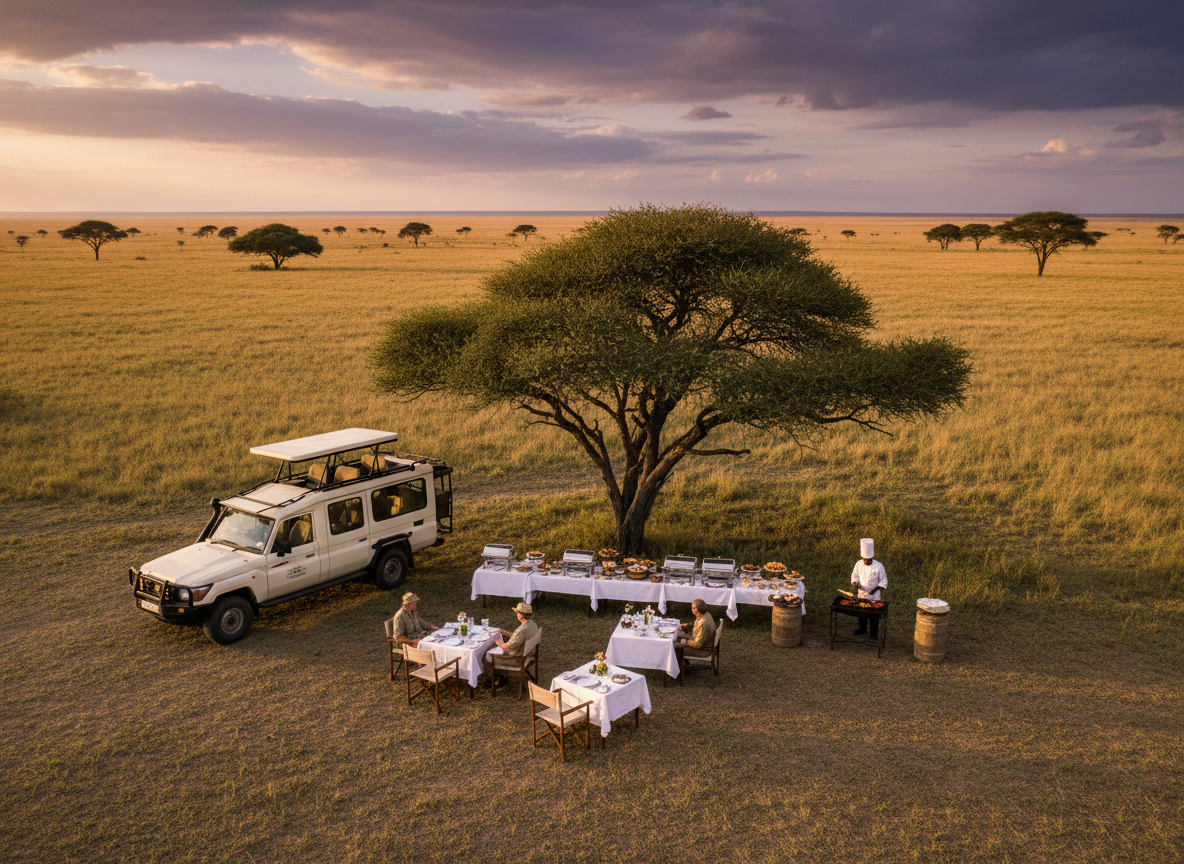
The setup begins while guests are out on the early morning game drive. Camp staff select a site in advance, usually a dry riverbed, a rocky outcrop with an open view, or a clearing near a waterhole. By the time the vehicle circles back, a table is already set and waiting.
The standard arrangement includes a tablecloth, proper silverware, glassware, and a folding camp table with chairs. At well-run camps, staff also bring a portable grill or gas burner for eggs cooked to order. A coffee and tea station is set up nearby. The whole arrangement is compact enough to assemble in under an hour and leave no trace.
Timing typically puts guests at the table between 7:00 and 9:00 in the morning. That window catches the golden hour light, peak bird activity, and the tail end of the period when nocturnal predators are still moving. Morning game drives in most parks begin before dawn, so by the time breakfast is served, guests have generally had two or more hours in the field already.
Your guide stays present through the meal. In open wilderness areas without a fence line, a camp ranger may also stand nearby. This is standard practice where large animals can approach without warning. Guests are briefed before leaving the vehicle, and the protocol is straightforward: stay close, stay calm, let the ranger read the situation.
What Gets Served
The menu varies by camp and by how remote the site is, but a typical bush breakfast in East Africa covers several consistent categories.
Kenyan coffee or tea. Most camps in Kenya source locally grown arabica beans from the highlands. Coffee is brewed in a traditional press or on a small camp stove. A portable espresso setup is not uncommon at higher-end properties.
Fresh fruit. Seasonal fruit plates commonly include papaya, mango, pineapple, and passion fruit. At camps sourcing from local markets, the selection reflects what is actually in season rather than a fixed all-year list.
Eggs cooked to order. Omelets are the most practical option over an open flame or portable grill. Scrambled eggs, fried eggs, or a simple vegetable egg scramble are also common. The cooking happens on-site.
Bread and pastry. Sliced bread, croissants, or scones are standard, paired with butter, Kenyan honey, and jam. Some camps bake their own bread at the main kitchen before the drive leaves.
Juice and champagne. Cold-pressed juice is a default. At camps where bush breakfasts are a celebration experience, chilled champagne or sparkling wine is included or available on request. The mimosa combination is particularly popular for honeymoon and anniversary travelers.
Smoked or cured meats. Less universal, but present at many camps as a protein option alongside the eggs.
Where Bush Breakfasts Are Most Common
Masai Mara, Kenya. The Mara is the most frequent setting for bush breakfasts in Kenya. Open grass plains give camp staff easy access to exposed viewpoints. During the Great Migration (roughly July through October), a breakfast stop can coincide with wildebeest crossing activity or large predator movement nearby.
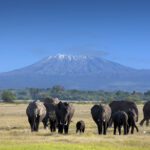
Amboseli National Park, Kenya. Amboseli offers unobstructed views of Mount Kilimanjaro across the Tanzanian border. The mountain is most visible in the early morning before heat haze builds. Elephant herds move through the marsh at that hour. The park’s open terrain makes logistics straightforward and the visual context hard to match.
Tsavo East National Park, Kenya. Tsavo East is less visited and more raw. The landscape is red volcanic soil, wide plains, and large elephant herds with a distinctive rust-colored tinge from the dust. Camps here use bush breakfasts to reach spots that see very little vehicle traffic, which gives the experience a different quality from the busier parks.
Beyond Breakfast: Sundowners and Bush Dinners
Bush dining extends beyond the morning hours.
Sundowners are the late-afternoon equivalent. A guide drives guests to a viewpoint or open plain as the sun drops toward the horizon, and a small folding table is set with drinks, usually wine, beer, or gin and tonic, alongside light snacks. The timing is calibrated to the sunset, typically around 6:00 to 6:30 PM. The stop runs for 30 to 45 minutes and returns to camp before full dark. The mood is quieter than a breakfast stop. The day’s drives are done, the heat has dropped, and the plains take on a different color.
Bush dinners take place after dark. The setup is more involved: a cleared area near camp or a designated outdoor spot, lanterns or torches for light, and a full dinner service. A camp ranger usually stands a perimeter watch during the meal. Bush dinners are less about wildlife watching and more about atmosphere. The night sounds change the experience entirely: insects, nightjars, and the occasional distant call of a hyena or lion somewhere out in the dark.
Not every camp offers all three formats. Sundowners are the most widely available. Bush breakfasts require more early-morning coordination and are sometimes offered only on request or as a premium add-on to full-board packages. Bush dinners are the least common and are often weather-dependent.
Explorer Notes
Confirm availability before you book. Bush breakfasts are not standard at every camp. Some restrict outdoor dining to certain seasons or specific package tiers. Ask explicitly when confirming your itinerary.
Dress for the morning temperature. Even in equatorial Africa, early mornings in highland parks can drop into the low teens Celsius. A light fleece goes in the game drive bag regardless. The same cold that makes morning drives comfortable makes that first cup of coffee welcome for practical reasons, not theatrical ones.
Weather can cancel a bush breakfast. Camps call off outdoor setups if rain is likely, and the correct ones do not apologize for it. Wet linen in open country is unpleasant, and lightning risk in open plains is real. Most camps will offer a covered terrace alternative.
Photography timing is short. The best directional light at a bush breakfast location lasts roughly 30 minutes after sunrise. If that matters to you, mention it to your guide. Most experienced guides already know and will time the stop accordingly.
Dietary needs require advance notice. A bush setting limits what can be improvised more than a full kitchen does. If you have a significant dietary restriction, flag it when you book and confirm it again on arrival.
Conclusion
A bush breakfast on safari replaces some of the routine of a travel day with something less predictable and more grounded in where you actually are. The food is secondary to the location. What makes the experience worthwhile is the combination of setting, time of day, and the fact that everything around you is operating on its own schedule, entirely indifferent to your meal.
If it is on offer at a camp you are considering, it is worth requesting.
Turn this reading into a real itinerary with help from a Kenya-based safari team.
Start Planning Your Safari