Once a beach holiday in Diani starts to settle in, many travelers hit the same decision point: stay by the ocean the whole time, or use a few days to see wildlife inland. If that second option is on the table, the next question usually comes fast. Should the trip go toward Amboseli, or toward Tsavo?
That is where a lot of planning guides get vague. They tell readers both parks are excellent, which is true, but they stop short of explaining how the experiences actually differ. A 3 day safari from Kenya coast can feel very different depending on which park you choose. Amboseli offers concentrated elephant viewing and the visual drama of Kilimanjaro. Tsavo offers scale, geological variety, and a stronger sense of wilderness. This guide breaks down the difference in a way that helps readers match the park to their travel priorities. For the wider coast-to-bush planning layer, pair it with the Safari from Diani Beach guide.
Start With the Right Question
The useful question is not “Which park is better?” It is “Which park fits the trip I want this time?”
An Amboseli safari from Diani Beach often suits travelers who want high-yield sightings, iconic imagery, and a more readable first safari. A Diani Beach to Tsavo 3 days plan often suits travelers who care more about atmosphere, landscape range, and the feeling of being in a larger, less concentrated wilderness system. Readers leaning toward the Tsavo option can compare this with the dedicated 3-day Tsavo route guide.
Both parks can work within a 3-day window from the coast. Both ask for early starts and efficient road transfers. Both can justify the shift from palm-fringed beach to inland bush. But they are not interchangeable.
Choose Amboseli If You Want Clarity and Iconic Wildlife Scenes
Amboseli is compact by safari standards, and that compactness helps. Wildlife is easier to locate, the park’s major viewing areas are more concentrated, and the best-known scenes are instantly recognizable.
Readers often lean toward Amboseli if:
- this is their first safari
- they want strong elephant sightings
- they care about photography
- they want the Kilimanjaro backdrop
- they are traveling with family or mixed-interest groups
The park is built around a swamp system fed by underground water from Kilimanjaro. During the dry season, that water draws animals in from the surrounding plains. The result is a landscape where game-viewing logic makes intuitive sense. Drive toward water, and wildlife often follows.
That is one reason a Diani to Amboseli safari can feel rewarding even in a short format. The park is small enough to be productive quickly, but varied enough to keep the experience from feeling repetitive.
Choose Tsavo If You Want Space, Variety, and a Wilder Mood
Tsavo is a different proposition. It is not one park in the experiential sense, but a huge protected system divided into Tsavo East and Tsavo West. Together they create one of Kenya’s largest wilderness regions.
Readers often lean toward Tsavo if:
- they want fewer vehicles around them
- they enjoy dramatic landscapes as much as wildlife sightings
- they have already done one classic safari elsewhere
- they want the trip to feel bigger and less curated
- they are drawn to red-earth scenery, lava fields, springs, and long horizons
Tsavo East is flatter, drier, and more associated with the Galana River, Lugard Falls, and the famous red elephants. Tsavo West is more topographically varied, with lava flows, Mzima Springs, crater country, and thicker vegetation in places. If someone asks for a Tsavo Amboseli comparison, this is the first real split to understand: Amboseli concentrates the experience, while Tsavo spreads it out.
That does not automatically make one better. It changes the rhythm. In Amboseli, viewers often feel close to the action early. In Tsavo, the reward is often cumulative. The park reveals itself more gradually.
Wildlife Differences That Matter to Travelers
For many people, wildlife is still the main deciding factor. This is where the two destinations separate clearly.
Amboseli
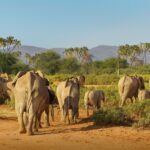
Amboseli is best known for elephants, and not only because of the mountain backdrop. The park has one of the most studied elephant populations in the world through the Amboseli Elephant Research Project. That research depth gives elephant sightings extra context. Families, matriarch behavior, and generational continuity are not abstract ideas here.
Other realistic Amboseli expectations include:
- buffalo
- lion
- cheetah
- zebra
- giraffe
- wildebeest
- heavy birdlife around wetlands and swamps
The main advantage for first-timers is concentration. Wildlife does not always feel easy in Amboseli, but it often feels legible.
Tsavo
Tsavo’s wildlife experience is more dispersed, but often more atmospheric. Elephants are still central, especially the dust-coated herds associated with Tsavo East. Lions here are famous for their often reduced manes. Leopard, buffalo, giraffe, antelope, crocodiles, hippos, and a wide bird list all contribute to the feeling of abundance, but the sightings often unfold across a much larger visual field.
The point is not that Tsavo has less wildlife. It is that wildlife is encountered in a different style. For a reader asking Amboseli or Tsavo which is better, the answer depends on whether the priority is density and iconic framing, or scale and immersion.
Landscape and Photography: This Is Often the Real Divider
Some travelers think they are choosing based on animals, then realize later they were really choosing based on visual atmosphere.
Amboseli’s signature frame is obvious: elephants on open plains with Kilimanjaro behind them, especially on clear early mornings. That visual shorthand is powerful for photographers and for travelers who want a safari that immediately feels like the image they had in mind before arriving in Kenya.
Tsavo works differently. It is a park of textured geology and changing terrain. Red soil, dry woodland, river lines, volcanic formations, and spring-fed sections create a more varied visual story. Instead of one iconic frame, Tsavo offers mood, scale, and contrast.
For readers comparing Diani Beach safari options, this often becomes the cleanest distinction:
- Choose Amboseli for iconic clarity.
- Choose Tsavo for atmospheric range.
What a 3-Day Itinerary Usually Feels Like
A best safari from Diani 3 days plan is always a compromise between transfer time and wildlife time, but not necessarily a bad one. Three days is long enough to feel that the trip has structure rather than being a rushed overnight sprint.
Day 1
Departure from Diani usually happens early. Travel time is shorter for Tsavo West than for Amboseli, though exact routing matters. After arrival, most itineraries settle in quickly and use the afternoon for a first game drive. This is often the moment when the coast-to-bush contrast lands properly.
Day 2
Day 2 is the heart of the trip. There is usually a dawn start, extended time in the park, and the strongest wildlife window of the itinerary. In Amboseli, that may mean swamp zones, elephant families, and long mountain views if cloud conditions cooperate. In Tsavo, it may mean river sections, springs, lava country, or a broader circuit built around landscape diversity.
Day 3
The final morning usually includes either a short game drive or another guided activity before the return to Diani. It is enough time to leave with a coherent memory of the place, which is really what matters in a three-day format. Readers who already know they want a longer inland chapter can continue from here to the 5-day Tsavo and Amboseli route guide.
Walking Safaris: A Detail Worth Checking
One of the more meaningful differences between itineraries is whether guided walking is actually available. A standard vehicle safari gives scale, reach, and the ability to cover ground. Walking does something else. It slows the landscape down.
An Amboseli walking safari or a walking session near Tsavo typically happens outside the core park areas, usually on conservancy land or in adjoining buffer zones where it is permitted and guided correctly. That matters because some itineraries mention walking loosely, while others do not offer it at all.
For readers considering Kenya safari choice in a short format, a walking component can change the tone of the trip in a major way. On foot, smaller details suddenly matter:
- tracks and spoor
- plant texture
- bird movement
- wind direction
- animal sign in the soil
Travelers who want the bush to feel more tactile and less vehicle-bound should ask directly whether walking is part of the actual itinerary or just a possible add-on.
Conservation Context: Why These Parks Matter Beyond the Trip
Amboseli and Tsavo are not only scenic destinations. They are major conservation landscapes with very different stories.
Amboseli’s global reputation is closely tied to elephant research. The long-running Amboseli Elephant Research Project has shaped how people understand elephant family structure, memory, and long-term behavior. For readers who want wildlife sightings to carry scientific context, that matters.
Tsavo’s conservation story is more spatial and more community-linked. The wider Tsavo landscape connects park systems, local communities, corridor areas, and buffer zones. In practice, that means the future of wildlife here depends not just on formal park boundaries but on how surrounding land is managed and valued.
Readers do not need a full conservation lecture to appreciate the trip, but understanding this difference can sharpen the experience. Amboseli often feels like a park defined by a famous species and a famous mountain. Tsavo often feels like a living system whose scale extends beyond a single postcard image.
Explorer Notes
- Choose Amboseli for first-safari confidence, elephant density, and mountain-backed photography.
- Choose Tsavo for range, wilderness mood, and more varied geology.
- If time is tight, be realistic about transfer hours before choosing the farther option.
- Ask whether walking is included, optional, or unavailable.
- In Amboseli, early visibility on Kilimanjaro matters more than many travelers expect.
- In Tsavo, patience matters more than many first-time safari guests expect.
Frequently Asked Questions
Is Amboseli or Tsavo better from Diani Beach?
Neither is universally better. Amboseli is often better for first-time safari travelers and iconic elephant photography. Tsavo is often better for travelers who want scale and a wilder atmosphere.
Which park is closer to Diani?
Tsavo West is generally closer than Amboseli, so it often involves less transfer time from the coast.
Is three days enough for either park?
Yes, three days is enough for a meaningful trip to either destination, though it remains a compact safari rather than a deep exploration.
Are walking safaris available?
Sometimes, yes, but usually outside the core park on conservancy or permitted adjacent land. Travelers should confirm the exact setup before assuming it is part of the plan.
Which park is better for photography?
Amboseli is stronger for classic elephant-and-Kilimanjaro imagery. Tsavo is stronger for mood, red-earth atmosphere, and broader landscape variety.
Conclusion
A 3 day safari Diani Beach Amboseli itinerary makes sense when the priority is concentrated wildlife viewing and iconic imagery. A Tsavo-based route makes sense when the priority is scale, atmosphere, and the feeling of entering a larger wilderness system. That is the most useful way to frame the choice.
For readers planning from the coast, the decision does not need to be abstract. Think about what kind of memory matters more: the clean, unforgettable frame of elephants beneath Kilimanjaro, or the slower accumulation of red earth, springs, rivers, and open wild country. Once that answer is clear, the right park usually is too.
Every trip described here can be tailored: dates, budget, camps, and pace built around you.
Get a Personalised Safari