

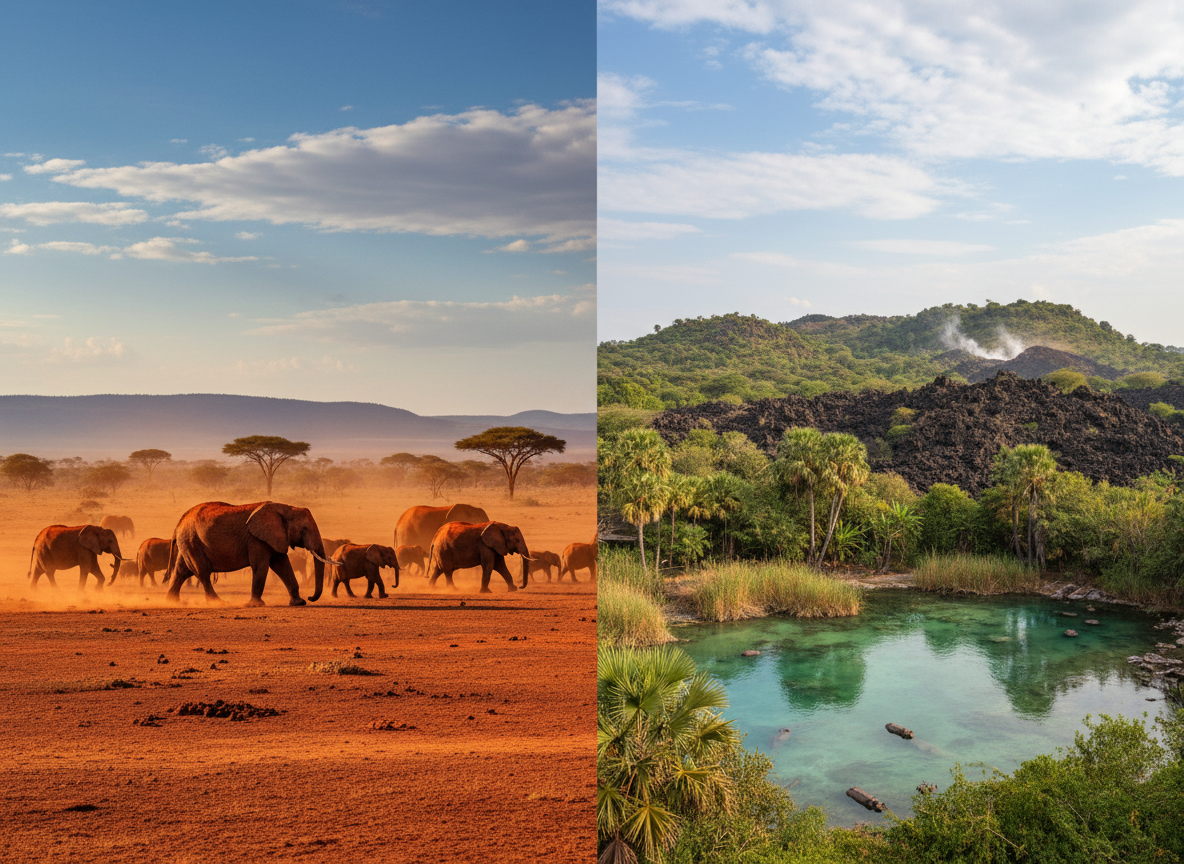
Together, Tsavo East and Tsavo West form one of the largest protected wildlife areas on Earth. But the two parks are separated by the Nairobi to Mombasa highway and offer very different safari experiences. The tsavo east vs tsavo west comparison is one that many Kenya travellers face: particularly those doing a Mombasa road trip or combining the Tsavo parks with the Masai Mara or the coast.
This guide from Trunktrails Safaris explains the key differences across wildlife, scenery, accessibility, accommodation, and who each park suits best.
Overview
Tsavo East National Park covers approximately 13,747 km2, making it Kenya’s largest national park. It is characterised by flat, semi-arid plains, open scrubland, and the Galana River. The landscape is sparse and dramatic, with the red volcanic soils that give the famous Tsavo elephants their distinctive colour.
Tsavo West National Park covers approximately 9,065 km2. It sits on the western side of the Mombasa highway and has a more varied landscape: volcanic hills, lava flows, wetlands, and the Mzima Springs. Kilimanjaro is visible on clear days from the western section.
Both parks are in southeastern Kenya, accessed from Nairobi via the Mombasa highway (approximately 200 to 250 km from Nairobi) or from Mombasa heading inland.
Wildlife: Tsavo East vs Tsavo West
Tsavo East Wildlife

Tsavo East is famous for its large elephant herds: often numbering in the hundreds: that are coated in the distinctive red volcanic dust of the park’s soils. These red elephants are iconic and a defining Tsavo East experience.
The park also supports lion, leopard, cheetah, buffalo, hippo, and Nile crocodile along the Galana River. Gerenuk, lesser kudu, and fringe-eared oryx add species diversity. Rhino are present in specific protected areas. Birdlife is exceptional with over 500 species.
The open plains and sparse vegetation of Tsavo East give good visibility for wildlife spotting, though the vastness of the park means sightings can require driving time to locate.
Tsavo West Wildlife

Tsavo West has a slightly higher diversity of habitats: volcanic hills, wetlands, riverine forest, and open savannah: which supports a different mix of wildlife. Black rhino are found in the Ngulia Rhino Sanctuary within Tsavo West, making it one of Kenya’s better parks for rhino viewing. Hippo are abundant at Mzima Springs. Leopard, lion, and cheetah are all present.
The varied topography of Tsavo West creates habitat diversity that supports species not as common in Tsavo East’s open plains. Birdwatching is exceptional: Ngulia Lodge is a globally recognised birdwatching site particularly during migration season.
Summary: Wildlife
| Feature | Tsavo East | Tsavo West |
| Elephants | Very large herds (red elephants) | Good populations |
| Rhino | Present in protected areas | Ngulia Sanctuary (more reliable) |
| Hippo | Galana River | Mzima Springs (very good) |
| Lion/Leopard/Cheetah | Present | Present |
| Gerenuk/Lesser Kudu | Yes | Less common |
| Birdlife | Exceptional (500+ species) | Exceptional (Ngulia migration site) |
| Habitat diversity | Open semi-arid plains | Varied (hills, wetlands, lava) |
Scenery and Landscape
Tsavo East is vast, flat, and elemental. The red laterite soils, the sparse acacia scrub, and the enormous skies create a landscape of raw, almost harsh beauty. The Galana River and Lugard’s Falls provide dramatic focal points. The Yatta Plateau: the world’s longest lava flow: runs along the northern section.
Tsavo West is more visually varied. The Chyulu Hills provide a green, forested backdrop. Mzima Springs: where crystal-clear water bubbles from an underground lava system and supports hippo and crocodile: is one of Kenya’s most extraordinary natural features. Volcanic cones and ancient lava flows add geological interest.
Travellers who want dramatic open plains choose Tsavo East. Travellers who want more diverse scenery, including hills, springs, and volcanic formations, tend to prefer Tsavo West.
Accessibility

Both parks are accessible from Nairobi via the A109 Mombasa highway. The main gates are approximately:
- Tsavo East (Voi Gate): Around 340 km from Nairobi, approximately four hours by road
- Tsavo West (Mtito Andei Gate): Around 240 km from Nairobi, approximately three hours by road
Tsavo West is slightly closer to Nairobi, making it more commonly included in shorter itineraries from the capital. Both parks are also accessible from Mombasa for travellers combining safari with a coast stay: Tsavo East is closer to Mombasa.
Bush flights serve both parks from Wilson Airport in Nairobi and from Mombasa.
Accommodation
Tsavo East has a moderate range of accommodation including Satao Camp, Ashnil Aruba Lodge, Severin Safari Camp, and Ndololo Camp. Options are primarily mid-range, with a limited ultra-luxury selection.
Tsavo West has Kilaguni Serena Safari Lodge (one of Kenya’s oldest safari lodges, located at a waterhole), Severin Safari Camp, Finch Hattons Luxury Tented Camp (a renowned luxury property), and several mid-range options.
Both parks are less developed for tourism than the Masai Mara, which is part of their appeal: quieter, less commercial, and genuinely remote.
Which Should You Choose?
Choose Tsavo East if:
- Seeing very large elephant herds: including the famous red elephants: is your priority
- You want the classic open, vast savannah landscape
- You are combining with the Kenya coast from Mombasa
- Birdwatching is a key interest and you want the open-country species
- You want a less-visited park with a strong sense of space and remoteness
Choose Tsavo West if:
- Rhino viewing is a priority (Ngulia Sanctuary)
- You want varied scenery including springs, volcanic hills, and Chyulu Hills views
- Mzima Springs is on your list (hippo and crocodile through an underwater viewing window)
- You are heading from Nairobi and want the closer option
- Birdwatching during migration season (October to November) is a specific goal
Combine both: Many Trunktrails Safaris itineraries covering the Tsavo region include both parks in a single circuit: entering Tsavo West from Nairobi and exiting through Tsavo East toward Mombasa or vice versa. The parks share a boundary and flow naturally together.
At Trunktrails Safaris, our tours and safaris team designs Tsavo itineraries as standalone experiences or as part of a broader Kenya circuit combining Tsavo with the Masai Mara or the coast.
Quick Comparison: Tsavo East vs Tsavo West
| Factor | Tsavo East | Tsavo West |
| Size | 13,747 km2 | 9,065 km2 |
| Red elephants | Yes (iconic) | Less prominent |
| Rhino | Protected areas | Ngulia Sanctuary (reliable) |
| Mzima Springs | No | Yes |
| Scenery | Open plains, red soil | Varied: hills, lava, wetlands |
| Distance from Nairobi | ~340 km (4 hrs) | ~240 km (3 hrs) |
| Distance from Mombasa | Closer | Further |
| Crowd levels | Very low | Low |
| Accommodation | Mid-range focused | Mid-range to luxury |
| Best combined with | Mombasa coast, Masai Mara | Nairobi day trip, Tsavo East loop |
Plan Your Tsavo Safari with Trunktrails Safaris
Whether you want a Tsavo East red elephant safari, a Tsavo West springs and rhino experience, or a full Tsavo circuit combining both, Trunktrails Safaris can design the right itinerary. Our tours and safaris team operates across Kenya’s parks and knows which camps, routes, and timings work best for each part of the Tsavo ecosystem.
Contact Trunktrails Safaris today and let us plan your Tsavo safari.