

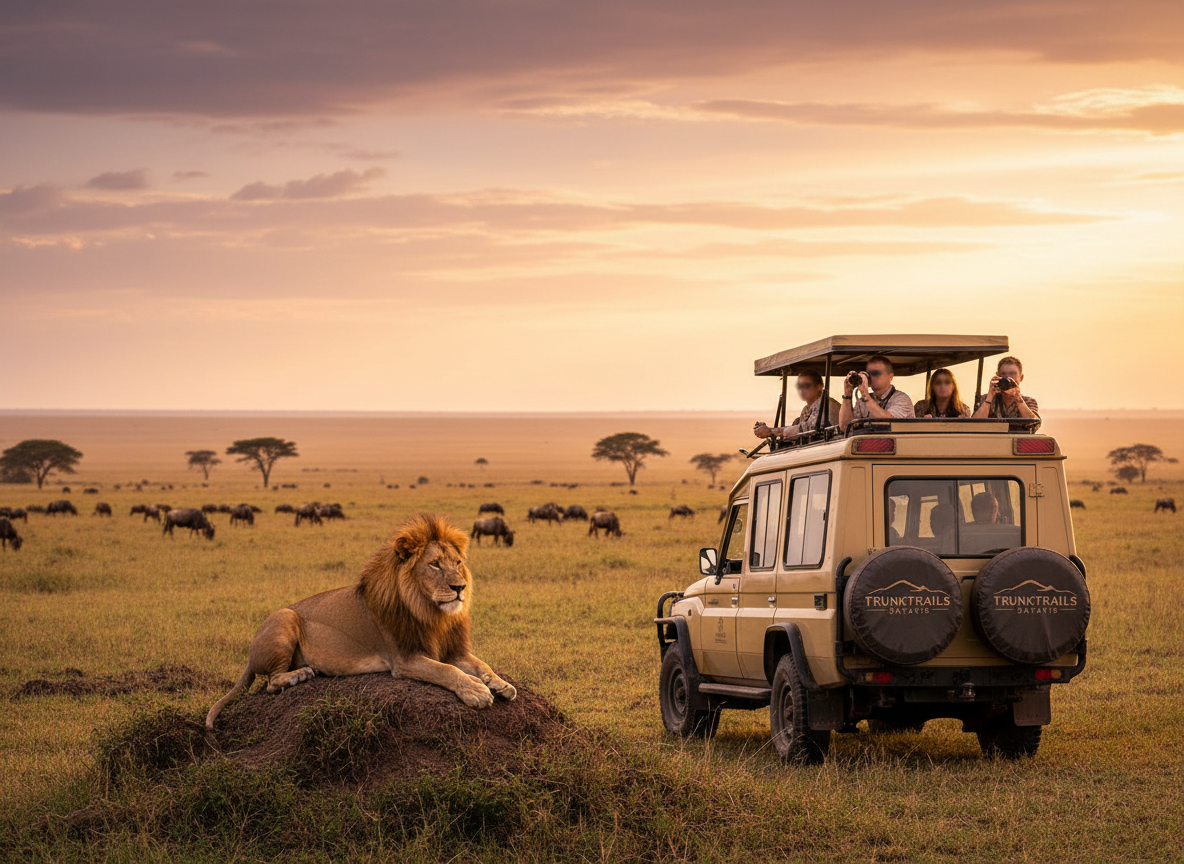
For most first-time Kenya safari visitors, game drives: in a modified 4WD vehicle with a pop-up roof: are the default and expected format. But for travellers looking for a deeper, more immersive connection to the bush, a walking safari kenya offers something that no vehicle can replicate: the full sensory experience of being in the African wilderness on foot.
This guide from Trunktrails Safaris compares walking safari and vehicle safari across every dimension that matters: safety, wildlife access, physical requirements, what you actually experience, and where in Kenya each option is available.
What Is a Vehicle Safari?

A vehicle safari: or game drive: is conducted in a modified 4WD Land Cruiser or Land Rover with a pop-up roof that allows standing and 360-degree views. You travel with a guide/driver who navigates the reserve, uses radio communication to locate wildlife, and narrates what you are seeing.
Vehicle safaris allow you to:
- Cover large distances across the reserve in a single drive
- Approach and observe a wide range of species safely
- Photograph wildlife from a stable platform at appropriate distances
- Move quickly between sightings
- Be at eye level with large predators while remaining protected
The vehicle is accepted by wildlife as a neutral object in the environment: lions, cheetah, and elephants routinely allow vehicles within 10 to 20 metres because they associate vehicles with neither predator nor prey.
What Is a Walking Safari?
A walking safari masai mara: more accurately called a guided bush walk: is conducted on foot with an armed, trained guide. In the Masai Mara National Reserve itself, walking safaris are not permitted. They are available in the private conservancies surrounding the reserve, where different rules apply.
A walking safari kenya typically involves:
- Groups of two to six guests maximum
- An armed professional guide (Kenya Professional Safari Guides Association trained)
- A focused walk of two to three hours, typically in the morning
- Covering three to eight kilometres on foot through the bush
- Reading tracks, identifying plants and insects, and understanding the ecosystem at ground level
The walking safari changes your relationship with the bush fundamentally. You are no longer an observer watching from above: you are present in the environment, aware of wind direction, listening to birdsong, reading the ground for signs.
Wildlife on a Walking Safari
The walking safari experience kenya differs from a game drive in how wildlife is encountered, not necessarily how much wildlife is seen.
Large predator avoidance: Walking safaris are not designed to approach lion, elephant, or buffalo. The guide is trained to detect and avoid dangerous animals. If a predator is encountered at close range, the group stops and the guide manages the situation. This is rare, but it is why the guide is armed.
Small wildlife revelation: Walking safaris reveal the wildlife that vehicles drive past without noticing: insects, tracks, pellets, bark markings, dung beetles, hornbills, mongoose, and the smaller mammals and reptiles that are invisible from a vehicle. A walking safari often produces a profound shift in how you perceive the bush.
Tracking: Following lion, elephant, or leopard tracks on foot to establish their movement and position: without necessarily encountering them directly: is one of the most skilled and rewarding elements of the guided walking safari experience.
Safety
The is walking safari safe kenya question is the first thing most first-time walkers ask. The honest answer is: yes, walking safaris are safe when conducted properly with a trained, armed guide, in an area approved for walking, with appropriate protocols.
Key safety elements:
- Armed escort with a professional rifle (usually .458 or .375 calibre)
- Mandatory guide training and certification
- Group size limits (small groups move quietly and are easier to manage)
- Pre-walk briefing on protocols: how to walk, where to step, when to stop, absolute silence requirements
- No walking during dangerous periods: no night walks with large predator presence nearby
Incidents on properly conducted walking safaris in Kenya are extremely rare. The overwhelming majority of guests describe the experience as exhilarating rather than frightening.
Key Differences: Walking Safari vs Vehicle Safari
| Factor | Walking Safari | Vehicle Safari |
| Coverage area | Small (3 to 8 km per walk) | Large (50 to 100+ km per drive) |
| Large wildlife sightings | Indirect/tracking focus | Direct, close approach |
| Small wildlife and tracking | Exceptional | Limited |
| Physical requirement | Moderate fitness, walking ability | None |
| Sensory immersion | Total: wind, sound, smell, ground | Partial: primarily visual |
| Safety | Yes, with trained armed guide | High: vehicle as protective barrier |
| Duration | 2 to 3 hours | 3 to 5 hours (morning or afternoon) |
| Availability | Private conservancies only | National Reserve and conservancies |
| Children | Age 12+ typically | All ages (depending on camp) |
| Cost | Supplement or included at some conservancy camps | Standard included game drive |
Where Walking Safaris Are Available in Kenya

Walking safaris in the Masai Mara ecosystem are available in the private conservancies: Olare Motorogi, Naboisho, Mara North, Ol Kinyei, and others: but not inside the Masai Mara National Reserve itself (reserve regulations prohibit foot safaris).
Other Kenya locations with excellent walking safari offerings:
- Laikipia Plateau (Ol Pejeta, Borana, Ol Jogi)
- Chyulu Hills (near Tsavo West)
- Lewa Wildlife Conservancy
- Northern Kenya (Samburu area private conservancies)
Which Should You Choose?
Choose vehicle safari as your primary activity if:
- You want to see as many species as possible across a large area
- Large predator encounters and river crossings are your priority
- You are travelling with children under 12
- Physical fitness or mobility is a consideration
- This is your first safari and you want the maximum wildlife coverage
Add a walking safari if:
- You want the full sensory, immersive bush experience alongside game drives
- Tracking, bush craft, and small wildlife interest you as much as big game
- You are staying in a private conservancy where walking is available
- You are a return visitor looking for a deeper layer to the safari experience
The best Masai Mara itineraries at Trunktrails Safaris combine both: multiple vehicle game drives as the core, with one or two morning bush walks in a conservancy for the immersive ground-level experience.
Plan Your Kenya Safari with Trunktrails Safaris
Whether you want a classic vehicle safari, a conservancy with walking safari access, or a full combination itinerary, Trunktrails Safaris will design the right Kenya safari for you. Our tours and safaris team knows which Masai Mara conservancy camps offer the best walking safari experience and can match you to the right guide.
Contact Trunktrails Safaris today and tell us what kind of safari experience you are looking for.