
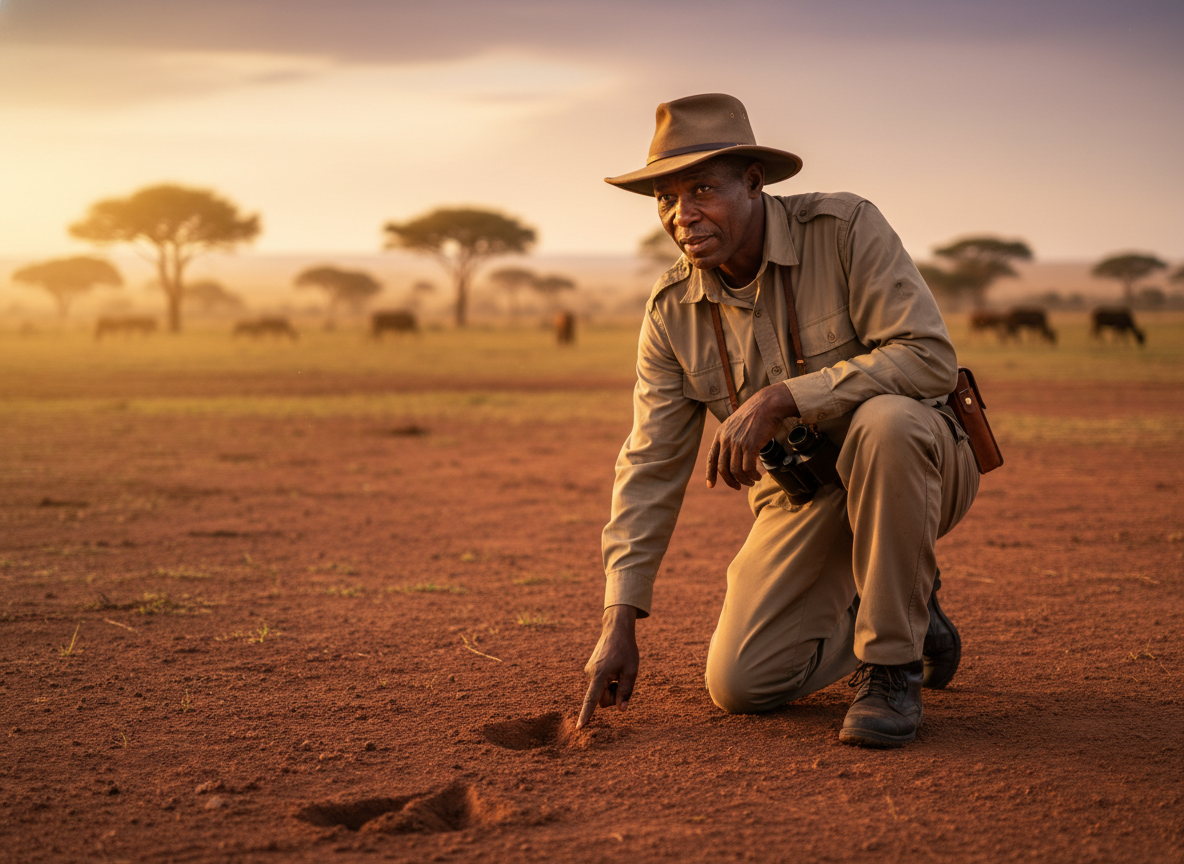
The lodge can be extraordinary. The timing can be perfect — peak migration, golden light, dry season reserves at their clearest. But if the guide lacks depth, the safari will be ordinary. No amount of careful planning or well-chosen accommodation compensates for someone who does not know how to read the landscape or bring it to life.
Most travelers spend months researching destinations, seasons, and camps. Very few spend equivalent time on the one question that shapes the experience more than any other: who is actually sitting in the front seat?
Knowing what to look for in a safari guide, and how to assess quality before you arrive, is the most useful preparation a traveler can do.
Certifications and What the Tiers Actually Mean
The credible guide certification systems in Africa use tiered structures that require progressive field testing, written examinations, and documented experience in the field.
In Kenya, the Kenya Professional Safari Guides Association (KPSGA) grades guides at three levels: Bronze for entry-level competency, Silver for intermediate knowledge and experience, and Gold for the highest designation — awarded after years of active guiding and a comprehensive field assessment. The Field Guides Association of Southern Africa (FGASA) operates a comparable graded pathway used across Tanzania, Botswana, Zambia, and South Africa.
A Bronze grade indicates baseline competency. Gold indicates serious accumulated depth. When asking an operator about their guides, request the specific tier, not just whether the guide is “certified.” The distinction matters.
Certification is not the full picture. Some of the most knowledgeable guides in Africa came up through apprenticeships, family involvement in conservation over generations, or decades of self-directed study. Certification confirms formal training; it does not replace years of field time.
Look for:
- KPSGA Gold or FGASA Level 2 or above
- A minimum of five years of guiding experience in the specific ecosystem you are visiting
- Regional specialization — savanna, forest, desert, and coastal guides have different knowledge sets
- Evidence of continued learning beyond the certification exam
What to Look for in a Safari Guide: Reading Wildlife Behavior
This is the quality that separates a guide from a driver.
Skilled guides do not chase animals. They anticipate them. A cluster of vultures circling three kilometers out signals something specific. A small herd of zebra moving with urgency tells a different story. A lioness who tilts one ear toward a stand of tall grass and holds position for a fraction too long is communicating something that an experienced guide will recognize before anyone else in the vehicle does.
Guides who read behavior arrive at sightings before the action starts. They follow fresh tracks crossing the road and redirect quietly. They watch the horizon. They notice when elephants shift posture in a way that signals mild agitation, and they know when to back the vehicle away before any visible stress is apparent.
This intuition is built from thousands of hours in the field. There is no shortcut to it.
A guide who understands animal body language also knows when to cut the engine and stay still, when distance is more productive than proximity, and when to leave entirely. Ethical positioning and exceptional sightings are not in conflict. Calm animals behave naturally, and natural behavior is what most travelers come to see.
Knowledge That Extends Beyond the Big Five
Any guide can identify a giraffe. A guide with depth tells you it is a reticulated giraffe specific to northern Kenya rather than the Masai giraffe found further south, explains the patterning difference, and notes that the individual you are watching has been observed in this corridor across three successive dry seasons.
That depth shows up across categories:
- Bird identification by call, not only visual — East Africa alone hosts over 1,000 species
- Reading spoor: tracks, scat, territorial scrape marks, and scent posts
- Plant knowledge: which species indicate seasonal water sources, medicinal uses, browse preferences by species
- Cultural history of the landscape and the communities connected to it over time
- Insect ecology, from termite mound engineering to dung beetle navigation using the Milky Way
Guides who see the full ecosystem turn a standard game drive into a layered field course. They make you notice things you had not considered before, and that shift in attention is what distinguishes a good safari from one you carry with you for years.
Communication and Storytelling
Knowledge is only useful if it can be communicated clearly. The best field guides are natural teachers who read a group, adjust their vocabulary, and know when to speak and when to stay quiet.
Silence at the right moment is its own skill. Sitting near a pride of lions at dusk with the engine off and no one speaking is an experience that running commentary would only diminish. Knowing when to create that silence, and holding it, is something skilled guides do deliberately.
Look for guides who:
- Speak your language fluently and without significant effort (multilingual guides are common and genuinely valuable in international safari contexts)
- Adjust the depth and direction of information to match your interests — photographic timing, behavioral ecology, conservation policy, or cultural history
- Share personal field observations and stories rather than reciting standard descriptions
- Read the group’s energy and adapt — a family with young children has different needs than two ornithologists on a dedicated birding trip
Safety, Composure, and Vehicle Positioning
A qualified guide makes the field feel safe without making safety the constant topic of conversation.
This comes from technical competence: knowing how to position a vehicle relative to wind direction and sightlines, recognizing the body language cues that precede a charge, and maintaining calm during close encounters so that no one in the vehicle escalates the situation by panicking. An experienced guide has been in dozens of tense scenarios. Their composure in those moments is what regulates everyone else.
Watch out for guides who take unnecessary risks to achieve a closer photograph, who ignore stress signals in animals for the sake of proximity, or who appear uncertain when explaining safety protocols on a walking safari. These patterns indicate someone who prioritizes spectacle over judgment, which carries real risk in the field.
Flexibility and Personalization
A safari that treats every guest identically is a missed opportunity.
Skilled guides adapt to the group. Photographers need vehicle positioning that accounts for light direction and clean backgrounds. Serious birders want to slow down at habitat transitions. Some travelers want every sighting narrated in detail; others want to sit quietly in the presence of something remarkable without explanation. The guide who recognizes which mode is needed, and shifts into it without prompting, is operating at a high level.
Ask operators directly:
- Do guides adapt drives based on the interests of the specific group?
- How much flexibility exists in timing and route choices within the reserve?
- Are there specialist guides available for walking safaris, night drives, or photography-focused itineraries?
How to Vet a Guide Before You Arrive
Most travelers meet their guide for the first time at the airstrip. You can still assess quality well before that.
Questions worth putting to any operator or lodge:
- What KPSGA or FGASA certification level do your guides hold?
- How long have your guides been guiding specifically in this reserve or region?
- Will I have the same guide throughout the trip, or do guides rotate?
- Can I read guest reviews that mention guides by name?
- Do you have specialist guides for walking, night drives, or birding?
Red flags in the responses:
- Vague or deflecting answers about certification tiers
- High guide turnover presented as standard
- Guides who function as general lodge staff with guiding as a secondary role
- An absence of guest testimonials that name specific guides
Operators who take guide quality seriously are proud to discuss it. They name their guides, profile them, and connect returning guests with individuals they have asked for by name. Reluctance to engage with these questions directly is almost always worth noting.
Explorer Notes
- In Kenya, ask to see the guide’s KPSGA grade card. Gold-rated guides have met the highest field standard in the country, and operators who invest in Gold-rated staff are easy to identify quickly.
- In Tanzania, Botswana, and southern Africa, FGASA certification combined with Wilderness First Aid credentials indicates a guide prepared for both interpretation and emergencies. Ask for both.
- Night drives and walking safaris require specialist training beyond a standard guiding certification. If those activities are part of your itinerary, confirm the additional credentials separately before arrival.
- Guide-to-guest ratio shapes the experience significantly. A private vehicle with one guide focused entirely on your group is a qualitatively different setting from a shared vehicle where the guide is managing multiple competing interests at once.
The Variable That Determines Almost Everything Else
You can recover from a disappointing lodge by adjusting expectations. You can add a day if a flight is delayed. You cannot get back time in the field with a guide who is not paying attention.
The right guide changes what you notice, what you understand, and what you carry home. They are not a feature of the safari — they are the experience itself. The time spent assessing guide quality before you book is the single most productive use of your planning effort.
Turn this reading into a real itinerary with help from a Kenya-based safari team.
Start Planning Your Safari
[…] At Trunktrails Safaris, we help travelers navigate Kenya travel documents requirements daily. This comprehensive guide covers everything you need to know about Kenya visa process so you can focus on planning your adventure. […]