The Serengeti migration is one of the few wildlife events that genuinely earns the word extraordinary. More than two million wildebeest, zebras, and gazelles trace a continuous loop through the Serengeti-Mara ecosystem, driven by rain patterns and the perpetual search for fresh grass. No other land migration on Earth comes close in scale.
But the migration is also consistently misunderstood, and that misunderstanding costs travelers the experience they came for.
This article explains how the migration actually works, what happens where and when, and the planning decisions that determine whether you witness something remarkable or spend a week in the wrong part of a very large park.
The Serengeti Migration Never Stops
The most important thing to understand about the Serengeti migration is that it has no beginning or end. The herds move in a clockwise circuit through Tanzania’s Serengeti and Kenya’s Masai Mara, roughly following the rainfall and the green grass it produces. They do not pause, and they do not gather in one place and wait.
This matters for planning because “going to see the migration” is not a single decision. It requires knowing which phase of the cycle will be visible during your specific travel window, then positioning yourself accordingly.
Three phases generate the most distinctive wildlife experiences: calving season in the south, the rut and Grumeti crossings in the west, and the Mara River crossings in the north. Each has a different character, different viewing conditions, and different crowd levels.
Three Phases Worth Planning Around
Calving Season (January to March, Southern Serengeti)
Between January and March the herds gather on the short-grass plains of the southern Serengeti, centered around the Ndutu area and the Ngorongoro Conservation Area. This is calving season: roughly half a million wildebeest calves are born within a compressed six-week window.
The density of wildlife here during calving is difficult to convey. Newborn calves can stand within minutes of birth, but they are also highly vulnerable. Cheetahs, lions, hyenas, and leopards converge on the plains specifically because the hunting is so reliable. Game drives during January and February often produce multiple predator encounters in a single morning.
This phase is frequently overlooked by first-time planners who arrive fixed on seeing a river crossing. That is a genuine planning error. Calving season offers predator activity and photographic opportunity that the northern crossings do not reliably match, with smaller crowds and lower accommodation rates.
The Rut and Grumeti Crossings (May to June, Western Corridor)
By late April and May the rains on the southern and central plains ease, and the herds push northwest toward the Western Corridor. The Grumeti River runs through this stretch, and though the crossings here are smaller in scale than those on the Mara, they still involve large numbers of animals navigating crocodile-occupied water.
More notable during this window is the rut. Wildebeest mating season peaks in May and June, producing territorial behavior and open-ground activity that makes for compelling viewing. The landscape remains green and lush at this stage. Tourist numbers are well below peak levels, and the dry season has not yet arrived, so dust is minimal.
Mara River Crossings (July to September, Northern Serengeti)
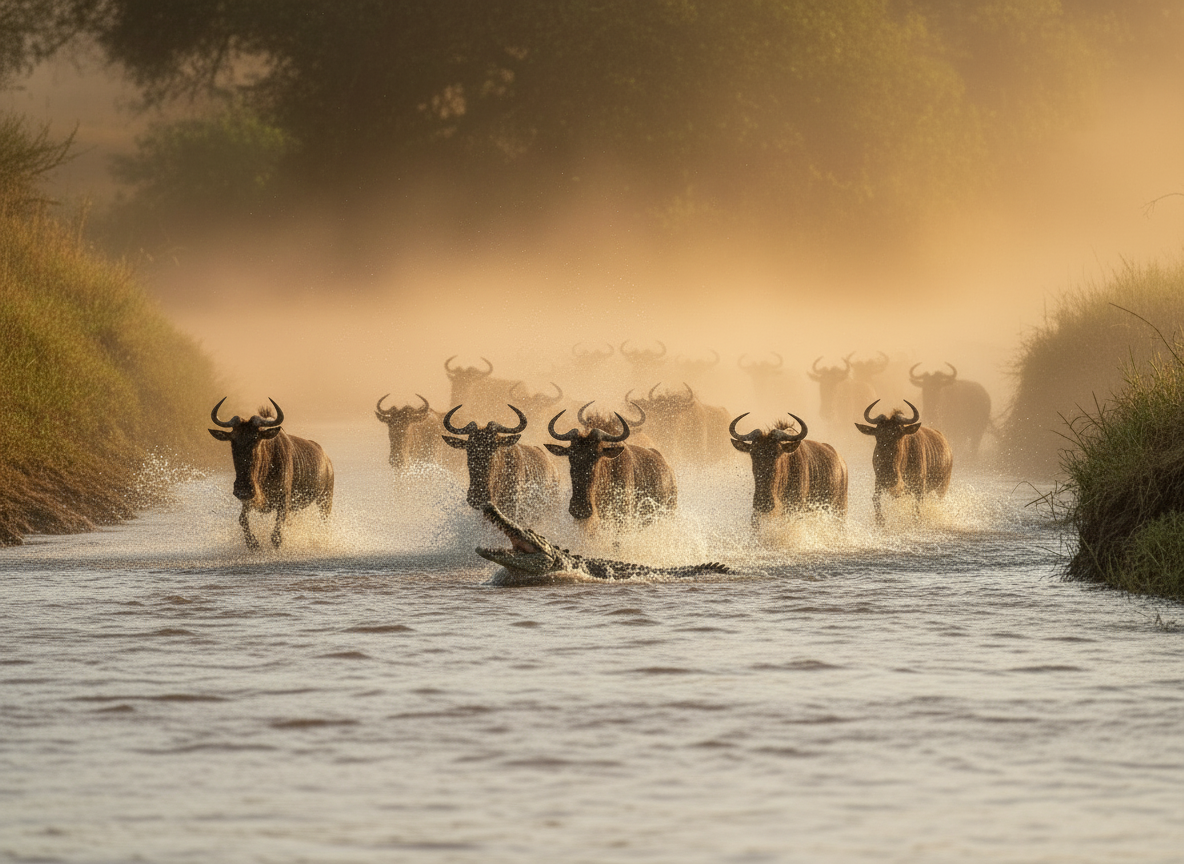
This is the phase most travelers have in mind when planning a migration safari. Between July and September the herds press into the northern Serengeti and begin crossing the Mara River into Kenya’s Masai Mara, then crossing back again as the season shifts.
The crossings themselves are chaotic. Thousands of wildebeest and zebras push into the river while large Nile crocodiles wait in the shallows. The noise, the movement, the predation — nothing about watching a Mara River crossing is passive.
What photographs do not capture: crossings are unpredictable. The herds may attempt one several times in a day, or they may hold back for three days with no clear reason. Travelers who arrive for two nights and leave disappointed are not unusual. Planning four nights minimum in the northern Serengeti during this period gives a meaningful chance of witnessing at least one crossing.
This is also peak season. Accommodation must be booked six to twelve months in advance, and prices reflect the demand.
Month-by-Month Position Guide
| Month | Where the Herds Are | Key Activity |
|---|---|---|
| January–March | Southern Serengeti, Ndutu | Calving, predator concentration |
| April–May | Central to Western Serengeti | Northward movement, long rains |
| May–June | Western Corridor, Grumeti River | Rut, Grumeti crossings |
| July–September | Northern Serengeti, Mara River | Mara River crossings |
| October–November | Northern Serengeti, moving south | Reverse crossings, short rains |
| December | Southern and Central Serengeti | Herds regathering pre-calving |
During April and May the herds are dispersed and less concentrated. Some camps close for maintenance. Access can be limited by heavy rainfall. This is the quietest and most affordable period for a Serengeti visit, though migration photography is difficult.
October and November see the herds moving south again, with further river crossings in the northern section. Prices drop from the July to September peak, wildlife activity remains strong, and afternoon rains are generally brief.
Five Planning Mistakes That Cost Travelers the Experience
Treating the Serengeti as a single destination. The park covers 5,700 square miles. Driving from the southern plains to the northern Mara River zone takes six to eight hours by road. The area that positions you well for calving is a different country from where you need to be for river crossings. Decide which phase you want to see first, then build your accommodation around that location.
Expecting a guaranteed river crossing. The herds cross when they are ready, not when you have arrived. Three nights in the northern Serengeti during peak crossing season is a minimum, not a guarantee. Four or five nights improves the odds significantly.
Ignoring calving season. The Mara River crossing holds an outsized place in migration coverage. Calving season in January and February can produce equally powerful experiences at lower prices, with better availability and less competition at game drive sites.
Choosing a fixed lodge when following the herds matters. Fixed lodges do not move. Mobile tented camps relocate seasonally to track the herds, which means you are always close to the action rather than relying on long drives to reach it. For migration-focused visits, a mobile camp in the right zone consistently outperforms a fixed lodge in the wrong one. Well-regarded operators running mobile camps in the Serengeti include Nomad Tanzania, Asilia Africa, and &Beyond.
Underestimating internal transfer time. If your itinerary covers multiple Serengeti zones, flying between camps is the practical choice. Road transfers that appear feasible on a map often consume entire days of a seven-night trip.
Explorer Notes
Budget range. A mid-range seven-day Serengeti migration safari runs roughly $4,000 to $7,000 per person, including shared game drives, domestic flights between parks, and a Ngorongoro Crater visit. Luxury mobile camps with private guides and premium locations range from $8,000 to $12,000 per person. Itineraries with helicopter transfers and exclusive private concessions reach $15,000 to $25,000 and above for seven to ten days.
Combining destinations. The Serengeti pairs naturally with Ngorongoro Crater, which offers reliable Big Five sightings independent of migration timing. A practical structure is three nights in the relevant migration zone, two nights at Ngorongoro, and an optional extension into Tarangire or Lake Manyara.
What to bring. The Serengeti is dusty in the dry season and muddy in the wet. A dust bag for camera equipment is worth carrying. Early departures — often 5:30 AM — are standard for game drives because predators are most active at dawn. Light layers and solid sun protection matter more than formal clothing.
Realistic expectations. You may not see a river crossing. You may not see a cheetah bring down a newborn calf on the open plains. Wildlife does not perform to schedule. What you are very likely to see, regardless of timing, is a landscape carrying animals at a density that most parts of the world no longer produce. That alone justifies the journey.
What to Take Away from This
The Serengeti migration rewards travelers who understand how it actually works. The event is real, the scale is genuine, and the wildlife activity it generates — at calving, during the rut, at the river — is as dramatic as the photographs suggest. But it is not concentrated in one place, it does not run on a fixed timetable, and the gap between a forgettable safari and a memorable one often comes down to choosing the right zone for your travel dates and allowing enough time once you are there.
Position matters. Timing matters. And setting aside the expectation that any single moment is guaranteed may be the most useful preparation you can make before going.
Every trip described here can be tailored: dates, budget, camps, and pace built around you.
Get a Personalised Safari