Picking a safari vehicle often gets less attention than choosing a camp or a season, yet it shapes almost every hour you spend on game drives. Knowing how to choose a Kenya safari vehicle means matching the vehicle to the parks and conservancies on your route. It is not just about picking whichever one looks good online. The wrong choice can mean a slow crawl through black cotton soil, or a vehicle that isn’t even allowed where you’re headed. Here are five factors that actually decide which vehicle works for your trip, and which one wastes your money.
1. Vehicle Types: How to Choose a Kenya Safari Vehicle That Fits Your Trip
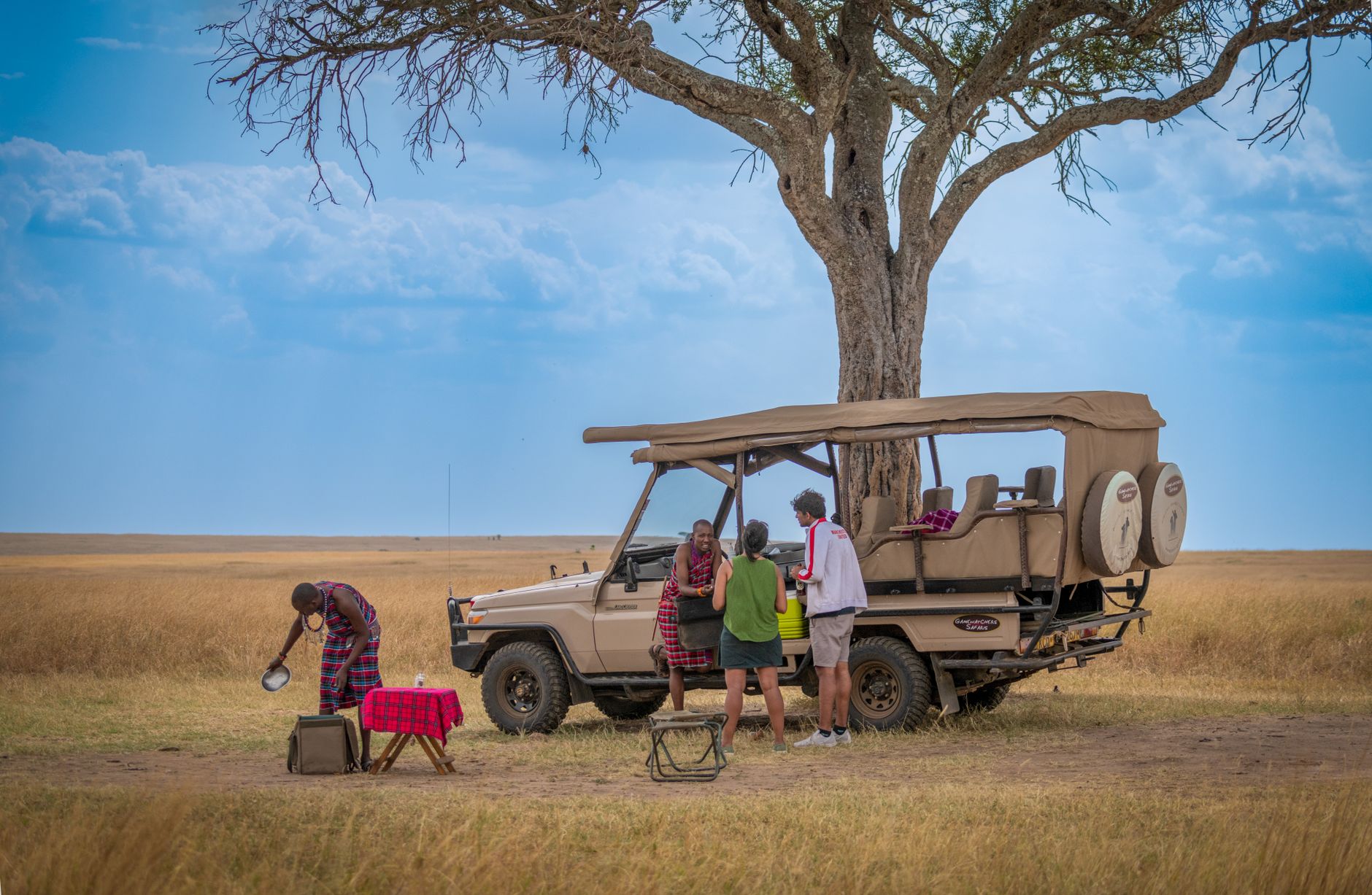
Kenya safaris run on four main types of safari vehicle. The closed 4×4 Land Cruiser with a pop-up roof is the default for private itineraries, built for both tarmac transfers and rough park tracks. Open-sided safari vehicles sit lower and open on the sides, giving a wider view and better photo angles. They’re restricted to certain areas, as you’ll see below. Safari minivans cost less and work fine for dry-season trips that stick mostly to tarmac roads, though they struggle once the ground turns muddy. Overland trucks carry larger groups across multiple countries on fixed routes and are built for distance, not close-up game viewing.
Land Cruiser vs safari van comparisons come up in almost every planning conversation. The answer usually comes down to season and road conditions rather than price alone. Most private itineraries default to the closed Land Cruiser, and for good reason. It handles nearly every road condition in the country, and every park allows it.
2. Closed vs Open-Sided 4×4: Which Parks Allow Each?
Masai Mara National Reserve and most national parks require closed-roof vehicles and ban off-road driving. Open-sided 4x4s are limited to private conservancies such as Ol Pejeta, Naboisho, and Mara North, where they pair with off-road access and night drives. Check which zones your itinerary covers before assuming an open vehicle will be available.
This is worth confirming early, because it changes what a trip actually looks like day to day. Read up on Masai Mara conservation fees and vehicle rules before booking, since the reserve itself is stricter than the conservancies around it. If open-air game drives matter to you, look at Ol Pejeta’s open-vehicle conservancy tours instead. That kind of access usually comes bundled with the conservancy stay rather than sold separately.
3. Private vs Shared: Is the Window Seat Worth the Extra Cost?
A private vehicle guarantees a window seat for every passenger and full control over how long you stay at each sighting. A shared group vehicle, usually six to seven travelers, costs meaningfully less but means splitting roof-hatch time and following a fixed group schedule. Choose private if photography drives your trip, shared if budget matters more than pace.
Private vs shared safari vehicle decisions really come down to what you want from each game drive. A photographer who needs to linger at a leopard sighting will resent a group vote to move on. A first-time traveler working through a tighter Kenya safari cost may not mind sharing. The savings can free up money for a better camp instead.
4. Group Size and Seating: How Many Fit in a Land Cruiser?
A standard Land Cruiser seats six passengers in individual window seats, plus one seat up front. Couples often get a shorter five-seat version at a lower rate. Families or groups of seven or more need either two vehicles or a van. Adding extra passengers to one Land Cruiser sacrifices the window-seat guarantee that makes it worth booking in the first place.
Safari vehicle seating sounds like a small detail until you’re the one stuck in a middle seat for a week straight. If your group is close to that six or seven mark, ask your operator directly how seats will be split. Do not assume everyone gets a window.
5. Terrain and Season: Why the Same Trip Needs a Different Vehicle
Black cotton soil in the Mara and fine volcanic dust in Amboseli can turn a minivan into a liability during the April to May and November rains. A Land Cruiser’s diff-lock and higher clearance keep you from getting stuck in those conditions. In the June to October and January to February dry months, a van becomes a reasonable trade-off on tarmac-heavy routes.
The terrain differences between Amboseli and Tsavo show up fastest in vehicle choice. Amboseli’s dust and Tsavo’s sandier tracks both favor higher clearance over comfort features, especially outside the dry season. If your route mixes parks with different ground conditions, plan around the toughest terrain on the itinerary, not the easiest.
Beyond the five factors above, a few features are worth checking regardless of vehicle type. Look for a full-height pop-up roof rather than a small hatch, individual window seats with seatbelts, a charging point, and a guide radio for sighting alerts. Wi-Fi and leather seats are nice, but they don’t change the quality of the game viewing.
Choose the Vehicle Before You Choose the Camp
Before you book a camp or lodge, ask your operator which vehicle type applies to each park and conservancy on your itinerary, and confirm how seating works for your group size. That single question can save you from a mismatched vehicle on your first game drive.
More safari planning resources
- Kenya safari packages from SafariPure
- Kenya wildlife tours from Trunktrails Safaris
- Best time to visit Kenya month-by-month map from Valley Safaris
- Compare Kenya safari packages on FindMySafari
Understanding how to choose a Kenya safari vehicle protects both your budget and your photos. Confirm the vehicle type, seating policy, and any group-size limits directly with touringinsights.com before you pay a deposit.