

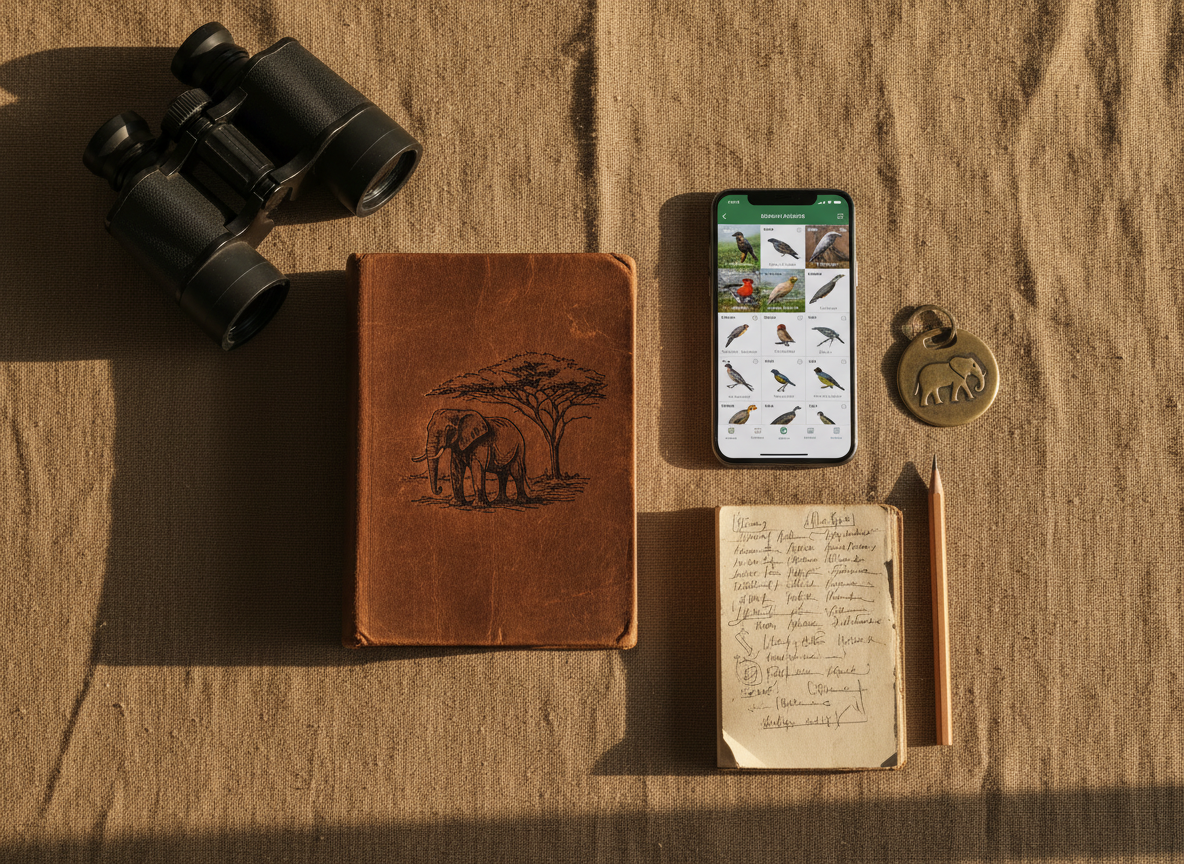
Every safari traveler faces the same pre-departure question: what wildlife reference tools should I bring? Field guides, wildlife apps, bird identification apps, and the professional safari guide who is sitting right there in the vehicle: all offer different types of information. Understanding what each does well helps you use these tools without undermining the experience.
This guide from Trunktrails Safaris compares apps, field guides, and professional guide knowledge on a Kenya safari.
Quick Comparison: Safari Apps vs Guidebooks vs Guide Knowledge
| Factor | Safari Apps | Field Guidebooks | Professional Guide |
| Wildlife ID | Fast for common species | Comprehensive; species-level detail | Instant for local species; subspecies level |
| Behavior Interpretation | Very limited | Some behavioral descriptions | Expert: real-time behavioral prediction |
| Bird ID | Merlin Bird ID: excellent | Field guides to East African birds | Expert: call identification; subspecies |
| Track Reading | Impossible | Basic in some guides | Expert: age, species, direction, behavior |
| Offline Function | Requires prior download | Always works | Always works |
| Battery Dependency | Yes | No | No |
| Current Location Data | Some have sighting maps | No | Full radio and phone network |
| Learning Depth | Shallow without context | Moderate: reference use | Deep: ecological narrative and system |
| Price | Free to $10 for premium apps | $20 to $80 for quality field guides | Included in safari cost |
| Best Use | Pre-trip learning; bird ID; plant ID | Bedside species reference; deep reading | Primary wildlife interpretation tool |
Safari Apps: The Digital Reference
What They Do Well
Safari apps have improved enormously in recent years. Key apps for Kenya safari travelers:
Merlin Bird ID (Cornell Lab of Ornithology): The single most recommended app for Kenya safari birding. Merlin covers 1,100+ East African bird species with:
- Photo identification from your own images
- Sound ID: hold the phone up and it identifies birds calling in the field
- Detailed range maps and behavioral notes
- Offline functionality after downloading the East Africa species pack
For birdwatching, Merlin is genuinely transformative. Your guide identifies the lilac-breasted roller perched on the acacia; Merlin shows you the subspecies range, its Latin name, and the call recording.
iNaturalist: Useful for plant, insect, and invertebrate identification when wildlife observation moves beyond large mammals. Also logs your sightings with GPS coordinates.
Google Lens: Unexpectedly useful in camps for identifying insects, spiders, plants, and fungi encountered around the tent at night.
What They Cannot Do
Safari apps cannot:
- Read animal behavior in real time
- Predict what an animal is about to do
- Access the guide radio network
- Identify individual animals within a known group
- Understand the ecological relationships between species in this specific ecosystem
Using a smartphone to Google a lion mid-sighting also has obvious social costs: both to the experience quality and to the guide relationship.
Guidebooks: The Printed Reference
What They Do Well

A quality East African wildlife field guide is still the most comprehensive printed resource for species-level detail. Recommended titles for Kenya:
- “Field Guide to the Larger Mammals of Africa” by Chris Stuart and Tilde Stuart: Comprehensive mammal coverage
- “The Safari Companion” by Richard Estes: Excellent behavioral ecology companion
- “Birds of East Africa” by Terry Stevenson and John Fanshawe: The standard East African bird reference (900+ species)
- “Wildlife of East Africa” by Martin Withers and David Hosking: Compact, practical field companion
Guidebooks reward pre-trip preparation. Reading about cheetah behavior, lion social structure, and elephant communication before your safari means you arrive with a framework for understanding what you see. A good guide builds on this existing framework: your questions become more precise and the guide’s answers more deeply satisfying.
What Guidebooks Cannot Do
Guidebooks cannot tell you that the elephant 20 meters away is the matriarch you saw yesterday at the waterhole. They cannot explain why the baboon troop is alarm-calling right now. They cannot predict that the lion pride is about to move.
Guidebooks are reference tools, not real-time interpreters.
Professional Guide Knowledge: The Primary Tool
What a Professional Guide Knows
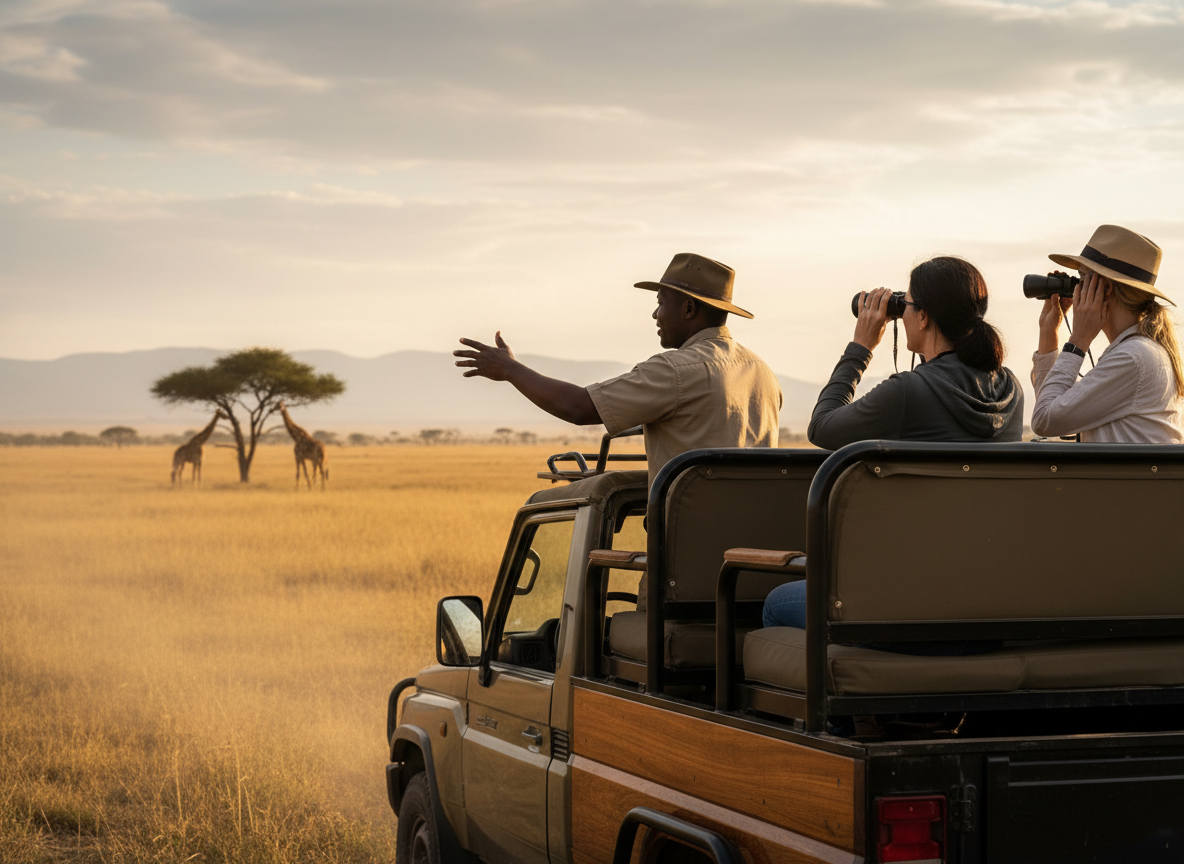
A professional Kenya safari guide with 10 to 15 years of field experience brings a depth of knowledge that no app or book can replicate:
- Individual animal identification: The guide knows specific lions, cheetahs, and leopards by facial markings, ear notches, and territorial location: and can tell you their personal histories
- Behavioral prediction: Postural and contextual cues tell the guide what an animal is about to do: movement direction, threat response, pre-hunt behavior
- Ecological system: The guide understands the Mara ecosystem as a single interconnected system: how rainfall patterns affect wildebeest movement, how wildebeest presence affects lion territory, how lion territory affects hyena distribution
- Real-time network: Your guide is in constant communication with other guides by radio and phone: providing live intelligence about sightings across the conservancy
- Cultural context: The guide connects the ecosystem to human history, Maasai land tenure, and the conservation story
When Guides Appreciate Your Reference Tools
Most professional guides are genuinely pleased when a guest uses binoculars, asks bird identification questions, or raises something they read in a field guide. The best safari conversations begin with a guest who has done pre-trip reading and is engaging the guide at a substantive level.
What guides appreciate less is being replaced by a Google search mid-sighting. A guest who is looking at a screen when the cheetah launches its sprint has made a clear choice about what they came for.
The Ideal Setup: All Three in Combination
The best Kenya safari reference strategy:
- Before the trip: Read field guides and browse safari app resources to build a species framework
- On the drive: Use Merlin for bird identification; defer to the guide for everything mammal and behavioral
- In the evenings: Write notes, look up species in field guides, and plan questions for the next morning’s drive
- App discipline on the vehicle: Phone down during active sightings; technology is support, not primary experience
Which Should You Choose?
Prioritize Safari Apps If You:
- Are a dedicated birder who wants precise species identification in the field
- Want offline species resources downloaded before entering remote areas
- Are comfortable using digital tools as reference alongside guide interpretation
Prioritize Field Guides If You:
- Prefer printed reference for evening reading and species deepening
- Are a naturalist who wants comprehensive species-level information
- Want reference materials that work without battery, signal, or screen
Rely on Guide Knowledge For:
- All primary wildlife interpretation on the vehicle
- Behavioral prediction and real-time ecological explanation
- Individual animal recognition and territorial history
- The human story of the landscape and conservation
The guide is not a reference tool: they are the primary interpreter of the experience. Apps and books support this interpretation. They do not replace it.
Plan Your Kenya Safari with Trunktrails Safaris
Trunktrails Safaris provides pre-departure information packs that include app recommendations, field guide suggestions, and a Kenya wildlife overview to help you arrive prepared. Our guides are experienced at engaging curious, well-prepared travelers who get more from every drive because they ask better questions.
Tell us your wildlife interests: mammal focus, birding, photography: and we will connect you with the right guide and the right preparation for your Kenya safari.