

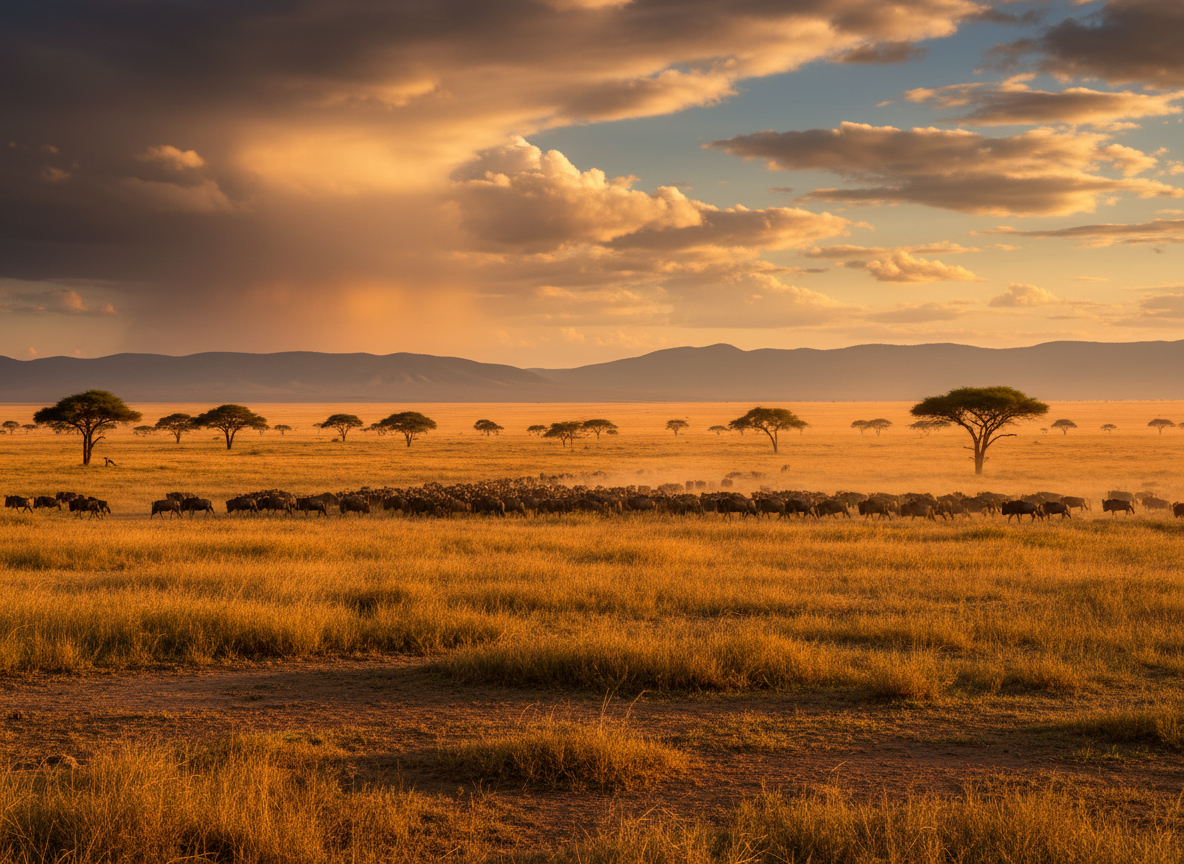
The Masai Mara doesn’t need much introduction. It’s one of those rare places where the reality exceeds the hype—where you can watch a cheetah hunt at sunrise, track a pride of lions through golden grass by midday, and fall asleep to the sound of hyenas calling across the plains.
But beyond the postcard moments, there’s something deeper happening here. The Mara isn’t just a wildlife park. It’s a living ecosystem that pulses with movement, drama, and an intensity you won’t find in many other places on Earth.
Wildlife density that changes the game
The Masai Mara is home to one of the highest concentrations of large predators in Africa. Lions, leopards, cheetahs—they’re not just present, they’re visible. You’re not spending days hoping for a sighting. You’re watching behavior unfold in real time.
The open savanna makes it easier to spot wildlife, but it’s the sheer volume that sets the Mara apart. Elephants move through in family groups. Hippos cluster in rivers. Giraffes browse acacia trees in groups of six or more.
The ecosystem is dense, active, and constantly shifting.
The Great Migration: front-row access
Between July and October, the Masai Mara becomes the stage for one of the most dramatic wildlife events on the planet. Over a million wildebeest, zebras, and gazelles cross the Mara River in search of fresh grazing.
The crossings are chaotic, dangerous, and unforgettable.
Crocodiles wait in the water. Predators stalk the herds on the banks. The noise, the dust, the sheer scale—it’s overwhelming in the best possible way.
Even outside migration season, the Mara holds its own. Resident wildlife populations are strong year-round, and the landscape shifts beautifully between wet and dry seasons.
Conservancies: the quieter, better Mara
Most visitors focus on the Masai Mara National Reserve, but the real magic often happens just outside it—in the private conservancies. Places like Mara Naboisho, Olare Motorogi, and Mara North offer lower vehicle density, off-road driving, night drives, and walking safaris.
These conservancies are community-owned, meaning your visit directly supports Maasai landowners. The wildlife moves freely between reserve and conservancy, but the experience feels more intimate, more intentional.
You’re not jostling for position at a sighting. You’re alone with a leopard in a tree, or watching a lion coalition at dusk without another vehicle in sight.
Accessibility without compromise
The Masai Mara is one of the most accessible safari destinations in East Africa. Daily flights connect Nairobi to multiple airstrips across the Mara ecosystem. You can be on a game drive within hours of landing in Kenya.
But accessibility doesn’t mean crowds—if you choose your location carefully. The conservancies, in particular, offer exclusivity without isolation.
You’re still in the heart of the action, just with more space to breathe.
Guides who know the land
The quality of guiding in the Mara is exceptional. Many guides are Maasai, with generations of knowledge passed down through their families. They don’t just find animals—they read the landscape, anticipate movement, and tell stories that add layers of meaning to what you’re seeing.
A good guide transforms a safari from sightseeing into storytelling. In the Mara, you’re likely to find that level of expertise across the board.
When to visit
The Mara works year-round, but timing shapes the experience.
July to October brings migration season. River crossings, predator action, high energy. November to June offers fewer visitors, lush landscapes, excellent predator sightings, and lower rates.
There’s no bad time to visit, but there are different rhythms depending on what you’re after.
Why it should be your next destination
The Masai Mara delivers on every level. It’s visually stunning, ecologically rich, and operationally smooth. Whether it’s your first safari or your tenth, the Mara offers something that feels both timeless and immediate.
If you’re looking for a safari that balances accessibility with authenticity, wildlife density with space to breathe, the Mara is hard to beat. And if you want help navigating the conservancies and finding the quieter corners, Trunktrails Safaris specializes in exactly that—curated experiences that go deeper than the standard circuit.
The Mara isn’t just a destination. It’s a reminder of what wild places can still be.
[…] Masai Mara (July–October): […]
[…] does not serve the small safari airstrips at Masai Mara, Amboseli, or Samburu. Kenya Airways does operate some domestic routes from JKIA to Mombasa, […]