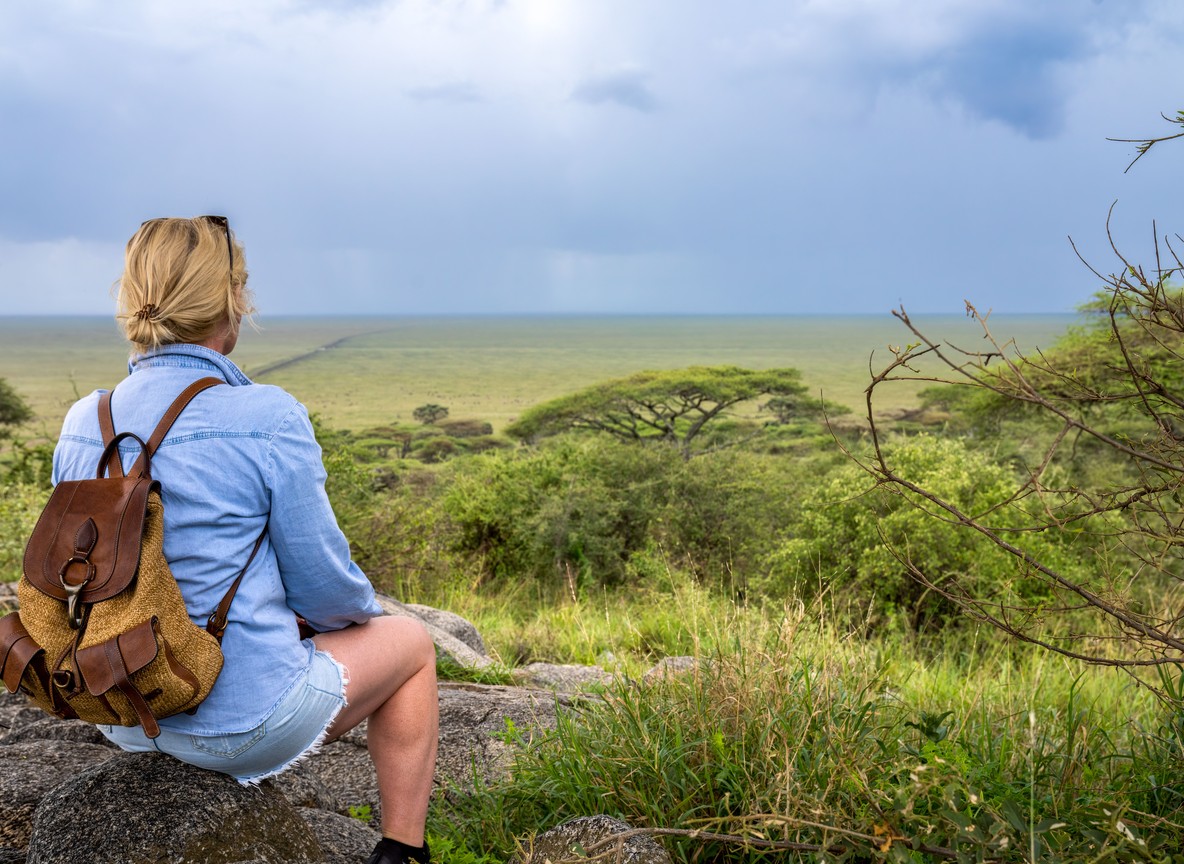
Safety questions for a solo female safari rarely come up during the game drive. They come up in the gaps: the airport transfer, the walk from your tent to the mess tent at night, the ride between a Nairobi hotel and your flight the next morning. Touring Insights put together a practical rundown of the apps, ride-hailing choices, and camp habits that actually reduce risk on a Kenya safari, with real numbers instead of vague reassurance.
Why Solo Female Safety Looks Different on Safari Than in a City
City safety advice focuses on streets, strangers, and transport. Safari safety adds wildlife, remote radio-only locations, and long stretches with no phone signal. A conservancy camp in the Mara Triangle or Naboisho might sit 40 minutes by dirt road from the nearest reserve gate, with no cell tower for kilometers. That changes what “safety app” even means. A GPS check-in app is only useful if you set it up before you lose signal, not after.
The good news is that camps that host solo travelers regularly have built precautions into daily routine for decades. The apps and ride-hailing choices matter most in the connective tissue around the safari itself, airport to hotel, hotel to airstrip, and the Nairobi nights before or after.
SOS and Safety Apps Worth Setting Up Before You Fly
Set these up on home wifi before departure, since app stores and account verification can be slow on Kenyan mobile data.
| Tool | What It Does | Works Offline? | Indicative Cost |
|---|---|---|---|
| TripWhistle Global SOS | Auto-detects your country and dials the correct local emergency number (999 or 112 in Kenya) | Needs a signal to call, works without data | Free |
| bSafe | Live GPS location sharing with chosen contacts, timed check-ins, loud SOS alarm | Needs data or SMS fallback | Free tier; paid tier indicative USD 5-10/month |
| Sitata | Travel safety alerts plus one-tap medical or security assistance line | Needs data for alerts, phone line for assistance | Indicative USD 5-15/month, some travel insurers include it |
| WhatsApp location share | Live location pin sent to a family contact or your camp manager | Needs data | Free |
| Kenya Red Cross emergency line | Toll-free national emergency and ambulance dispatch | Works on any Kenyan SIM, no data needed | Free, dial 1199 |
Save the Kenya Red Cross number (1199) and the national police line (999 or 112) as phone contacts, not just notes in an app, so they work even if your phone is locked or an app has crashed. Confirm your camp’s own emergency and medevac contact at check-in since it varies by property and changes faster than any app database.
Ride-Hailing in Kenya: Which App and When
Ride-hailing is reliable in Nairobi and other larger towns but drops off outside them, so know the handoff points.
| App | Best For | Safety Features | Indicative Fare, JKIA to Karen (approx. 20 km) |
|---|---|---|---|
| Uber | Nairobi, Mombasa, Kisumu | In-app trip sharing, driver rating, cashless payment | USD 12-18 |
| Bolt | Nairobi, wider driver pool, often cheaper | In-app trip sharing, driver rating, cashless payment | USD 10-15 |
| Little Cab | Nairobi, Kenyan-owned platform | In-app trip sharing, driver rating | USD 10-16 |
| Camp or hotel-arranged transfer | Airport to safari lodge, rural roads | Vetted driver, camp knows your ETA | Indicative USD 40-80 for a private JKIA transfer |
Outside Nairobi, Mombasa, and a handful of larger towns, ride-hailing apps have little or no coverage. On safari, your transport is the camp vehicle or a pre-arranged airstrip transfer, not an app. For the Nairobi-to-Maasai Mara leg specifically, a scheduled flight from Wilson Airport to an airstrip like Keekorok, Ol Kiombo, or Musiara takes about 45 minutes to an hour, against 5 to 6 hours by road covering roughly 270 km. Most solo travelers on a tighter timeline fly; it also removes several hours of unmonitored road transit.
When you do use a ride-hailing app in Nairobi, always share your trip through the app’s live-tracking feature and text the license plate to your camp contact or a friend before you get in. Sit in the back seat, and if the driver’s photo or plate does not match the app, cancel and rebook.
Camp Precautions: What Good Properties Already Do
Reputable Kenya safari camps have solo female protocols even when they do not advertise them.
- Askari escort after dark. Camps such as Angama Mara, Governors’ Camp, and Kicheche Mara Camp assign an armed or trained askari to walk you between your tent and the mess tent once the sun sets, since wildlife moves through unfenced camps at night. Ask for this on arrival if it is not offered automatically.
- Radio or bell call system. Many tented camps give each tent a horn, whistle, or radio to call for an escort rather than walking alone, even for a short distance.
- Tent placement. Solo travelers can usually request a tent closer to the mess tent or camp office rather than the row’s far end. It costs nothing to ask at booking.
- Daily check-in rhythm. Guides and camp managers track which guests are out on drives and when they are due back, so a missed return time gets noticed quickly, unlike a city hotel.
- Gate and permit paperwork. Camps inside the Masai Mara National Reserve register guest movements through gates like Sekenani, Talek, and Oloolaimutia, so your presence in the reserve is logged, not informal.
What to Ask a Camp Before You Book
A short pre-booking email answers most safety questions before you commit. Ask whether solo female guests are common at the property, whether an askari escort is standard or on request, and what the tent-to-mess-tent distance is at night. Find out how the camp handles a medical situation, including which evacuation service they use and how far the nearest airstrip is. A camp that answers specifically, with names and distances, is usually the camp that has thought this through already.
A Pre-Departure Safety Checklist
Before you fly, confirm travel insurance includes medical evacuation coverage for remote areas, since standard travel insurance often excludes bush airstrip evacuation. Register with your embassy’s traveler program if one exists for Kenya. Screenshot your camp’s address, phone number, and the Kenya Red Cross number, since screenshots work without signal. Share your full itinerary, including camp names and expected dates, with one contact at home. Load an offline map of Nairobi and your safari region onto your phone before departure, since data coverage in conservancies is patchy at best.
Explorer Notes
A few field-level habits from repeat solo travelers. Ask your guide at the start of the first game drive how the vehicle’s radio check-in works, since knowing the schedule yourself is more reassuring than assuming someone else is tracking it. Pack a small physical whistle as a backup to any app, since it needs no battery and no signal. If a camp puts you in a tent at the end of a row, it is fine to ask to move closer to the mess tent, most managers accommodate this without hesitation. Finally, keep a paper copy of key numbers, camp contact, Kenya Red Cross 1199, and your embassy, tucked in a daypack pocket. Phones die at the worst moments, usually right when you need them.
What to Read Next
- Planning the Nairobi stopover before or after your safari? Read our Nairobi safety for solo female travelers guide.
- Weighing the cost of traveling alone? See our single supplement solo safari pricing guide.
- Curious whether an all-women group tour suits you better? Check our women-only group safaris in Kenya guide.
FAQ
What is the best SOS app for a solo female safari in Kenya? TripWhistle Global SOS is a solid free baseline since it dials Kenya’s correct emergency number automatically. Pair it with a GPS-sharing app like bSafe for live location tracking with a trusted contact.
Is Uber or Bolt safe for a solo woman in Nairobi? Both are generally reliable in Nairobi when you use in-app trip sharing, verify the driver and plate before entering, and sit in the back seat. Coverage drops sharply outside major towns, so budget for a camp-arranged transfer once you leave the city.
Do safari camps provide security for solo female guests at night? Most reputable camps offer an askari escort after dark, either automatically or on request. Ask specifically at booking and again at check-in, since policies vary by property.
Do I need medical evacuation coverage for a Kenya safari? Yes. Standard travel insurance often excludes evacuation from remote bush airstrips. Confirm your policy covers medevac from conservancy or reserve locations before you travel.
Does my phone work at safari camps in the Maasai Mara? Coverage is inconsistent. Many camps have wifi at the main lodge but weak or no signal at individual tents, which is why offline maps and physical backups like a whistle or printed contact list matter.
Solo does not have to mean unprepared. Visit our Tour Packages page to compare camps with strong solo-traveler track records, or ask a partner operator directly about their askari and evacuation protocols before you book.
Further reading
- Magical Kenya (Kenya Tourism Board)
- Kenya Wildlife Service
- Maasai Mara Wildlife Conservancies Association