Why Does Kenya Safari Planning for Afrikaans Speakers Make Sense?
This guide covers Kenya safari planning for Afrikaans speakers. It walks through flights from Johannesburg and Cape Town, visa and eTA rules, costs in Rand, malaria precautions, and how a Kenya trip compares with Kruger.
You know the Lowveld at dawn, the H4-1 with the windows down, lions calling across the Sabie River. Kenya feels different, but it should not scare you. It rewards people who already read animal behaviour well, and it is not as far as you think, shorter to fly to than London. You trade the long drive to the Kruger gate for a direct flight and a short hop in a small plane.
Kenya also offers something Kruger mostly cannot: the Great Migration in the Masai Mara. Between July and October, you can watch wildebeest cross the Mara River, a spectacle you will not see in any South African reserve. Our Masai Mara guide covers migration timing and camp choices in more detail.
Afrikaans will not help you here, but it will not hurt you either. English is the working language of Kenya’s tourism industry, and guides, drivers, camp managers, and booking staff all speak it well.
What Are the Visa and Entry Requirements for South African Passport Holders?
South African and Namibian passport holders need an electronic travel authorisation, or eTA, to enter Kenya. Kenya moved to this system in 2024, so you apply online before you travel and do not visit an embassy.
The eTA carries an application fee, small compared with the rest of your trip budget. Check the official Kenyan eTA portal for the current amount, and avoid third-party agents that charge a markup. Transit passengers need one too, so apply even if you only change planes in Nairobi. Processing usually takes a few days, but apply at least two weeks before departure.
Your passport must be valid for at least six months from your arrival date, with at least two blank pages for stamps.
How Long Is the Flight from Johannesburg or Cape Town to Nairobi?
The non-stop flight from Johannesburg to Nairobi takes about four and a half hours, on Kenya Airways or South African Airways. From Cape Town, the flight takes roughly five and a half hours, though some routes connect through Johannesburg.
You land at Jomo Kenyatta International Airport in Nairobi, then continue with a domestic flight to a small airstrip near the camp. That hop takes about 45 minutes to the Masai Mara, or about 50 minutes to Amboseli. Driving to the Mara takes five to six hours on a good day, with a rough, unpaved final stretch, so most first-time visitors fly instead.
Is Kenya or Kruger Better for a First Safari?
The honest answer is that it depends on what you want. Kruger is cheaper and easier. You drive yourself, stay in rest camps or private lodges, and pay in Rand, and if your budget is tight, Kruger wins.
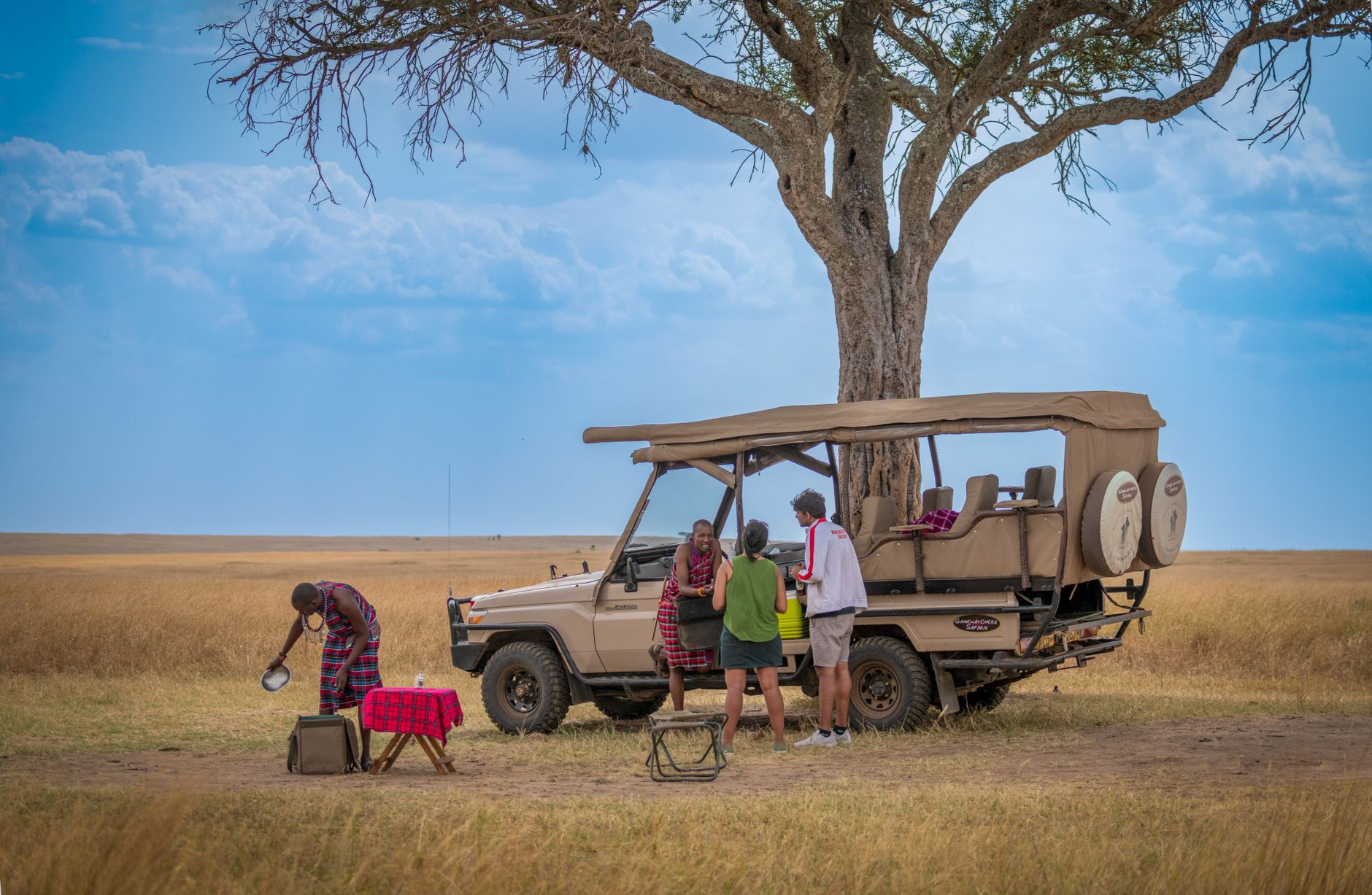
Kenya gives you a different experience. You fly into the bush, stay in a tented camp with canvas walls, and go out with a professional guide twice a day. Wildlife density in the Mara and Amboseli is extremely high, and you will likely see more cats in a week than in a month at Kruger.
Here is a quick comparison:
| Factor | Kruger National Park | Kenya (Masai Mara or Amboseli) |
|---|---|---|
| Driving style | Self-drive on tar and gravel | Fly-in, guided game drives |
| Entry fee guideline | Daily conservation fee for SA residents, check SANParks for the current rate | Masai Mara: USD 100/day (Jan to Jun), USD 200/day (Jul to Dec). Amboseli: USD 90/day. Non-resident rates |
| Wildlife highlights | Elephant, rhino, lion, leopard, buffalo | Same, plus the Great Migration (Mara) and big elephant herds (Amboseli) |
| Best time | Year-round, dry winter months (May to September) | Dry season (June to October), migration July to October |
| Guide | Optional, self-drive allowed | Mandatory, included in most packages |
| Language | Afrikaans widely spoken | English only, but guides are excellent |
If you want a safari that feels safe and familiar, and you are happy to drive yourself, stay in Kruger. If you want a more immersive, guided experience with a chance to see the migration, go to Kenya.
How Much Does a Kenya Safari Cost in Rand?
Kenya safaris are priced in US dollars. South Africans feel the exchange rate, but the value is still there. Our Kenya safari cost breakdown walks through the full budget picture.
A mid-range safari with tented camps, meals, game drives, and park fees runs from about USD 250 to USD 400 per person per day. That is roughly R4,500 to R7,200 at current exchange rates. A budget safari in basic camps can go as low as USD 150 per person per day. A luxury conservancy camp runs from USD 700 to over USD 1,500 per person per day.
The biggest line items are accommodation, park fees, flights, and the safari vehicle. Domestic flights add roughly USD 250 to USD 400 per person per itinerary, and park fees alone can total USD 200 to USD 300 per person for a week. Avoid a safari priced far below these ranges, since it usually means long transfers and camps outside the park.
Can I Pay in Rand or US Dollars in Kenya?
You cannot pay in Rand. The local currency is the Kenyan shilling, but most safari operators quote in US dollars, and many camps accept dollars in cash or by card.
Carry a mix of US dollars in small notes and a Visa or Mastercard. ATMs are common in Nairobi and larger towns, but not in the bush, and lodge card machines can fail in remote areas, so cash is the safest backup. Skip the airport currency counters and use a bank or a proper forex bureau in Nairobi instead, where the rates are better.
What Wildlife Will I See and When Is the Best Time to Visit?
Kenya’s parks deliver the classic safari animals: lion, leopard, cheetah, elephant, and buffalo in the Masai Mara, plus large elephant herds against the backdrop of Mount Kilimanjaro at Amboseli. Our Amboseli safari guide covers the herds and the best photography spots. Ol Pejeta Conservancy is one of the few places in Kenya to see both black and white rhino.
The best time to visit depends on what you want.
| Wildlife Goal | Best Months |
|---|---|
| Great Migration river crossings (Mara) | July to October |
| Big cats general viewing | June to October, dry season |
| Elephant herds at Amboseli | June to October, animals gather at water sources |
| Birdwatching | November to April, migratory birds present |
| Green landscapes, fewer crowds | January to March |
The dry season from June to October is the most reliable window, since wildlife concentrates around water. The long rains hit in April and May, and many camps close, while the short rains in November are light and bring fresh grass. If your main goal is the Great Migration, book for August or September, the peak months, though crossings are never guaranteed.
Do I Need Malaria Tablets for a Kenya Safari?
Yes. Most of Kenya’s safari circuit sits in malaria risk zones, including the Masai Mara, Amboseli, and Samburu. If you are used to malaria-free areas like the Cape, this is a real adjustment. Options include atovaquone-proguanil (Malarone), doxycycline, or mefloquine. Speak to your doctor or travel clinic at least four to six weeks before you travel.
Combine tablets with practical steps. Use a DEET-based insect repellent on exposed skin, following the strength guidance on the product label, and wear long trousers and long sleeves from dusk to dawn. Sleep under a mosquito net if your camp provides one, and use repellent even if it does not. Yellow fever vaccination is recommended, and you should be up to date on tetanus, hepatitis A, and typhoid.
Is Kenya Safe for South African Tourists?
Kenya is a stable, functioning democracy with a professional, well-regulated tourism industry, and millions of visitors travel there every year without serious incident.
Nairobi has the same urban crime issues as Johannesburg. Do not walk alone at night in the city, use hotel transport, and keep valuables out of sight. In the safari parks, you are with a guide, and camps are secure.
Is English Widely Spoken in Kenya?
Yes. English is an official language in Kenya, alongside Swahili. Every guide, driver, camp staff member, and booking agent you meet in tourism will speak fluent English, so you will not need Afrikaans or any other language. Learning a few Swahili phrases, like “jambo” for hello, still wins goodwill.
What Is the Difference Between a Kenyan Conservancy and a National Park?
This matters for your experience and your budget. A national park is public land, managed by the Kenya Wildlife Service. The Masai Mara is technically a national reserve, run by the Narok County Government rather than KWS, but the crowding problem is similar: vehicles can bunch up around sightings, especially during peak season.
A conservancy is private land, set aside for wildlife and tourism by local communities. Access is restricted to lodge guests, vehicle numbers are capped, and night drives and walking safaris are often possible, which national parks prohibit. Ol Pejeta, Loisaba, and Mara Naboisho are excellent examples of a quieter, more exclusive experience that costs more but is often worth it.
How Many Days Do You Need for a Decent Kenya Safari?
Plan for at least six nights: three in the Masai Mara, two in Amboseli or Samburu, and one in Nairobi on arrival. A shorter trip of five nights works too, with three in the Mara and two in conservancy land, though travel days eat into viewing time.
For a first Kenya safari, limit yourself to two main destinations. The Mara and Amboseli is a classic pairing. Add Samburu only if you have ten nights or more.
What Should I Pack and What Are the Practical Logistics?
Pack for warm days and cool mornings. Game drives start cool, even in summer, then warm up by midday, so layers are essential.
Neutral colours work best. Khaki, olive, and brown blend in, while bright colours and dark blue attract tsetse flies. Bring long trousers, a light jacket for the vehicle ride, and sturdy walking shoes.
The essentials list is short:
- Passport, valid six months, plus Kenyan eTA printed out
- Yellow fever certificate
- Malaria tablets and insect repellent
- Sunscreen, a wide-brimmed hat, and binoculars
- Camera with extra batteries and memory cards
- Power adaptor, since Kenya uses the three-pin type G socket
- A headlamp for camp nights
Small planes limit baggage to a soft duffel bag well under standard airline weight limits, since hard suitcases do not fit in bush planes. Most operators provide duffels, or you can buy one in Nairobi.
Should I Book with a Local Kenyan Operator or a South African Travel Agent?
A South African agent understands your time zone, language, and currency, and can bundle flights and add-ons, but their Kenya knowledge may be thinner and they often mark up the price. A Kenyan ground operator knows the parks, camps, and seasonal conditions, and can negotiate better rates, without any language barrier.
For a first trip, a Kenyan operator with strong independent reviews is a safer bet. Ask for references and confirm that your quote includes park fees, meals, and transfers.
Where Can You Compare Kenya Safari Operators?
TouringInsights is an editorial guide, not a safari operator, so we do not sell trips or take bookings. What we can do is point you toward places to compare safari operators and browse packages.
Browse packages on FindMySafari, Valley Safaris, or Trunktrails Safaris. Each lists multiple operators, so you can compare pricing, camps, and itineraries before deciding who to book with.